Banafsheh Payam, Mehdi Soltani, Mehdi Shamsaie Mehrgan, Houman Rajabi Islami, Melika Nazemi
{"title":"Saponins from sea cucumber disrupt Aeromonas hydrophila quorum sensing to mitigate pathogenicity.","authors":"Banafsheh Payam, Mehdi Soltani, Mehdi Shamsaie Mehrgan, Houman Rajabi Islami, Melika Nazemi","doi":"10.1186/s13568-025-01831-7","DOIUrl":null,"url":null,"abstract":"<p><p>Aeromonas hydrophila, a Gram-negative bacterium, poses significant threats to aquaculture, leading to substantial economic losses. Its pathogenicity is primarily driven by a sophisticated quorum sensing (QS) system that regulates virulence factors. This study investigates saponins extracted from the sea cucumber Holothuria leucospilota as potential natural inhibitors of QS in A. hydrophila, offering a novel disease management strategy for aquaculture. Specimens of H. leucospilota were collected, and saponins were extracted from their Cuvierian tubules through a process of homogenization, solvent extraction, and purification. The saponin extract's minimum bactericidal concentration (MBC) and minimum inhibitory concentration (MIC) against A. hydrophila were found to be 80 μg/mL and 30 μg/mL, respectively. Hemolysin, lipase, and protease are examples of QS-regulated virulence factors whose activities were found to be significantly reduced by sub-MIC levels of saponins. Additionally, swarming motility and biofilm formation were notably inhibited. A significant downregulation of the QS genes ahyI and ahyR was observed, indicating an effective disruption of the QS system.These findings suggest that saponins from H. leucospilota can inhibit the QS system in A. hydrophila, thereby reducing its pathogenicity. This disruption offers a promising method for controlling bacterial infections without directly killing the bacteria, potentially mitigating antibiotic resistance. The study highlights the potential of marine-derived compounds as natural QS inhibitors, contributing to environmentally friendly aquaculture practices. Overall, it provides evidence that sea cucumber saponins could serve as a novel class of anti-QS agents, presenting a new perspective on disease management in aquaculture and other bacterial infection contexts.</p>","PeriodicalId":7537,"journal":{"name":"AMB Express","volume":"15 1","pages":"43"},"PeriodicalIF":3.7000,"publicationDate":"2025-03-10","publicationTypes":"Journal Article","fieldsOfStudy":null,"isOpenAccess":false,"openAccessPdf":"https://www.ncbi.nlm.nih.gov/pmc/articles/PMC11893960/pdf/","citationCount":"0","resultStr":null,"platform":"Semanticscholar","paperid":null,"PeriodicalName":"AMB Express","FirstCategoryId":"5","ListUrlMain":"https://doi.org/10.1186/s13568-025-01831-7","RegionNum":3,"RegionCategory":"生物学","ArticlePicture":[],"TitleCN":null,"AbstractTextCN":null,"PMCID":null,"EPubDate":"","PubModel":"","JCR":"Q2","JCRName":"BIOTECHNOLOGY & APPLIED MICROBIOLOGY","Score":null,"Total":0}
引用次数: 0
Abstract
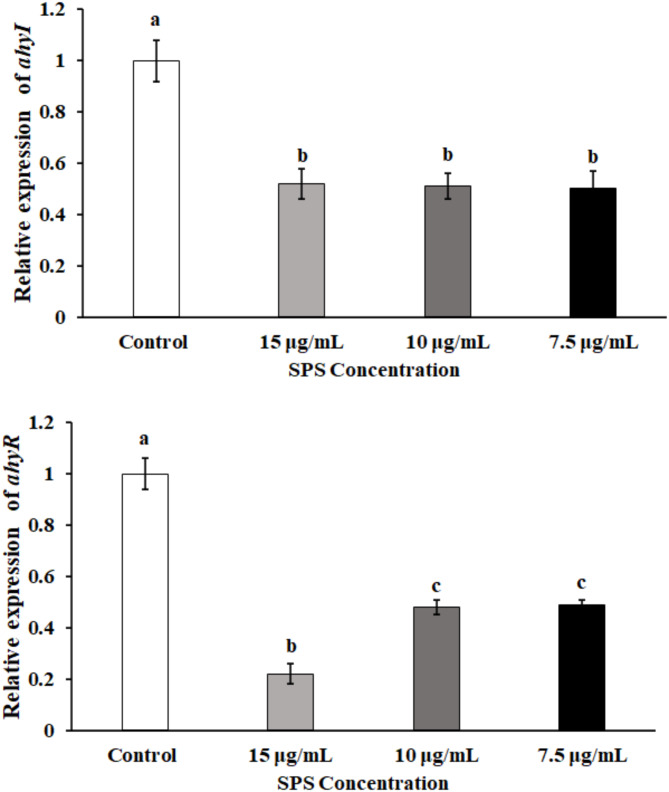
Aeromonas hydrophila, a Gram-negative bacterium, poses significant threats to aquaculture, leading to substantial economic losses. Its pathogenicity is primarily driven by a sophisticated quorum sensing (QS) system that regulates virulence factors. This study investigates saponins extracted from the sea cucumber Holothuria leucospilota as potential natural inhibitors of QS in A. hydrophila, offering a novel disease management strategy for aquaculture. Specimens of H. leucospilota were collected, and saponins were extracted from their Cuvierian tubules through a process of homogenization, solvent extraction, and purification. The saponin extract's minimum bactericidal concentration (MBC) and minimum inhibitory concentration (MIC) against A. hydrophila were found to be 80 μg/mL and 30 μg/mL, respectively. Hemolysin, lipase, and protease are examples of QS-regulated virulence factors whose activities were found to be significantly reduced by sub-MIC levels of saponins. Additionally, swarming motility and biofilm formation were notably inhibited. A significant downregulation of the QS genes ahyI and ahyR was observed, indicating an effective disruption of the QS system.These findings suggest that saponins from H. leucospilota can inhibit the QS system in A. hydrophila, thereby reducing its pathogenicity. This disruption offers a promising method for controlling bacterial infections without directly killing the bacteria, potentially mitigating antibiotic resistance. The study highlights the potential of marine-derived compounds as natural QS inhibitors, contributing to environmentally friendly aquaculture practices. Overall, it provides evidence that sea cucumber saponins could serve as a novel class of anti-QS agents, presenting a new perspective on disease management in aquaculture and other bacterial infection contexts.
期刊介绍:
AMB Express is a high quality journal that brings together research in the area of Applied and Industrial Microbiology with a particular interest in ''White Biotechnology'' and ''Red Biotechnology''. The emphasis is on processes employing microorganisms, eukaryotic cell cultures or enzymes for the biosynthesis, transformation and degradation of compounds. This includes fine and bulk chemicals, polymeric compounds and enzymes or other proteins. Downstream processes are also considered. Integrated processes combining biochemical and chemical processes are also published.







 京公网安备 11010802042870号
京ICP备2023020795号-1
京公网安备 11010802042870号
京ICP备2023020795号-1

 分享
分享
 求助内容:
求助内容: 应助结果提醒方式:
 扫码关注我们
