Seokjun Kim, Hyesu Jo, Yejun Son, Min Kyung Shin, Kyeongmin Lee, Jaeyu Park, Hayeon Lee, Lee Smith, Elena Dragioti, Guillaume Fond, Laurent Boyer, Guillermo F López Sánchez, Mark A Tully, Masoud Rahmati, Damiano Pizzol, Selin Woo, Dong Keon Yon
{"title":"Nationwide Trends in Screen Time and Associated Risk Factors by Family Structures Among Adolescents, 2008-2022: Nationwide Cross-Sectional Study.","authors":"Seokjun Kim, Hyesu Jo, Yejun Son, Min Kyung Shin, Kyeongmin Lee, Jaeyu Park, Hayeon Lee, Lee Smith, Elena Dragioti, Guillaume Fond, Laurent Boyer, Guillermo F López Sánchez, Mark A Tully, Masoud Rahmati, Damiano Pizzol, Selin Woo, Dong Keon Yon","doi":"10.2196/57962","DOIUrl":null,"url":null,"abstract":"<p><strong>Background: </strong>Although understanding long-term trends in adolescent screen time and the influence of family structure is essential, there is a lack of research addressing these issues comprehensively.</p><p><strong>Objective: </strong>This study aimed to conduct comprehensive investigations into adolescent screen time before and during the COVID-19 pandemic, with a particular focus on family structures.</p><p><strong>Methods: </strong>This study used nationwide, large-scale data from the Korea Youth Risk Behavior Web-Based Survey from South Korea. We aimed to indicate the changes in adolescent screen time over 15 years from 2008 to 2022. Weighted linear regression was used to analyze annual trends in screen time before and during the pandemic, and stratified analyses were conducted to examine associated risk factors across different family structures.</p><p><strong>Results: </strong>This study used data from a total of 836,972 individuals (n=403,456, 48.2% women), with an age range of 12-18 years. The analysis revealed an overall increase in screen time prepandemic (β=8.06, 95% CI 7.74-8.39), with a notable increase observed at the onset of the pandemic (β=162.06, 95% CI 159.49-164.64). Among diverse family structures, the orphanage group showed the most substantial increase in screen time during the pandemic (β<sub>diff</sub>=221.90, 95% CI 159.62-284.17). Risk factors associated with screen time during the pandemic varied by family structure. Notably, the nuclear family group presented distinct screen time-related risk factors, including grade, region of residence, physical activity frequency, sadness and despair, and the highest education level of parents.</p><p><strong>Conclusions: </strong>There has been a notable increase in average screen time among adolescents since the onset of the pandemic, with the orphanage group exhibiting a pronounced trend. The risk factors associated with screen time during the pandemic varied for each family structure. Findings from this study suggest that the implementation of individualized measures tailored to each family structure should be adopted to effectively address the increased issue of adolescent screen time since the pandemic.</p>","PeriodicalId":14765,"journal":{"name":"JMIR Public Health and Surveillance","volume":"11 ","pages":"e57962"},"PeriodicalIF":3.9000,"publicationDate":"2025-03-10","publicationTypes":"Journal Article","fieldsOfStudy":null,"isOpenAccess":false,"openAccessPdf":"https://www.ncbi.nlm.nih.gov/pmc/articles/PMC11933748/pdf/","citationCount":"0","resultStr":null,"platform":"Semanticscholar","paperid":null,"PeriodicalName":"JMIR Public Health and Surveillance","FirstCategoryId":"3","ListUrlMain":"https://doi.org/10.2196/57962","RegionNum":2,"RegionCategory":"医学","ArticlePicture":[],"TitleCN":null,"AbstractTextCN":null,"PMCID":null,"EPubDate":"","PubModel":"","JCR":"Q1","JCRName":"PUBLIC, ENVIRONMENTAL & OCCUPATIONAL HEALTH","Score":null,"Total":0}
引用次数: 0
Abstract
Background: Although understanding long-term trends in adolescent screen time and the influence of family structure is essential, there is a lack of research addressing these issues comprehensively.
Objective: This study aimed to conduct comprehensive investigations into adolescent screen time before and during the COVID-19 pandemic, with a particular focus on family structures.
Methods: This study used nationwide, large-scale data from the Korea Youth Risk Behavior Web-Based Survey from South Korea. We aimed to indicate the changes in adolescent screen time over 15 years from 2008 to 2022. Weighted linear regression was used to analyze annual trends in screen time before and during the pandemic, and stratified analyses were conducted to examine associated risk factors across different family structures.
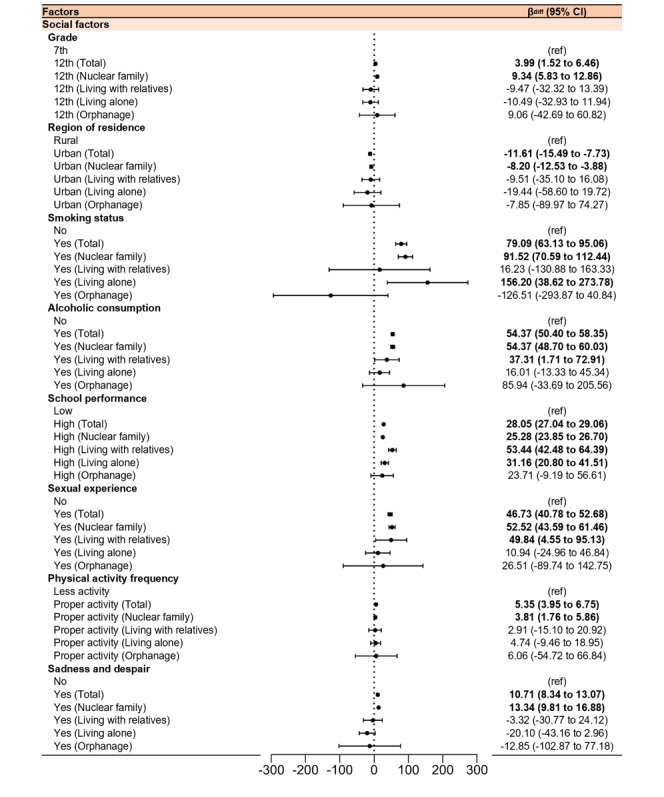
Results: This study used data from a total of 836,972 individuals (n=403,456, 48.2% women), with an age range of 12-18 years. The analysis revealed an overall increase in screen time prepandemic (β=8.06, 95% CI 7.74-8.39), with a notable increase observed at the onset of the pandemic (β=162.06, 95% CI 159.49-164.64). Among diverse family structures, the orphanage group showed the most substantial increase in screen time during the pandemic (βdiff=221.90, 95% CI 159.62-284.17). Risk factors associated with screen time during the pandemic varied by family structure. Notably, the nuclear family group presented distinct screen time-related risk factors, including grade, region of residence, physical activity frequency, sadness and despair, and the highest education level of parents.
Conclusions: There has been a notable increase in average screen time among adolescents since the onset of the pandemic, with the orphanage group exhibiting a pronounced trend. The risk factors associated with screen time during the pandemic varied for each family structure. Findings from this study suggest that the implementation of individualized measures tailored to each family structure should be adopted to effectively address the increased issue of adolescent screen time since the pandemic.
背景:虽然了解青少年屏幕时间的长期趋势和家庭结构的影响是必不可少的,但缺乏全面解决这些问题的研究。目的:本研究旨在对COVID-19大流行之前和期间的青少年屏幕时间进行全面调查,特别关注家庭结构。方法:本研究使用了来自韩国青少年风险行为网络调查的全国性大规模数据。我们的目标是指出从2008年到2022年15年间青少年屏幕时间的变化。加权线性回归用于分析大流行之前和期间屏幕时间的年度趋势,并进行分层分析以检查不同家庭结构中的相关风险因素。结果:本研究使用了来自836,972人的数据(n=403,456, 48.2%为女性),年龄范围为12-18岁。分析显示,大流行前筛查时间总体增加(β=8.06, 95% CI 7.74-8.39),在大流行开始时观察到筛查时间显著增加(β=162.06, 95% CI 159.49-164.64)。在不同的家庭结构中,孤儿院组在大流行期间屏幕时间增加最多(βdiff=221.90, 95% CI 159.62-284.17)。大流行期间与屏幕时间相关的风险因素因家庭结构而异。值得注意的是,核心家庭组呈现出明显的屏幕时间相关风险因素,包括年级、居住地区、体育活动频率、悲伤和绝望以及父母的最高教育水平。结论:自大流行病爆发以来,青少年的平均屏幕时间显著增加,孤儿院群体表现出明显的趋势。大流行期间与屏幕时间相关的风险因素因家庭结构而异。这项研究的结果表明,应采取针对每个家庭结构的个性化措施,以有效解决大流行以来青少年屏幕时间增加的问题。
期刊介绍:
JMIR Public Health & Surveillance (JPHS) is a renowned scholarly journal indexed on PubMed. It follows a rigorous peer-review process and covers a wide range of disciplines. The journal distinguishes itself by its unique focus on the intersection of technology and innovation in the field of public health. JPHS delves into diverse topics such as public health informatics, surveillance systems, rapid reports, participatory epidemiology, infodemiology, infoveillance, digital disease detection, digital epidemiology, electronic public health interventions, mass media and social media campaigns, health communication, and emerging population health analysis systems and tools.





 京公网安备 11010802042870号
京ICP备2023020795号-1
京公网安备 11010802042870号
京ICP备2023020795号-1

 分享
分享
 求助内容:
求助内容: 应助结果提醒方式:
 扫码关注我们
