Íñigo M Pérez Castillo, Josep M Argilés, Ricardo Rueda, María Ramírez, José M López Pedrosa
{"title":"Skeletal muscle atrophy and dysfunction in obesity and type-2 diabetes mellitus: Myocellular mechanisms involved.","authors":"Íñigo M Pérez Castillo, Josep M Argilés, Ricardo Rueda, María Ramírez, José M López Pedrosa","doi":"10.1007/s11154-025-09954-9","DOIUrl":null,"url":null,"abstract":"<p><p>Obesity and type-2 diabetes mellitus (T2DM) are interrelated metabolic disorders primarily driven by overnutrition and physical inactivity, which oftentimes entails a transition from obesity to T2DM. Compromised musculoskeletal health consistently emerges as a common hallmark in the progression of these metabolic disorders. Skeletal muscle atrophy and dysfunction can further impair whole-body metabolism and reduce physical exercise capacity, thus instigating a vicious cycle that further deteriorates the underlying conditions. However, the myocellular repercussions of these metabolic disturbances remain to be completely clarified. Insulin signaling not only facilitates skeletal muscle glucose uptake but also plays a central role in skeletal muscle anabolism mainly due to suppression of catabolic pathways and facilitating an anabolic response to nutrient feeding. Chronic overnutrition may trigger different myocellular mechanisms proposed to contribute to insulin resistance and aggravate skeletal muscle atrophy and dysfunction. These mechanisms mainly include the inactivation of insulin signaling components through sustained activation of stress-related pathways, mitochondrial dysfunction, a shift to glycolytic skeletal muscle fibers, and hyperglycemia. In the present review, we aim to delve on these mechanisms, providing an overview of the myocellular processes involved in skeletal muscle atrophy and dysfunction under chronic overnutrition, and their contribution to the progression to T2DM.</p>","PeriodicalId":21106,"journal":{"name":"Reviews in Endocrine & Metabolic Disorders","volume":" ","pages":"815-836"},"PeriodicalIF":8.0000,"publicationDate":"2025-10-01","publicationTypes":"Journal Article","fieldsOfStudy":null,"isOpenAccess":false,"openAccessPdf":"https://www.ncbi.nlm.nih.gov/pmc/articles/PMC12534344/pdf/","citationCount":"0","resultStr":null,"platform":"Semanticscholar","paperid":null,"PeriodicalName":"Reviews in Endocrine & Metabolic Disorders","FirstCategoryId":"3","ListUrlMain":"https://doi.org/10.1007/s11154-025-09954-9","RegionNum":2,"RegionCategory":"医学","ArticlePicture":[],"TitleCN":null,"AbstractTextCN":null,"PMCID":null,"EPubDate":"2025/3/10 0:00:00","PubModel":"Epub","JCR":"Q1","JCRName":"ENDOCRINOLOGY & METABOLISM","Score":null,"Total":0}
引用次数: 0
Abstract
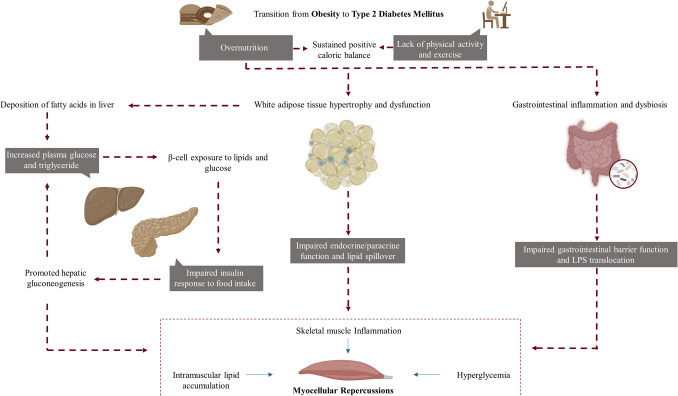
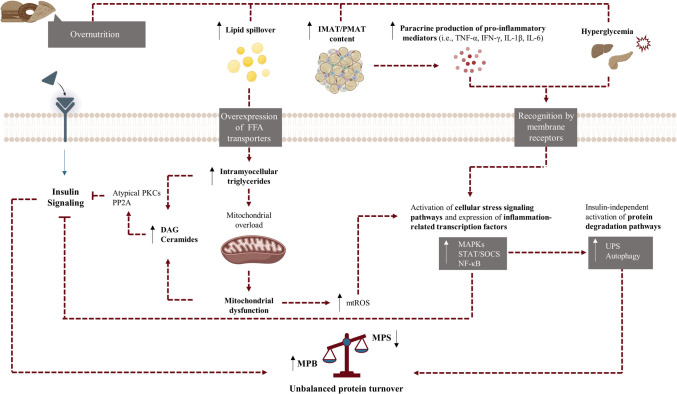
Obesity and type-2 diabetes mellitus (T2DM) are interrelated metabolic disorders primarily driven by overnutrition and physical inactivity, which oftentimes entails a transition from obesity to T2DM. Compromised musculoskeletal health consistently emerges as a common hallmark in the progression of these metabolic disorders. Skeletal muscle atrophy and dysfunction can further impair whole-body metabolism and reduce physical exercise capacity, thus instigating a vicious cycle that further deteriorates the underlying conditions. However, the myocellular repercussions of these metabolic disturbances remain to be completely clarified. Insulin signaling not only facilitates skeletal muscle glucose uptake but also plays a central role in skeletal muscle anabolism mainly due to suppression of catabolic pathways and facilitating an anabolic response to nutrient feeding. Chronic overnutrition may trigger different myocellular mechanisms proposed to contribute to insulin resistance and aggravate skeletal muscle atrophy and dysfunction. These mechanisms mainly include the inactivation of insulin signaling components through sustained activation of stress-related pathways, mitochondrial dysfunction, a shift to glycolytic skeletal muscle fibers, and hyperglycemia. In the present review, we aim to delve on these mechanisms, providing an overview of the myocellular processes involved in skeletal muscle atrophy and dysfunction under chronic overnutrition, and their contribution to the progression to T2DM.
期刊介绍:
Reviews in Endocrine and Metabolic Disorders is an international journal dedicated to the field of endocrinology and metabolism. It aims to provide the latest advancements in this rapidly advancing field to students, clinicians, and researchers. Unlike other journals, each quarterly issue of this review journal focuses on a specific topic and features ten to twelve articles written by world leaders in the field. These articles provide brief overviews of the latest developments, offering insights into both the basic aspects of the disease and its clinical implications. This format allows individuals in all areas of the field, including students, academic clinicians, and practicing clinicians, to understand the disease process and apply their knowledge to their specific areas of interest. The journal also includes selected readings and other essential references to encourage further in-depth exploration of specific topics.




 京公网安备 11010802042870号
京ICP备2023020795号-1
京公网安备 11010802042870号
京ICP备2023020795号-1

 分享
分享
 求助内容:
求助内容: 应助结果提醒方式:
 扫码关注我们
