Alleviating the emotional burden on families during organ donation requests in neurologic patients declared with brain death: the role of timing and circumstances of death.
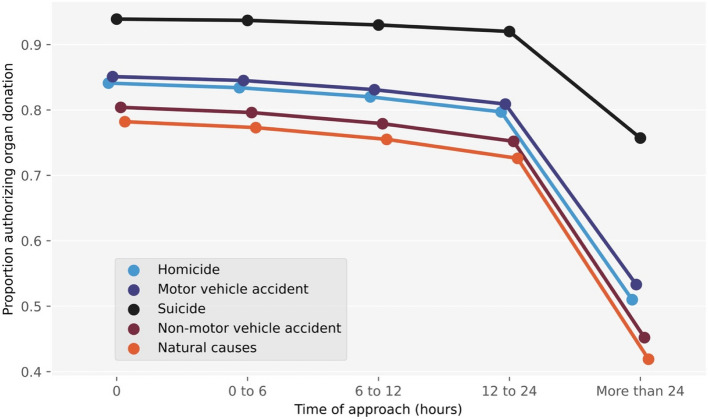
{"title":"Alleviating the emotional burden on families during organ donation requests in neurologic patients declared with brain death: the role of timing and circumstances of death.","authors":"Plamena P Powla, Deekshitha Turaka, Farima Fakhri","doi":"10.1186/s13690-025-01559-7","DOIUrl":null,"url":null,"abstract":"<p><p>Organ donation requests to families often occur during moments of profound grief and create an emotional burden that is compounded by the varying emotional responses to circumstances surrounding death. These responses, in turn, interact with the timing of the request to influence authorization decisions. Understanding the interplay between timing and circumstances of death is crucial for improving authorization rates and addressing the organ donor shortage. The Organ Retrieval and Collection of Health Information for Donation database was used to identify 3,289 potential donors with neurologic mechanisms of brain death. Multivariate logistic regression with interaction between timing and circumstance was used to estimate authorization rates. Results show no significant differences in authorization for requests made within 12 h of death, regardless of circumstance. However, significant differences in authorization were observed between requests made at the time of brain death and those made 12 or more hours later for natural causes, as well as those at 24 or more hours for homicide, motor vehicle accidents, and non-motor vehicle accidents. These findings indicate that the optimal timing for organ donation requests may depend on the emotional intensity of the situation. While quicker requests may be more effective in less emotionally charged cases, extending the time for families to grieve in highly distressing circumstances does not appear to negatively impact authorization rates. Tailoring the timing of donation requests to the circumstances of death, balancing sensitivity with the need for prompt decision-making, could reduce families' emotional burden, ease pressure in decision-making, and help address the shortage of organ donors.</p>","PeriodicalId":48578,"journal":{"name":"Archives of Public Health","volume":"83 1","pages":"66"},"PeriodicalIF":3.2000,"publicationDate":"2025-03-11","publicationTypes":"Journal Article","fieldsOfStudy":null,"isOpenAccess":false,"openAccessPdf":"https://www.ncbi.nlm.nih.gov/pmc/articles/PMC11895220/pdf/","citationCount":"0","resultStr":null,"platform":"Semanticscholar","paperid":null,"PeriodicalName":"Archives of Public Health","FirstCategoryId":"3","ListUrlMain":"https://doi.org/10.1186/s13690-025-01559-7","RegionNum":3,"RegionCategory":"医学","ArticlePicture":[],"TitleCN":null,"AbstractTextCN":null,"PMCID":null,"EPubDate":"","PubModel":"","JCR":"Q2","JCRName":"PUBLIC, ENVIRONMENTAL & OCCUPATIONAL HEALTH","Score":null,"Total":0}
引用次数: 0
Abstract
Organ donation requests to families often occur during moments of profound grief and create an emotional burden that is compounded by the varying emotional responses to circumstances surrounding death. These responses, in turn, interact with the timing of the request to influence authorization decisions. Understanding the interplay between timing and circumstances of death is crucial for improving authorization rates and addressing the organ donor shortage. The Organ Retrieval and Collection of Health Information for Donation database was used to identify 3,289 potential donors with neurologic mechanisms of brain death. Multivariate logistic regression with interaction between timing and circumstance was used to estimate authorization rates. Results show no significant differences in authorization for requests made within 12 h of death, regardless of circumstance. However, significant differences in authorization were observed between requests made at the time of brain death and those made 12 or more hours later for natural causes, as well as those at 24 or more hours for homicide, motor vehicle accidents, and non-motor vehicle accidents. These findings indicate that the optimal timing for organ donation requests may depend on the emotional intensity of the situation. While quicker requests may be more effective in less emotionally charged cases, extending the time for families to grieve in highly distressing circumstances does not appear to negatively impact authorization rates. Tailoring the timing of donation requests to the circumstances of death, balancing sensitivity with the need for prompt decision-making, could reduce families' emotional burden, ease pressure in decision-making, and help address the shortage of organ donors.
期刊介绍:
rchives of Public Health is a broad scope public health journal, dedicated to publishing all sound science in the field of public health. The journal aims to better the understanding of the health of populations. The journal contributes to public health knowledge, enhances the interaction between research, policy and practice and stimulates public health monitoring and indicator development. The journal considers submissions on health outcomes and their determinants, with clear statements about the public health and policy implications. Archives of Public Health welcomes methodological papers (e.g., on study design and bias), papers on health services research, health economics, community interventions, and epidemiological studies dealing with international comparisons, the determinants of inequality in health, and the environmental, behavioural, social, demographic and occupational correlates of health and diseases.





 京公网安备 11010802042870号
京ICP备2023020795号-1
京公网安备 11010802042870号
京ICP备2023020795号-1

 分享
分享
 求助内容:
求助内容: 应助结果提醒方式:
 扫码关注我们
