{"title":"Assessing the application of American Heart Association (AHA) guidelines in the management of heart failure with reduced ejection fraction.","authors":"Sima Sobhani Shahri, Zahra Pirayesh, Azar Zare Noughabi, Marzieh Heshmati, Saeede Khosravi Bizhaem, Shima Jafari, Toba Kazemi","doi":"10.1186/s43044-025-00629-z","DOIUrl":null,"url":null,"abstract":"<p><strong>Background: </strong>Heart failure (HF) is a significant global health issue. Appropriate and timely treatment at target doses significantly reduces mortality and enhances quality of life. However, studies indicate suboptimal pharmacotherapy among patients. This study aims to assess the medical treatment of patients with heart failure and reduced ejection fraction (HFrEF) and their adherence to the American Heart Association (AHA) guidelines. The study was designed as a cross-sectional analysis in the cardiac department of Razi Hospital in Birjand from March 20, 2020, to March 11, 2023, focusing on patients with left ventricular ejection fraction less than or equal to 40%. Data were extracted from patients' medical records. Medications were classified according to the four-pillar therapy recommended by the AHA, including β-blockers, ARNI, ACE inhibitors/ARBs, SGLT2, and MRAs. Patients were grouped based on their treatment regimens. The percentage of achieved target doses for each medication was categorized as follows: 0-25%, 25-50%, 50-99%, and 100%. Statistical analysis was conducted using SPSS version 22.</p><p><strong>Results: </strong>The study included patients with a mean age of 66 ± 13.7 years, of whom 278 (69%) were male. The mean ejection fraction was 26.8 ± 9.6%, and the most prevalent comorbidity was coronary artery disease (CAD) observed in 68.0% of patients. The in-hospital mortality rate was 5%. The results revealed that only 20% were on quadruple therapy, while 10% received none of the recommended medications. The prescription rates for key medications were as follows: β-blockers 76.4%, ACE inhibitors/ARBs 71.6%, MRA 63.3%, SGLT2I 33.5%, and ARNI 0%. Notably, 94.8% of prescribed SGLT2I doses met the target dose, while 84.4% of β-blocker prescriptions and 61.8% of ACEI/ARB prescriptions were below 75% of the target dose.</p><p><strong>Conclusion: </strong>The findings reveal significant gaps in the prescription of essential therapies, including MRAs and ARNIs, which are crucial for managing myocardial dysfunction. Addressing these gaps underscores the necessity for ongoing education and training for healthcare providers in heart failure management.</p>","PeriodicalId":74993,"journal":{"name":"The Egyptian heart journal : (EHJ) : official bulletin of the Egyptian Society of Cardiology","volume":"77 1","pages":"28"},"PeriodicalIF":0.0000,"publicationDate":"2025-03-10","publicationTypes":"Journal Article","fieldsOfStudy":null,"isOpenAccess":false,"openAccessPdf":"https://www.ncbi.nlm.nih.gov/pmc/articles/PMC11893950/pdf/","citationCount":"0","resultStr":null,"platform":"Semanticscholar","paperid":null,"PeriodicalName":"The Egyptian heart journal : (EHJ) : official bulletin of the Egyptian Society of Cardiology","FirstCategoryId":"1085","ListUrlMain":"https://doi.org/10.1186/s43044-025-00629-z","RegionNum":0,"RegionCategory":null,"ArticlePicture":[],"TitleCN":null,"AbstractTextCN":null,"PMCID":null,"EPubDate":"","PubModel":"","JCR":"","JCRName":"","Score":null,"Total":0}
引用次数: 0
Abstract
Background: Heart failure (HF) is a significant global health issue. Appropriate and timely treatment at target doses significantly reduces mortality and enhances quality of life. However, studies indicate suboptimal pharmacotherapy among patients. This study aims to assess the medical treatment of patients with heart failure and reduced ejection fraction (HFrEF) and their adherence to the American Heart Association (AHA) guidelines. The study was designed as a cross-sectional analysis in the cardiac department of Razi Hospital in Birjand from March 20, 2020, to March 11, 2023, focusing on patients with left ventricular ejection fraction less than or equal to 40%. Data were extracted from patients' medical records. Medications were classified according to the four-pillar therapy recommended by the AHA, including β-blockers, ARNI, ACE inhibitors/ARBs, SGLT2, and MRAs. Patients were grouped based on their treatment regimens. The percentage of achieved target doses for each medication was categorized as follows: 0-25%, 25-50%, 50-99%, and 100%. Statistical analysis was conducted using SPSS version 22.
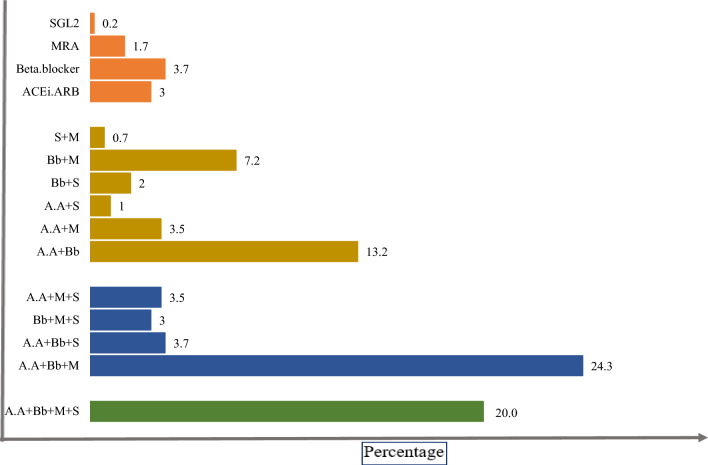
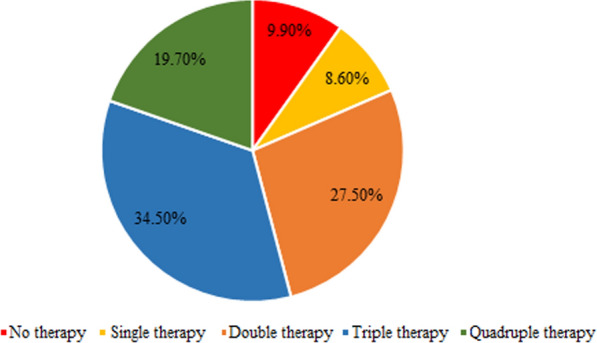
Results: The study included patients with a mean age of 66 ± 13.7 years, of whom 278 (69%) were male. The mean ejection fraction was 26.8 ± 9.6%, and the most prevalent comorbidity was coronary artery disease (CAD) observed in 68.0% of patients. The in-hospital mortality rate was 5%. The results revealed that only 20% were on quadruple therapy, while 10% received none of the recommended medications. The prescription rates for key medications were as follows: β-blockers 76.4%, ACE inhibitors/ARBs 71.6%, MRA 63.3%, SGLT2I 33.5%, and ARNI 0%. Notably, 94.8% of prescribed SGLT2I doses met the target dose, while 84.4% of β-blocker prescriptions and 61.8% of ACEI/ARB prescriptions were below 75% of the target dose.
Conclusion: The findings reveal significant gaps in the prescription of essential therapies, including MRAs and ARNIs, which are crucial for managing myocardial dysfunction. Addressing these gaps underscores the necessity for ongoing education and training for healthcare providers in heart failure management.




 京公网安备 11010802042870号
京ICP备2023020795号-1
京公网安备 11010802042870号
京ICP备2023020795号-1

 分享
分享

 求助内容:
求助内容: 应助结果提醒方式:
 扫码关注我们
