Conor D Hayden, Bruce P Murphy, Deirdre Gilsenan, Bahman Nasseroleslami, Orla Hardiman, Deirdre Murray
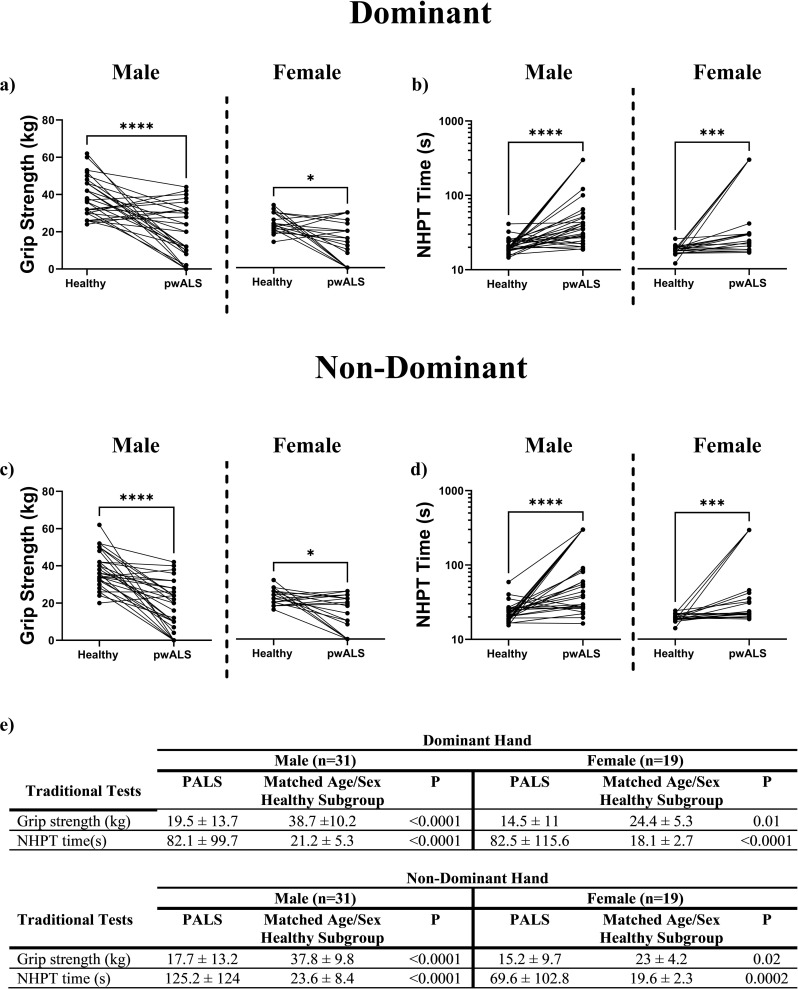
{"title":"Clinical validation of a novel hand dexterity measurement device.","authors":"Conor D Hayden, Bruce P Murphy, Deirdre Gilsenan, Bahman Nasseroleslami, Orla Hardiman, Deirdre Murray","doi":"10.1371/journal.pdig.0000744","DOIUrl":null,"url":null,"abstract":"<p><p>The lack of sensitive objective outcome measures for hand dexterity is a barrier for clinical assessment of neurological conditions and has negatively affected clinical trials. Here, we clinically validate a new method for measuring hand dexterity, a novel hand worn sensor that digitises the Finger Tapping Test. The device was assessed in a cohort of 180 healthy controls and 51 people with Amyotrophic Lateral Sclerosis (ALS) and compared against rating scales and traditional measures (Nine Hole Peg test and grip dynamometry). 14 features were extracted from the device and using a logistic regression algorithm, a 0-100 dexterity performance score was generated for each participant, which accounted for age/sex differences. The device returned objective ratings of a participant's hand dexterity (dominant, non-dominant and overall score). The average overall dexterity performance score in all healthy participants was 88 ± 17 (mean ± standard deviation). The overall dexterity score was statistically significantly worse in participants with ALS (age/sex matched healthy subset: 80 ± 20, ALS: 45 ± 32, p-value < 0.0001). The device also had a higher completion rate, (94% dominant hand) compared to the traditional measures (82% dominant hand). This test and scoring system have been validated and the regression model was developed using a framework that is potentially applicable to any relevant condition. This device could act as an objective outcome measure in clinical trials and may be useful in improving patient care.</p>","PeriodicalId":74465,"journal":{"name":"PLOS digital health","volume":"4 3","pages":"e0000744"},"PeriodicalIF":7.7000,"publicationDate":"2025-03-10","publicationTypes":"Journal Article","fieldsOfStudy":null,"isOpenAccess":false,"openAccessPdf":"https://www.ncbi.nlm.nih.gov/pmc/articles/PMC11893126/pdf/","citationCount":"0","resultStr":null,"platform":"Semanticscholar","paperid":null,"PeriodicalName":"PLOS digital health","FirstCategoryId":"1085","ListUrlMain":"https://doi.org/10.1371/journal.pdig.0000744","RegionNum":0,"RegionCategory":null,"ArticlePicture":[],"TitleCN":null,"AbstractTextCN":null,"PMCID":null,"EPubDate":"2025/3/1 0:00:00","PubModel":"eCollection","JCR":"","JCRName":"","Score":null,"Total":0}
引用次数: 0
Abstract
The lack of sensitive objective outcome measures for hand dexterity is a barrier for clinical assessment of neurological conditions and has negatively affected clinical trials. Here, we clinically validate a new method for measuring hand dexterity, a novel hand worn sensor that digitises the Finger Tapping Test. The device was assessed in a cohort of 180 healthy controls and 51 people with Amyotrophic Lateral Sclerosis (ALS) and compared against rating scales and traditional measures (Nine Hole Peg test and grip dynamometry). 14 features were extracted from the device and using a logistic regression algorithm, a 0-100 dexterity performance score was generated for each participant, which accounted for age/sex differences. The device returned objective ratings of a participant's hand dexterity (dominant, non-dominant and overall score). The average overall dexterity performance score in all healthy participants was 88 ± 17 (mean ± standard deviation). The overall dexterity score was statistically significantly worse in participants with ALS (age/sex matched healthy subset: 80 ± 20, ALS: 45 ± 32, p-value < 0.0001). The device also had a higher completion rate, (94% dominant hand) compared to the traditional measures (82% dominant hand). This test and scoring system have been validated and the regression model was developed using a framework that is potentially applicable to any relevant condition. This device could act as an objective outcome measure in clinical trials and may be useful in improving patient care.





 京公网安备 11010802042870号
京ICP备2023020795号-1
京公网安备 11010802042870号
京ICP备2023020795号-1

 分享
分享

 求助内容:
求助内容: 应助结果提醒方式:
 扫码关注我们
