Bolin Cao, Yu Guo, Fengguang Xia, Lunxiong Li, Zhanbing Ren, Min Lu, Jun Wang, Ruiwang Huang
{"title":"Dynamic reconfiguration of brain functional networks in world class gymnasts: a resting-state functional MRI study.","authors":"Bolin Cao, Yu Guo, Fengguang Xia, Lunxiong Li, Zhanbing Ren, Min Lu, Jun Wang, Ruiwang Huang","doi":"10.1093/braincomms/fcaf083","DOIUrl":null,"url":null,"abstract":"<p><p>Long-term intensive training has enabled world class gymnasts to attain exceptional skill levels, inducing notable neuroplastic changes in their brains. Previous studies have identified optimized brain modularity related to long-term intensive training based on resting-state functional MRI, which is associated with higher efficiency in motor and cognitive functions. However, most studies assumed that functional topological networks remain static during the scans, neglecting the inherent dynamic changes over time. This study applied a multilayer network model to identify the effect of long-term intensive training on dynamic functional network properties in gymnasts. The imaging data were collected from 13 gymnasts and 14 age- and gender-matched non-athlete controls. We first construct dynamic functional connectivity matrices for each subject to capture the temporal information underlying these brain signals. Then, we applied a multilayer community detection approach to analyse how brain regions form modules and how this modularity changes over time. Graph theoretical parameters, including flexibility, promiscuity, cohesion and disjointedness, were estimated to characterize the dynamic properties of functional networks across global, network, and nodal levels in the gymnasts. The gymnasts showed significantly lower flexibility, cohesion and disjointedness at the global level than the controls. Then, we observed lower flexibility and cohesion in the auditory, dorsal attention, sensorimotor, subcortical, cingulo-opercular and default mode networks in the gymnasts than in the controls. Furthermore, these gymnasts showed decreased flexibility and cohesion in several regions associated with motor function. Together, we found brain functional neuroplasticity related to long-term intensive training, primarily characterized by decreased flexibility of brain dynamics in the gymnasts, which provided new insights into brain reorganization in motor skill learning.</p>","PeriodicalId":93915,"journal":{"name":"Brain communications","volume":"7 2","pages":"fcaf083"},"PeriodicalIF":4.5000,"publicationDate":"2025-02-19","publicationTypes":"Journal Article","fieldsOfStudy":null,"isOpenAccess":false,"openAccessPdf":"https://www.ncbi.nlm.nih.gov/pmc/articles/PMC11891512/pdf/","citationCount":"0","resultStr":null,"platform":"Semanticscholar","paperid":null,"PeriodicalName":"Brain communications","FirstCategoryId":"1085","ListUrlMain":"https://doi.org/10.1093/braincomms/fcaf083","RegionNum":0,"RegionCategory":null,"ArticlePicture":[],"TitleCN":null,"AbstractTextCN":null,"PMCID":null,"EPubDate":"2025/1/1 0:00:00","PubModel":"eCollection","JCR":"Q1","JCRName":"CLINICAL NEUROLOGY","Score":null,"Total":0}
引用次数: 0
Abstract
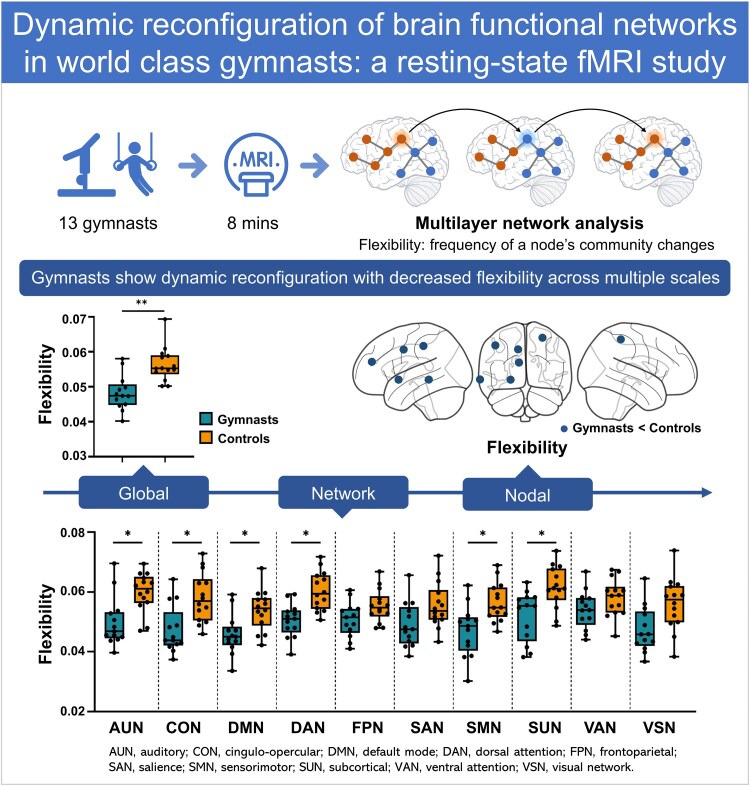
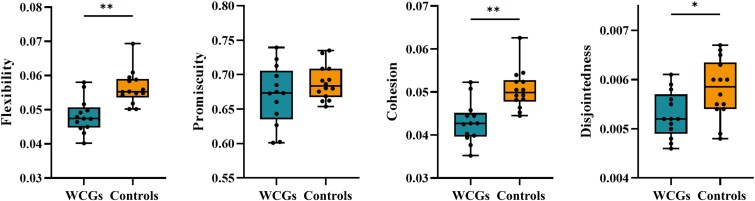
Long-term intensive training has enabled world class gymnasts to attain exceptional skill levels, inducing notable neuroplastic changes in their brains. Previous studies have identified optimized brain modularity related to long-term intensive training based on resting-state functional MRI, which is associated with higher efficiency in motor and cognitive functions. However, most studies assumed that functional topological networks remain static during the scans, neglecting the inherent dynamic changes over time. This study applied a multilayer network model to identify the effect of long-term intensive training on dynamic functional network properties in gymnasts. The imaging data were collected from 13 gymnasts and 14 age- and gender-matched non-athlete controls. We first construct dynamic functional connectivity matrices for each subject to capture the temporal information underlying these brain signals. Then, we applied a multilayer community detection approach to analyse how brain regions form modules and how this modularity changes over time. Graph theoretical parameters, including flexibility, promiscuity, cohesion and disjointedness, were estimated to characterize the dynamic properties of functional networks across global, network, and nodal levels in the gymnasts. The gymnasts showed significantly lower flexibility, cohesion and disjointedness at the global level than the controls. Then, we observed lower flexibility and cohesion in the auditory, dorsal attention, sensorimotor, subcortical, cingulo-opercular and default mode networks in the gymnasts than in the controls. Furthermore, these gymnasts showed decreased flexibility and cohesion in several regions associated with motor function. Together, we found brain functional neuroplasticity related to long-term intensive training, primarily characterized by decreased flexibility of brain dynamics in the gymnasts, which provided new insights into brain reorganization in motor skill learning.




 京公网安备 11010802042870号
京ICP备2023020795号-1
京公网安备 11010802042870号
京ICP备2023020795号-1

 分享
分享

 求助内容:
求助内容: 应助结果提醒方式:
 扫码关注我们
