Hongchao Li , Jun Wang , Jiawang Zhao , Jinshan Li , M.W. Fu
{"title":"Phase transformation within dynamically refined microbands inducing ultrahigh and sustained strain hardening in high-entropy alloys containing L12 precipitates","authors":"Hongchao Li , Jun Wang , Jiawang Zhao , Jinshan Li , M.W. Fu","doi":"10.1016/j.actamat.2025.120930","DOIUrl":null,"url":null,"abstract":"<div><div>Metallic materials exhibiting ultrahigh strength coupled with exceptional ductility play a pivotal role in advanced industries, yet enhancing strength typically sacrifices strain hardening and ductility. This study presents a strategy that activated an innovative deformation mechanism to overcome the long-standing trade-off between strength and ductility in an L1<sub>2</sub>-strengthened Al<sub>5</sub>Ti<sub>8</sub>(FeCoNi)<sub>86.9</sub>B<sub>0.1</sub> high-entropy alloy. After aging at 765 °C for 4 hours, the alloy achieved a yield strength of 1227 MPa, an ultimate tensile strength of 1742 MPa, and an elongation of 39.9%, attributed to the ultrahigh and sustained strain hardening induced by phase transformation within dynamically refined microbands during deformation. Our findings indicated that FCC→BCC transformation within the microbands was more favorable in an FCC matrix with a larger width. Furthermore, a high density of superlattice intrinsic stacking faults and Lomer-Cottrell locks in L1<sub>2</sub> phase were formed, leading to additional strain hardening of the alloy. The synergistic interaction between phase transformation and microband formation offers a promising approach for designing novel high-performance alloys with exceptional strength and ductility.</div></div>","PeriodicalId":238,"journal":{"name":"Acta Materialia","volume":"289 ","pages":"Article 120930"},"PeriodicalIF":9.3000,"publicationDate":"2025-05-01","publicationTypes":"Journal Article","fieldsOfStudy":null,"isOpenAccess":false,"openAccessPdf":"","citationCount":"0","resultStr":null,"platform":"Semanticscholar","paperid":null,"PeriodicalName":"Acta Materialia","FirstCategoryId":"88","ListUrlMain":"https://www.sciencedirect.com/science/article/pii/S1359645425002228","RegionNum":1,"RegionCategory":"材料科学","ArticlePicture":[],"TitleCN":null,"AbstractTextCN":null,"PMCID":null,"EPubDate":"2025/3/11 0:00:00","PubModel":"Epub","JCR":"Q1","JCRName":"MATERIALS SCIENCE, MULTIDISCIPLINARY","Score":null,"Total":0}
引用次数: 0
Abstract
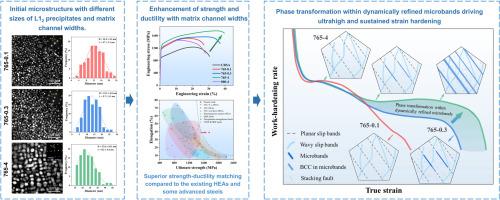
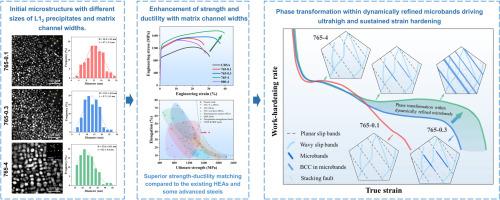
Metallic materials exhibiting ultrahigh strength coupled with exceptional ductility play a pivotal role in advanced industries, yet enhancing strength typically sacrifices strain hardening and ductility. This study presents a strategy that activated an innovative deformation mechanism to overcome the long-standing trade-off between strength and ductility in an L12-strengthened Al5Ti8(FeCoNi)86.9B0.1 high-entropy alloy. After aging at 765 °C for 4 hours, the alloy achieved a yield strength of 1227 MPa, an ultimate tensile strength of 1742 MPa, and an elongation of 39.9%, attributed to the ultrahigh and sustained strain hardening induced by phase transformation within dynamically refined microbands during deformation. Our findings indicated that FCC→BCC transformation within the microbands was more favorable in an FCC matrix with a larger width. Furthermore, a high density of superlattice intrinsic stacking faults and Lomer-Cottrell locks in L12 phase were formed, leading to additional strain hardening of the alloy. The synergistic interaction between phase transformation and microband formation offers a promising approach for designing novel high-performance alloys with exceptional strength and ductility.
期刊介绍:
Acta Materialia serves as a platform for publishing full-length, original papers and commissioned overviews that contribute to a profound understanding of the correlation between the processing, structure, and properties of inorganic materials. The journal seeks papers with high impact potential or those that significantly propel the field forward. The scope includes the atomic and molecular arrangements, chemical and electronic structures, and microstructure of materials, focusing on their mechanical or functional behavior across all length scales, including nanostructures.




 京公网安备 11010802042870号
京ICP备2023020795号-1
京公网安备 11010802042870号
京ICP备2023020795号-1

 分享
分享
 求助内容:
求助内容: 应助结果提醒方式:
 扫码关注我们
