Exploring antidiabetic potential of Nigella sativa and Silybum marianum seed extracts through bioassay-guided alpha-amylase inhibition activity and characterization of bioactive fractions
Kainat Nasir , Syeda Laila Rubab , Hina Fatima , Farzana Shamim , Abdul Tawab , Iqra Arshad , Riffat Iqbal , Sofia Parveen , Mubshara Saadia , Bakar Bin Khatab Abbasi , Ali Irfan , Mohammad Raish , Yousef A. Bin Jardan
{"title":"Exploring antidiabetic potential of Nigella sativa and Silybum marianum seed extracts through bioassay-guided alpha-amylase inhibition activity and characterization of bioactive fractions","authors":"Kainat Nasir , Syeda Laila Rubab , Hina Fatima , Farzana Shamim , Abdul Tawab , Iqra Arshad , Riffat Iqbal , Sofia Parveen , Mubshara Saadia , Bakar Bin Khatab Abbasi , Ali Irfan , Mohammad Raish , Yousef A. Bin Jardan","doi":"10.1016/j.rechem.2025.102183","DOIUrl":null,"url":null,"abstract":"<div><div>Diabetes mellitus is a global health threat, and natural remedies are gaining attention due to the severe side effects of synthetic drugs. The current study explores the antidiabetic potential of individual seed extracts and their combination prepared from <em>Nigella sativa</em> and <em>Silybum marianum</em> plants through a bioassay-guided study using alpha-amylase. The characterized column fraction F5 isolated from an herbal combination of <em>N. sativa</em> and <em>S. marianum</em> seed extracts showed the highest alpha-amylase inhibition activity (79.54 %) than the fractions of individual extracts, <em>N. sativa</em> fraction F7 (66.83 %) and <em>S. marianum</em> fraction F4 (68.87 %) in comparison with standard drug acarbose (78.65 %). The fractions with the highest percent inhibition activity were analyzed through FTIR, indicating the existence of different functional groups corresponding to diversity of bioactive compounds in fractions F5, F7, and F4. However, the highest number of peaks were noted in the F5 fraction (from combined extract). The isolated fraction F5 exhibited significant antidiabetic potential due to the presence of important phytochemicals, including mostly fatty acids, some phenolic compounds, steroids, alkaloids, vitamins, and organic acids, which may be manipulated for the development of some herbal drugs to safely manage diabetes in future studies after <em>in-vivo</em> and clinical trials.</div></div>","PeriodicalId":420,"journal":{"name":"Results in Chemistry","volume":"15 ","pages":"Article 102183"},"PeriodicalIF":4.2000,"publicationDate":"2025-05-01","publicationTypes":"Journal Article","fieldsOfStudy":null,"isOpenAccess":false,"openAccessPdf":"","citationCount":"0","resultStr":null,"platform":"Semanticscholar","paperid":null,"PeriodicalName":"Results in Chemistry","FirstCategoryId":"1085","ListUrlMain":"https://www.sciencedirect.com/science/article/pii/S2211715625001663","RegionNum":0,"RegionCategory":null,"ArticlePicture":[],"TitleCN":null,"AbstractTextCN":null,"PMCID":null,"EPubDate":"2025/3/7 0:00:00","PubModel":"Epub","JCR":"Q2","JCRName":"CHEMISTRY, MULTIDISCIPLINARY","Score":null,"Total":0}
引用次数: 0
Abstract
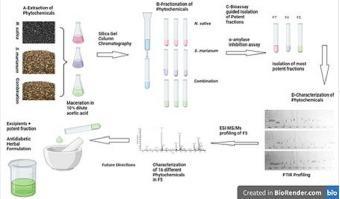
Diabetes mellitus is a global health threat, and natural remedies are gaining attention due to the severe side effects of synthetic drugs. The current study explores the antidiabetic potential of individual seed extracts and their combination prepared from Nigella sativa and Silybum marianum plants through a bioassay-guided study using alpha-amylase. The characterized column fraction F5 isolated from an herbal combination of N. sativa and S. marianum seed extracts showed the highest alpha-amylase inhibition activity (79.54 %) than the fractions of individual extracts, N. sativa fraction F7 (66.83 %) and S. marianum fraction F4 (68.87 %) in comparison with standard drug acarbose (78.65 %). The fractions with the highest percent inhibition activity were analyzed through FTIR, indicating the existence of different functional groups corresponding to diversity of bioactive compounds in fractions F5, F7, and F4. However, the highest number of peaks were noted in the F5 fraction (from combined extract). The isolated fraction F5 exhibited significant antidiabetic potential due to the presence of important phytochemicals, including mostly fatty acids, some phenolic compounds, steroids, alkaloids, vitamins, and organic acids, which may be manipulated for the development of some herbal drugs to safely manage diabetes in future studies after in-vivo and clinical trials.




 京公网安备 11010802042870号
京ICP备2023020795号-1
京公网安备 11010802042870号
京ICP备2023020795号-1

 分享
分享
 求助内容:
求助内容: 应助结果提醒方式:
 扫码关注我们
