Unraveling the secrets of probiotic adhesion: An overview of adhesion-associated cell surface components, adhesion mechanisms, and the effects of food composition
Ran Wang , Yuan Liu , Yanchao Wen, Siyu Chen, Xiaohan Zhang, Chi Zhang, Xinqi Liu
{"title":"Unraveling the secrets of probiotic adhesion: An overview of adhesion-associated cell surface components, adhesion mechanisms, and the effects of food composition","authors":"Ran Wang , Yuan Liu , Yanchao Wen, Siyu Chen, Xiaohan Zhang, Chi Zhang, Xinqi Liu","doi":"10.1016/j.tifs.2025.104945","DOIUrl":null,"url":null,"abstract":"<div><h3>Background</h3><div>Probiotics, as vital components of the human microecosystem, play a crucial role in maintaining host health. The adhesion of probiotics to epithelial cells or mucus layer represents the initial step in exerting their probiotic effects. Therefore, in-depth research into the adhesion mechanisms of probiotics and their influencing factors is essential for further understanding of probiotic functions and the develop more effective probiotic products.</div></div><div><h3>Scope and objective</h3><div>The review aims to summarize molecular mechanisms underlying probiotic adhesion, emphasizing the structures and functional dynamics of surface adhesins critical for probiotic-host interface interactions. It also endeavors to investigate the influence of dietary components on the adhesion capabilities of probiotics, providing a deeper understanding of how various food compositions can either promote or hinder the adhesion process. This understanding is crucial for developing targeted strategies to optimize probiotic efficacy and design functional foods that enhance the beneficial effects of probiotics.</div></div><div><h3>Key findings and conclusions</h3><div>Surface proteins are critical for the adhesion of <em>Lactobacillus</em> and <em>Bifidobacterium</em>, with different types of surface proteins within the same strain contributing to either non-specific or specific adhesion mechanisms. While some adhesion proteins share structural similarities across different strains, others exhibit unique structural features that distinguish them. Effective adhesion is a synergistic outcome influenced by both host epithelial cells and the surface components of probiotics, as observed in diverse environments such as the intestinal tract, oral cavity, and skin. Dietary components, including carbohydrates, proteins, and lipids, can modulate probiotic adherence. Among these, oligosaccharides have been more extensively studied, while the role of proteins is gaining increasing attention, highlighting the complex interplay between diet and probiotic functionality.</div></div>","PeriodicalId":441,"journal":{"name":"Trends in Food Science & Technology","volume":"159 ","pages":"Article 104945"},"PeriodicalIF":15.4000,"publicationDate":"2025-02-27","publicationTypes":"Journal Article","fieldsOfStudy":null,"isOpenAccess":false,"openAccessPdf":"","citationCount":"0","resultStr":null,"platform":"Semanticscholar","paperid":null,"PeriodicalName":"Trends in Food Science & Technology","FirstCategoryId":"97","ListUrlMain":"https://www.sciencedirect.com/science/article/pii/S0924224425000810","RegionNum":1,"RegionCategory":"农林科学","ArticlePicture":[],"TitleCN":null,"AbstractTextCN":null,"PMCID":null,"EPubDate":"","PubModel":"","JCR":"Q1","JCRName":"FOOD SCIENCE & TECHNOLOGY","Score":null,"Total":0}
引用次数: 0
Abstract
Background
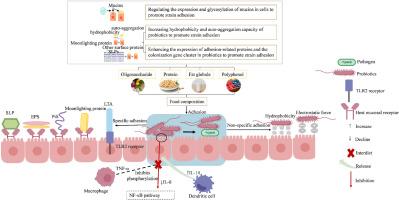
Probiotics, as vital components of the human microecosystem, play a crucial role in maintaining host health. The adhesion of probiotics to epithelial cells or mucus layer represents the initial step in exerting their probiotic effects. Therefore, in-depth research into the adhesion mechanisms of probiotics and their influencing factors is essential for further understanding of probiotic functions and the develop more effective probiotic products.
Scope and objective
The review aims to summarize molecular mechanisms underlying probiotic adhesion, emphasizing the structures and functional dynamics of surface adhesins critical for probiotic-host interface interactions. It also endeavors to investigate the influence of dietary components on the adhesion capabilities of probiotics, providing a deeper understanding of how various food compositions can either promote or hinder the adhesion process. This understanding is crucial for developing targeted strategies to optimize probiotic efficacy and design functional foods that enhance the beneficial effects of probiotics.
Key findings and conclusions
Surface proteins are critical for the adhesion of Lactobacillus and Bifidobacterium, with different types of surface proteins within the same strain contributing to either non-specific or specific adhesion mechanisms. While some adhesion proteins share structural similarities across different strains, others exhibit unique structural features that distinguish them. Effective adhesion is a synergistic outcome influenced by both host epithelial cells and the surface components of probiotics, as observed in diverse environments such as the intestinal tract, oral cavity, and skin. Dietary components, including carbohydrates, proteins, and lipids, can modulate probiotic adherence. Among these, oligosaccharides have been more extensively studied, while the role of proteins is gaining increasing attention, highlighting the complex interplay between diet and probiotic functionality.
期刊介绍:
Trends in Food Science & Technology is a prestigious international journal that specializes in peer-reviewed articles covering the latest advancements in technology, food science, and human nutrition. It serves as a bridge between specialized primary journals and general trade magazines, providing readable and scientifically rigorous reviews and commentaries on current research developments and their potential applications in the food industry.
Unlike traditional journals, Trends in Food Science & Technology does not publish original research papers. Instead, it focuses on critical and comprehensive reviews to offer valuable insights for professionals in the field. By bringing together cutting-edge research and industry applications, this journal plays a vital role in disseminating knowledge and facilitating advancements in the food science and technology sector.



 京公网安备 11010802042870号
京ICP备2023020795号-1
京公网安备 11010802042870号
京ICP备2023020795号-1

 分享
分享
 求助内容:
求助内容: 应助结果提醒方式:
 扫码关注我们
