Modification of Transparent Polyimide with High Aspect Ratio Nanowires to Simultaneously Improve the Thermal Conductivity, Haze, and Mechanical Properties
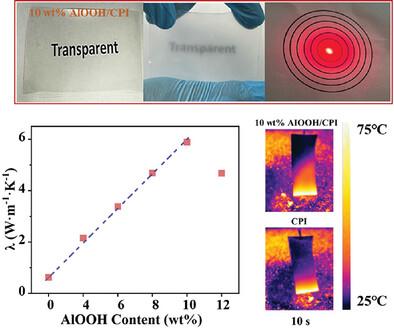
{"title":"Modification of Transparent Polyimide with High Aspect Ratio Nanowires to Simultaneously Improve the Thermal Conductivity, Haze, and Mechanical Properties","authors":"Chaohua Peng, Xinjie Ma, Mengting Wei, Conghui Yuan, Yiting Xu, Birong Zeng, Guorong Chen, Weiang Luo, Lizong Dai","doi":"10.1002/marc.202401040","DOIUrl":null,"url":null,"abstract":"<p>Currently, the high light transmittance and high haze thermally conductive polyimide film with excellent comprehensive performance exhibits great application prospects, while there are still challenges for achieving. Here, boehmite nanowires (BhNs) with an aspect ratio up to 60 for the modification of transparent polyimide (CPI) derived from the polymerization of fluorodiamine and fluorodianhydride, are prepared. Due to the unique size and orientation distribution of BhNs in CPI films, the as prepared CPI-BhN composite films show in-plane thermal conductivity up to 5.89 W m<sup>−1</sup> K<sup>−1</sup>, which is almost an order of magnitude higher than that of pure CPI (0.626 W m<sup>−1</sup> K<sup>−1</sup>). Meantime, optimal CPI-BhN composite films show a light transmittance of 52.9% at 550 nm and a haze of 35.3%. In addition, the BhNs form a strong hydrogen bond with the CPI polymer chains, enhancing the mechanical properties of the composite films. Studies on thermal stability, fatigue resistance, and flame retardancy indicate that the CPI-BhN composite films have excellent performances. These findings provide a new idea for the design and fabrication of high-performance composite films for new-generation optoelectronic devices.</p>","PeriodicalId":205,"journal":{"name":"Macromolecular Rapid Communications","volume":"46 12","pages":""},"PeriodicalIF":4.3000,"publicationDate":"2025-03-03","publicationTypes":"Journal Article","fieldsOfStudy":null,"isOpenAccess":false,"openAccessPdf":"","citationCount":"0","resultStr":null,"platform":"Semanticscholar","paperid":null,"PeriodicalName":"Macromolecular Rapid Communications","FirstCategoryId":"92","ListUrlMain":"https://onlinelibrary.wiley.com/doi/10.1002/marc.202401040","RegionNum":3,"RegionCategory":"化学","ArticlePicture":[],"TitleCN":null,"AbstractTextCN":null,"PMCID":null,"EPubDate":"","PubModel":"","JCR":"Q2","JCRName":"POLYMER SCIENCE","Score":null,"Total":0}
引用次数: 0
Abstract
Currently, the high light transmittance and high haze thermally conductive polyimide film with excellent comprehensive performance exhibits great application prospects, while there are still challenges for achieving. Here, boehmite nanowires (BhNs) with an aspect ratio up to 60 for the modification of transparent polyimide (CPI) derived from the polymerization of fluorodiamine and fluorodianhydride, are prepared. Due to the unique size and orientation distribution of BhNs in CPI films, the as prepared CPI-BhN composite films show in-plane thermal conductivity up to 5.89 W m−1 K−1, which is almost an order of magnitude higher than that of pure CPI (0.626 W m−1 K−1). Meantime, optimal CPI-BhN composite films show a light transmittance of 52.9% at 550 nm and a haze of 35.3%. In addition, the BhNs form a strong hydrogen bond with the CPI polymer chains, enhancing the mechanical properties of the composite films. Studies on thermal stability, fatigue resistance, and flame retardancy indicate that the CPI-BhN composite films have excellent performances. These findings provide a new idea for the design and fabrication of high-performance composite films for new-generation optoelectronic devices.
目前,综合性能优异的高透光率、高雾度导热聚酰亚胺薄膜展现出巨大的应用前景,但实现上仍存在挑战。本文制备了宽高比高达60的薄水铝石纳米线(BhNs),用于改性由氟二胺和氟二酐聚合而成的透明聚酰亚胺(CPI)。由于CPI薄膜中bhn的独特尺寸和取向分布,所制备的CPI- bhn复合薄膜的面内导热系数高达5.89 W m-1 K-1,比纯CPI (0.626 W m-1 K-1)高出近一个数量级。同时,优化后的CPI-BhN复合薄膜在550 nm处的透光率为52.9%,雾度为35.3%。此外,bhn与CPI聚合物链形成强氢键,增强了复合膜的力学性能。热稳定性、抗疲劳性和阻燃性研究表明,CPI-BhN复合薄膜具有优异的性能。这些发现为新一代光电器件高性能复合薄膜的设计和制造提供了新的思路。
期刊介绍:
Macromolecular Rapid Communications publishes original research in polymer science, ranging from chemistry and physics of polymers to polymers in materials science and life sciences.



 京公网安备 11010802042870号
京ICP备2023020795号-1
京公网安备 11010802042870号
京ICP备2023020795号-1

 分享
分享
 求助内容:
求助内容: 应助结果提醒方式:
 扫码关注我们
