Predicting periprosthetic joint infection in primary total knee arthroplasty: a machine learning model integrating preoperative and perioperative risk factors.
Yuk Yee Chong, Chun Man Lawrence Lau, Tianshu Jiang, Chunyi Wen, Jiang Zhang, Amy Cheung, Michelle Hilda Luk, Ka Chun Thomas Leung, Man Hong Cheung, Henry Fu, Kwong Yuen Chiu, Ping Keung Chan
{"title":"Predicting periprosthetic joint infection in primary total knee arthroplasty: a machine learning model integrating preoperative and perioperative risk factors.","authors":"Yuk Yee Chong, Chun Man Lawrence Lau, Tianshu Jiang, Chunyi Wen, Jiang Zhang, Amy Cheung, Michelle Hilda Luk, Ka Chun Thomas Leung, Man Hong Cheung, Henry Fu, Kwong Yuen Chiu, Ping Keung Chan","doi":"10.1186/s12891-025-08296-6","DOIUrl":null,"url":null,"abstract":"<p><strong>Background: </strong>Periprosthetic joint infection leads to significant morbidity and mortality after total knee arthroplasty. Preoperative and perioperative risk prediction and assessment tools are lacking in Asia. This study developed the first machine learning model for individualized prediction of periprosthetic joint infection following primary total knee arthroplasty in this demographic.</p><p><strong>Methods: </strong>A retrospective analysis was conducted on 3,483 primary total knee arthroplasty (81 with periprosthetic joint infection) from 1998 to 2021 in a Chinese tertiary and quaternary referral academic center. We gathered 60 features, encompassing patient demographics, operation-related variables, laboratory findings, and comorbidities. Six of them were selected after univariate and multivariate analysis. Five machine learning models were trained with stratified 10-fold cross-validation and assessed by discrimination and calibration analysis to determine the optimal predictive model.</p><p><strong>Results: </strong>The balanced random forest model demonstrated the best predictive capability with average metrics of 0.963 for the area under the receiver operating characteristic curve, 0.920 for balanced accuracy, 0.938 for sensitivity, and 0.902 for specificity. The significant risk factors identified were long operative time (OR, 9.07; p = 0.018), male gender (OR, 3.11; p < 0.001), ASA > 2 (OR, 1.68; p = 0.028), history of anemia (OR, 2.17; p = 0.023), and history of septic arthritis (OR, 4.35; p = 0.030). Spinal anesthesia emerged as a protective factor (OR, 0.55; p = 0.022).</p><p><strong>Conclusion: </strong>Our study presented the first machine learning model in Asia to predict periprosthetic joint infection following primary total knee arthroplasty. We enhanced the model's usability by providing global and local interpretations. This tool provides preoperative and perioperative risk assessment for periprosthetic joint infection and opens the potential for better individualized optimization before total knee arthroplasty.</p>","PeriodicalId":9189,"journal":{"name":"BMC Musculoskeletal Disorders","volume":"26 1","pages":"241"},"PeriodicalIF":2.4000,"publicationDate":"2025-03-11","publicationTypes":"Journal Article","fieldsOfStudy":null,"isOpenAccess":false,"openAccessPdf":"https://www.ncbi.nlm.nih.gov/pmc/articles/PMC11895328/pdf/","citationCount":"0","resultStr":null,"platform":"Semanticscholar","paperid":null,"PeriodicalName":"BMC Musculoskeletal Disorders","FirstCategoryId":"3","ListUrlMain":"https://doi.org/10.1186/s12891-025-08296-6","RegionNum":3,"RegionCategory":"医学","ArticlePicture":[],"TitleCN":null,"AbstractTextCN":null,"PMCID":null,"EPubDate":"","PubModel":"","JCR":"Q2","JCRName":"ORTHOPEDICS","Score":null,"Total":0}
引用次数: 0
Abstract
Background: Periprosthetic joint infection leads to significant morbidity and mortality after total knee arthroplasty. Preoperative and perioperative risk prediction and assessment tools are lacking in Asia. This study developed the first machine learning model for individualized prediction of periprosthetic joint infection following primary total knee arthroplasty in this demographic.
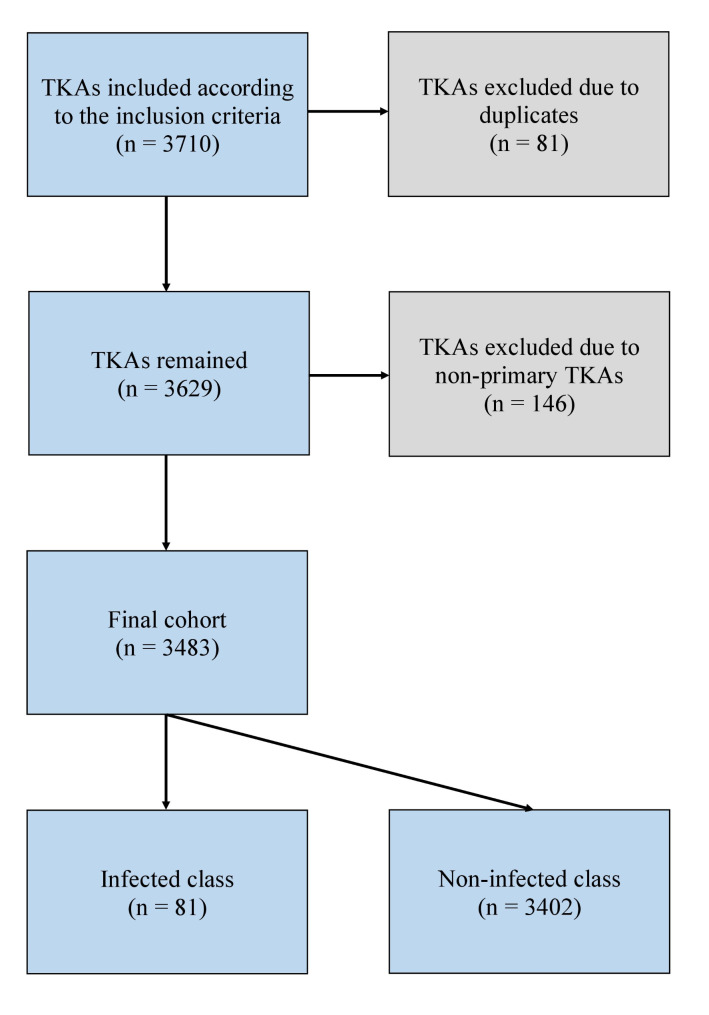
Methods: A retrospective analysis was conducted on 3,483 primary total knee arthroplasty (81 with periprosthetic joint infection) from 1998 to 2021 in a Chinese tertiary and quaternary referral academic center. We gathered 60 features, encompassing patient demographics, operation-related variables, laboratory findings, and comorbidities. Six of them were selected after univariate and multivariate analysis. Five machine learning models were trained with stratified 10-fold cross-validation and assessed by discrimination and calibration analysis to determine the optimal predictive model.
Results: The balanced random forest model demonstrated the best predictive capability with average metrics of 0.963 for the area under the receiver operating characteristic curve, 0.920 for balanced accuracy, 0.938 for sensitivity, and 0.902 for specificity. The significant risk factors identified were long operative time (OR, 9.07; p = 0.018), male gender (OR, 3.11; p < 0.001), ASA > 2 (OR, 1.68; p = 0.028), history of anemia (OR, 2.17; p = 0.023), and history of septic arthritis (OR, 4.35; p = 0.030). Spinal anesthesia emerged as a protective factor (OR, 0.55; p = 0.022).
Conclusion: Our study presented the first machine learning model in Asia to predict periprosthetic joint infection following primary total knee arthroplasty. We enhanced the model's usability by providing global and local interpretations. This tool provides preoperative and perioperative risk assessment for periprosthetic joint infection and opens the potential for better individualized optimization before total knee arthroplasty.
期刊介绍:
BMC Musculoskeletal Disorders is an open access, peer-reviewed journal that considers articles on all aspects of the prevention, diagnosis and management of musculoskeletal disorders, as well as related molecular genetics, pathophysiology, and epidemiology.
The scope of the Journal covers research into rheumatic diseases where the primary focus relates specifically to a component(s) of the musculoskeletal system.





 京公网安备 11010802042870号
京ICP备2023020795号-1
京公网安备 11010802042870号
京ICP备2023020795号-1

 分享
分享
 求助内容:
求助内容: 应助结果提醒方式:
 扫码关注我们
