{"title":"Cox-Sage: enhancing Cox proportional hazards model with interpretable graph neural networks for cancer prognosis.","authors":"Ruijun Mao, Li Wan, Minghao Zhou, Dongxi Li","doi":"10.1093/bib/bbaf108","DOIUrl":null,"url":null,"abstract":"<p><p>High-throughput sequencing technologies have facilitated a deeper exploration of prognostic biomarkers. While many deep learning (DL) methods primarily focus on feature extraction or employ simplistic fully connected layers within prognostic modules, the interpretability of DL-extracted features can be challenging. To address these challenges, we propose an interpretable cancer prognosis model called Cox-Sage. Specifically, we first propose an algorithm to construct a patient similarity graph from heterogeneous clinical data, and then extract protein-coding genes from the patient's gene expression data to embed them as features into the graph nodes. We utilize multilayer graph convolution to model proportional hazards pattern and introduce a mathematical method to clearly explain the meaning of our model's parameters. Based on this approach, we propose two metrics for measuring gene importance from different perspectives: mean hazard ratio and reciprocal of the mean hazard ratio. These metrics can be used to discover two types of important genes: genes whose low expression levels are associated with high cancer prognosis risk, and genes whose high expression levels are associated with high cancer prognosis risk. We conducted experiments on seven datasets from TCGA, and our model achieved superior prognostic performance compared with some state-of-the-art methods. As a primary research, we performed prognostic biomarker discovery on the LIHC (Liver Hepatocellular Carcinoma) dataset. Our code and dataset can be found at https://github.com/beeeginner/Cox-sage.</p>","PeriodicalId":9209,"journal":{"name":"Briefings in bioinformatics","volume":"26 2","pages":""},"PeriodicalIF":7.7000,"publicationDate":"2025-03-04","publicationTypes":"Journal Article","fieldsOfStudy":null,"isOpenAccess":false,"openAccessPdf":"https://www.ncbi.nlm.nih.gov/pmc/articles/PMC11894944/pdf/","citationCount":"0","resultStr":null,"platform":"Semanticscholar","paperid":null,"PeriodicalName":"Briefings in bioinformatics","FirstCategoryId":"99","ListUrlMain":"https://doi.org/10.1093/bib/bbaf108","RegionNum":2,"RegionCategory":"生物学","ArticlePicture":[],"TitleCN":null,"AbstractTextCN":null,"PMCID":null,"EPubDate":"","PubModel":"","JCR":"Q1","JCRName":"BIOCHEMICAL RESEARCH METHODS","Score":null,"Total":0}
引用次数: 0
Abstract
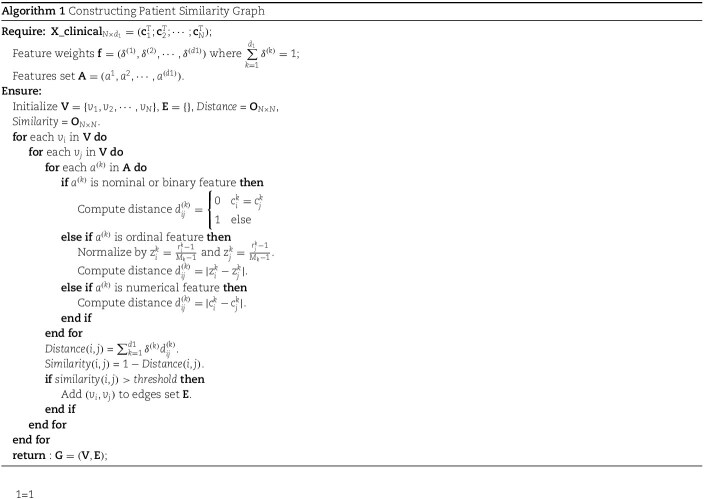
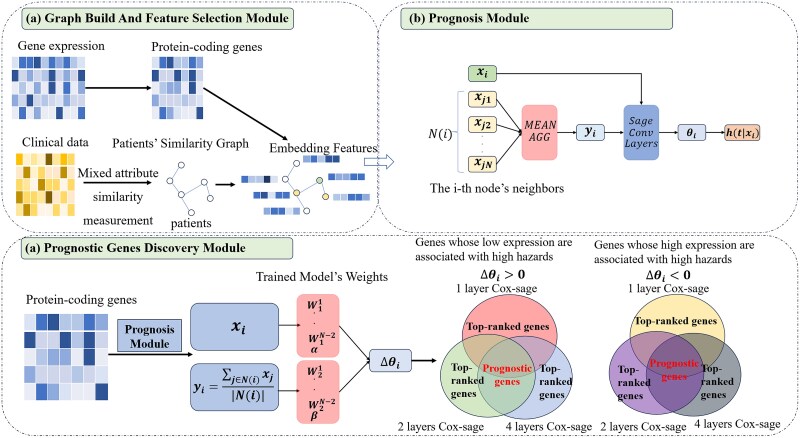
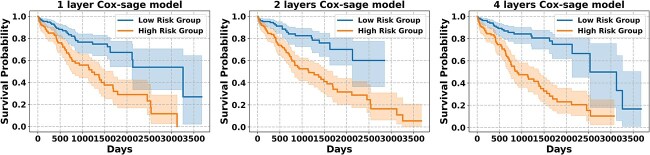
High-throughput sequencing technologies have facilitated a deeper exploration of prognostic biomarkers. While many deep learning (DL) methods primarily focus on feature extraction or employ simplistic fully connected layers within prognostic modules, the interpretability of DL-extracted features can be challenging. To address these challenges, we propose an interpretable cancer prognosis model called Cox-Sage. Specifically, we first propose an algorithm to construct a patient similarity graph from heterogeneous clinical data, and then extract protein-coding genes from the patient's gene expression data to embed them as features into the graph nodes. We utilize multilayer graph convolution to model proportional hazards pattern and introduce a mathematical method to clearly explain the meaning of our model's parameters. Based on this approach, we propose two metrics for measuring gene importance from different perspectives: mean hazard ratio and reciprocal of the mean hazard ratio. These metrics can be used to discover two types of important genes: genes whose low expression levels are associated with high cancer prognosis risk, and genes whose high expression levels are associated with high cancer prognosis risk. We conducted experiments on seven datasets from TCGA, and our model achieved superior prognostic performance compared with some state-of-the-art methods. As a primary research, we performed prognostic biomarker discovery on the LIHC (Liver Hepatocellular Carcinoma) dataset. Our code and dataset can be found at https://github.com/beeeginner/Cox-sage.
期刊介绍:
Briefings in Bioinformatics is an international journal serving as a platform for researchers and educators in the life sciences. It also appeals to mathematicians, statisticians, and computer scientists applying their expertise to biological challenges. The journal focuses on reviews tailored for users of databases and analytical tools in contemporary genetics, molecular and systems biology. It stands out by offering practical assistance and guidance to non-specialists in computerized methodologies. Covering a wide range from introductory concepts to specific protocols and analyses, the papers address bacterial, plant, fungal, animal, and human data.
The journal's detailed subject areas include genetic studies of phenotypes and genotypes, mapping, DNA sequencing, expression profiling, gene expression studies, microarrays, alignment methods, protein profiles and HMMs, lipids, metabolic and signaling pathways, structure determination and function prediction, phylogenetic studies, and education and training.



 京公网安备 11010802042870号
京ICP备2023020795号-1
京公网安备 11010802042870号
京ICP备2023020795号-1

 分享
分享
 求助内容:
求助内容: 应助结果提醒方式:
 扫码关注我们
