Raquelle I Mesholam-Gately, Arundati Nagendra, Matcheri Keshavan
{"title":"Renaming schizophrenia: why, how, and what next?","authors":"Raquelle I Mesholam-Gately, Arundati Nagendra, Matcheri Keshavan","doi":"10.1097/YCO.0000000000001002","DOIUrl":null,"url":null,"abstract":"<p><strong>Purpose of review: </strong>The debate over renaming schizophrenia has gained international momentum, driven by concerns about stigma and scientific accuracy. This review examines the arguments for and against renaming schizophrenia, highlighting research data from the US and international efforts.</p><p><strong>Recent findings: </strong>Proponents argue that the current term perpetuates stigma, is scientifically outdated, and that stakeholders, including those with lived experience, favor a name change. Opponents, however, caution that renaming might not reduce stigma and could complicate access to care. Stigma associated with schizophrenia leads to significant discrimination in healthcare, employment, and social interactions. Moreover, the term inaccurately suggests a 'split' in the brain, contributing to public misconceptions. Survey data from various countries reveal substantial support for renaming, with some evidence suggesting that new terms can reduce stigma and improve treatment engagement. Historical precedents, such as the renaming of multiple personality disorder to dissociative identity disorder, show that such changes can occur without disrupting care.</p><p><strong>Summary: </strong>The review concludes that while renaming schizophrenia could align the term with contemporary science and reduce stigma, a systematic, consensus-building approach involving diverse stakeholders is essential. Future steps should focus on finding an appropriate name that reflects the illness's core aspects and ensures optimal care.</p>","PeriodicalId":11022,"journal":{"name":"Current Opinion in Psychiatry","volume":" ","pages":"147-153"},"PeriodicalIF":4.9000,"publicationDate":"2025-05-01","publicationTypes":"Journal Article","fieldsOfStudy":null,"isOpenAccess":false,"openAccessPdf":"","citationCount":"0","resultStr":null,"platform":"Semanticscholar","paperid":null,"PeriodicalName":"Current Opinion in Psychiatry","FirstCategoryId":"3","ListUrlMain":"https://doi.org/10.1097/YCO.0000000000001002","RegionNum":2,"RegionCategory":"医学","ArticlePicture":[],"TitleCN":null,"AbstractTextCN":null,"PMCID":null,"EPubDate":"2025/3/11 0:00:00","PubModel":"Epub","JCR":"Q1","JCRName":"PSYCHIATRY","Score":null,"Total":0}
引用次数: 0
Abstract
Purpose of review: The debate over renaming schizophrenia has gained international momentum, driven by concerns about stigma and scientific accuracy. This review examines the arguments for and against renaming schizophrenia, highlighting research data from the US and international efforts.
Recent findings: Proponents argue that the current term perpetuates stigma, is scientifically outdated, and that stakeholders, including those with lived experience, favor a name change. Opponents, however, caution that renaming might not reduce stigma and could complicate access to care. Stigma associated with schizophrenia leads to significant discrimination in healthcare, employment, and social interactions. Moreover, the term inaccurately suggests a 'split' in the brain, contributing to public misconceptions. Survey data from various countries reveal substantial support for renaming, with some evidence suggesting that new terms can reduce stigma and improve treatment engagement. Historical precedents, such as the renaming of multiple personality disorder to dissociative identity disorder, show that such changes can occur without disrupting care.
Summary: The review concludes that while renaming schizophrenia could align the term with contemporary science and reduce stigma, a systematic, consensus-building approach involving diverse stakeholders is essential. Future steps should focus on finding an appropriate name that reflects the illness's core aspects and ensures optimal care.
期刊介绍:
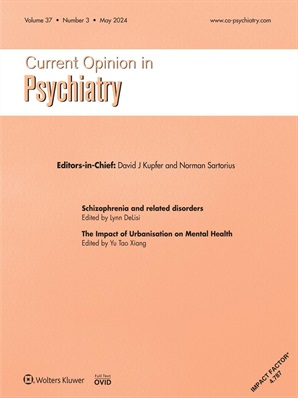
Current Opinion in Psychiatry is an easy-to-digest bimonthly journal covering the most interesting and important advances in the field of psychiatry. Eight sections on mental health disorders including schizophrenia, neurodevelopmental disorders and eating disorders, are presented alongside five area-specific sections, offering an expert evaluation on the most exciting developments in the field.



 京公网安备 11010802042870号
京ICP备2023020795号-1
京公网安备 11010802042870号
京ICP备2023020795号-1

 分享
分享
 求助内容:
求助内容: 应助结果提醒方式:
 扫码关注我们
