Deirdre Church, Christopher Naugler, Maggie Guo, Ranjani Somayaji
{"title":"Evaluating the epidemiology of vaginitis in a contemporary cohort: a population-based study.","authors":"Deirdre Church, Christopher Naugler, Maggie Guo, Ranjani Somayaji","doi":"10.3389/fpubh.2024.1486356","DOIUrl":null,"url":null,"abstract":"<p><strong>Introduction: </strong>Bacterial vaginosis (BV), vulvovaginal candidiasis (VVC), and <i>Trichomonas vaginalis</i> (TV) commonly cause infectious vaginitis in women, especially those of reproductive age. Characterization of the epidemiology of infectious vaginitis in a contemporary population-based cohort was done to determine the longitudinal age-standardized and sex-based testing, positivity, and incidence rates and ratios of infectious vaginitis in a large Canadian healthcare region.</p><p><strong>Methods: </strong>We conducted a population-based cohort study from March 2015 through March 2018 using the Alberta Precision Laboratories (APL) microbiology database. Calgary 2016 census data was used to calculate incidence rates (IR) and ratios (IRR) for cases and testing rates.</p><p><strong>Results: </strong>For testing and positivity, female sex, and younger age groups were associated with increased risk of BV, VVC, and TV infections. The annual mean population in 2016 was 1,411,660 individuals (50.3% female). A total of 40,259 cases/293,853 tests (13.7%) of BV, 32,894 cases/293,853 tests (11.2%) of VVC, and 2018 cases/342,986 tests (0.7%) of TV were identified. The overall IR for BV ranged from 0 to 609 cases per 10,000 person-years. The overall IR for VVC ranged from 0 to 445 per 10,000 person-years. The overall IR for TV ranged from 0 to 27 per 10,000 person-years. The highest age-specific testing positivity rate and IR rate for BV and VVC occurred in women aged 20-34 years and 20-34 years. For TV, female IR for BV, VVC, and TV remained stable during the study.</p><p><strong>Discussion: </strong>These unique regional data provide insight for the development of appropriate age-specific clinical testing criteria according to relative risk of acquisition of each vaginitis agent.</p>","PeriodicalId":12548,"journal":{"name":"Frontiers in Public Health","volume":"12 ","pages":"1486356"},"PeriodicalIF":3.4000,"publicationDate":"2025-02-25","publicationTypes":"Journal Article","fieldsOfStudy":null,"isOpenAccess":false,"openAccessPdf":"https://www.ncbi.nlm.nih.gov/pmc/articles/PMC11893580/pdf/","citationCount":"0","resultStr":null,"platform":"Semanticscholar","paperid":null,"PeriodicalName":"Frontiers in Public Health","FirstCategoryId":"3","ListUrlMain":"https://doi.org/10.3389/fpubh.2024.1486356","RegionNum":3,"RegionCategory":"医学","ArticlePicture":[],"TitleCN":null,"AbstractTextCN":null,"PMCID":null,"EPubDate":"2024/1/1 0:00:00","PubModel":"eCollection","JCR":"Q2","JCRName":"PUBLIC, ENVIRONMENTAL & OCCUPATIONAL HEALTH","Score":null,"Total":0}
引用次数: 0
Abstract
Introduction: Bacterial vaginosis (BV), vulvovaginal candidiasis (VVC), and Trichomonas vaginalis (TV) commonly cause infectious vaginitis in women, especially those of reproductive age. Characterization of the epidemiology of infectious vaginitis in a contemporary population-based cohort was done to determine the longitudinal age-standardized and sex-based testing, positivity, and incidence rates and ratios of infectious vaginitis in a large Canadian healthcare region.
Methods: We conducted a population-based cohort study from March 2015 through March 2018 using the Alberta Precision Laboratories (APL) microbiology database. Calgary 2016 census data was used to calculate incidence rates (IR) and ratios (IRR) for cases and testing rates.
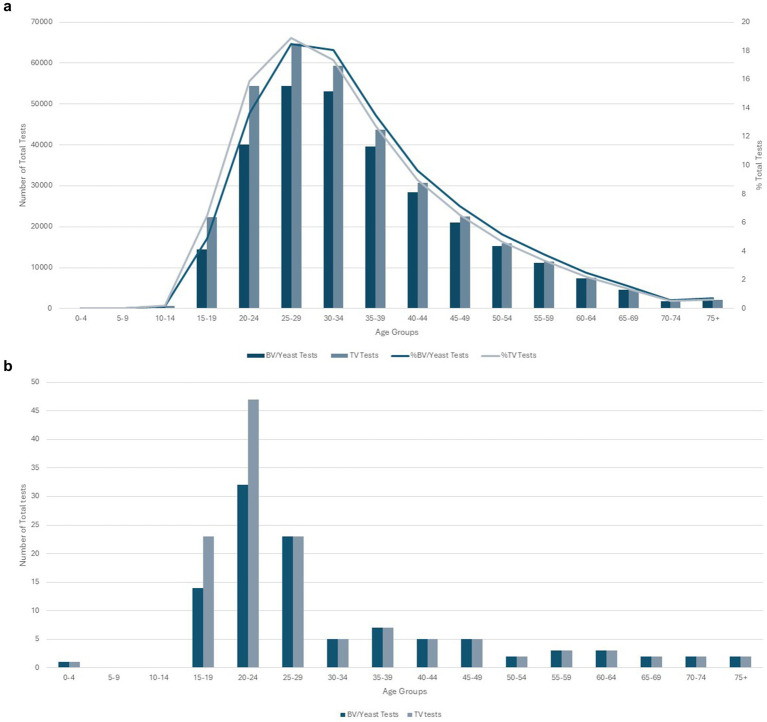
Results: For testing and positivity, female sex, and younger age groups were associated with increased risk of BV, VVC, and TV infections. The annual mean population in 2016 was 1,411,660 individuals (50.3% female). A total of 40,259 cases/293,853 tests (13.7%) of BV, 32,894 cases/293,853 tests (11.2%) of VVC, and 2018 cases/342,986 tests (0.7%) of TV were identified. The overall IR for BV ranged from 0 to 609 cases per 10,000 person-years. The overall IR for VVC ranged from 0 to 445 per 10,000 person-years. The overall IR for TV ranged from 0 to 27 per 10,000 person-years. The highest age-specific testing positivity rate and IR rate for BV and VVC occurred in women aged 20-34 years and 20-34 years. For TV, female IR for BV, VVC, and TV remained stable during the study.
Discussion: These unique regional data provide insight for the development of appropriate age-specific clinical testing criteria according to relative risk of acquisition of each vaginitis agent.
期刊介绍:
Frontiers in Public Health is a multidisciplinary open-access journal which publishes rigorously peer-reviewed research and is at the forefront of disseminating and communicating scientific knowledge and impactful discoveries to researchers, academics, clinicians, policy makers and the public worldwide. The journal aims at overcoming current fragmentation in research and publication, promoting consistency in pursuing relevant scientific themes, and supporting finding dissemination and translation into practice.
Frontiers in Public Health is organized into Specialty Sections that cover different areas of research in the field. Please refer to the author guidelines for details on article types and the submission process.






 京公网安备 11010802042870号
京ICP备2023020795号-1
京公网安备 11010802042870号
京ICP备2023020795号-1

 分享
分享
 求助内容:
求助内容: 应助结果提醒方式:
 扫码关注我们
