{"title":"TaiChi-MSS protocol: enhancing cognitive and brain function in MCI patients through Tai Chi exercise combined with multisensory stimulation.","authors":"Chunhui Zhou, Ganfeng Yang, Yinying Wang, Ruiting Zhu, Dong Zhu","doi":"10.3389/fnagi.2025.1514127","DOIUrl":null,"url":null,"abstract":"<p><strong>Background: </strong>The aging population in China is confronted with considerable challenges, with 14.71% of elderly individuals affected by mild cognitive impairment (MCI). The practice of Tai Chi has been demonstrated to enhance cognitive function, while sensory stimulation has been shown to facilitate neural activity. Nevertheless, the combined impact of Tai Chi and sensory stimulation on cognitive, sensory functions, and brain activation in older adults with MCI remains uncertain. This study aims to ascertain whether the integration of Tai Chi with sensory stimulation can facilitate more efficacious interventions for these outcomes.</p><p><strong>Methods and analysis: </strong>The TaiChi-MSS (Tai Chi and Multisensory Stimulation for Cognitive Function) study is a multi-center, randomized controlled trial (RCT) conducted in Suzhou and Shanghai, enrolling 88 participants aged 60 years or older with MCI. Participants will be randomly assigned to one of four groups: Tai Chi, multisensory stimulation, Tai Chi combined with multisensory stimulation or control. The intervention will last 6 months, with follow-up assessments at 3, 6, and 9 months. Primary outcomes include cognitive and sensory assessments, assessed using the Montreal Cognitive Assessment (MoCA), Mini-Mental State Examination (MMSE), domain-specific cognitive tests, Pure Tone Audiometry (PTA), and Sniffin' Sticks Odor Identification Test. Secondary outcomes involve brain activation, measured through functional Magnetic Resonance Imaging (fMRI) scans. fMRI will be used to assess brain structure and connectivity changes, focusing on neuroplasticity. Data will be analyzed using mixed-effects models. The False Discovery Rate (FDR) will be the correction method for multiple comparisons to control for the expected proportion of false positives.</p><p><strong>Ethics and dissemination: </strong>This study was approved by the ethics committee of Shanghai University of Sport (No. 102772023RT200). The results of this study will be disseminated in peer-reviewed journals and presented at academic conferences.</p>","PeriodicalId":12450,"journal":{"name":"Frontiers in Aging Neuroscience","volume":"17 ","pages":"1514127"},"PeriodicalIF":4.5000,"publicationDate":"2025-02-25","publicationTypes":"Journal Article","fieldsOfStudy":null,"isOpenAccess":false,"openAccessPdf":"https://www.ncbi.nlm.nih.gov/pmc/articles/PMC11893585/pdf/","citationCount":"0","resultStr":null,"platform":"Semanticscholar","paperid":null,"PeriodicalName":"Frontiers in Aging Neuroscience","FirstCategoryId":"3","ListUrlMain":"https://doi.org/10.3389/fnagi.2025.1514127","RegionNum":2,"RegionCategory":"医学","ArticlePicture":[],"TitleCN":null,"AbstractTextCN":null,"PMCID":null,"EPubDate":"2025/1/1 0:00:00","PubModel":"eCollection","JCR":"Q2","JCRName":"GERIATRICS & GERONTOLOGY","Score":null,"Total":0}
引用次数: 0
Abstract
Background: The aging population in China is confronted with considerable challenges, with 14.71% of elderly individuals affected by mild cognitive impairment (MCI). The practice of Tai Chi has been demonstrated to enhance cognitive function, while sensory stimulation has been shown to facilitate neural activity. Nevertheless, the combined impact of Tai Chi and sensory stimulation on cognitive, sensory functions, and brain activation in older adults with MCI remains uncertain. This study aims to ascertain whether the integration of Tai Chi with sensory stimulation can facilitate more efficacious interventions for these outcomes.
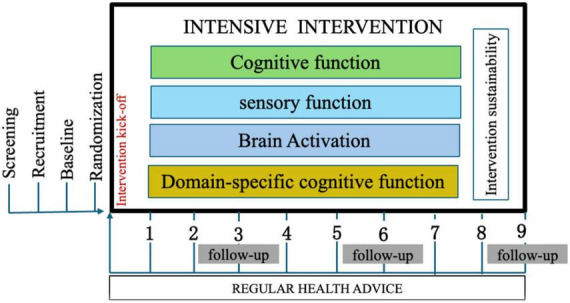
Methods and analysis: The TaiChi-MSS (Tai Chi and Multisensory Stimulation for Cognitive Function) study is a multi-center, randomized controlled trial (RCT) conducted in Suzhou and Shanghai, enrolling 88 participants aged 60 years or older with MCI. Participants will be randomly assigned to one of four groups: Tai Chi, multisensory stimulation, Tai Chi combined with multisensory stimulation or control. The intervention will last 6 months, with follow-up assessments at 3, 6, and 9 months. Primary outcomes include cognitive and sensory assessments, assessed using the Montreal Cognitive Assessment (MoCA), Mini-Mental State Examination (MMSE), domain-specific cognitive tests, Pure Tone Audiometry (PTA), and Sniffin' Sticks Odor Identification Test. Secondary outcomes involve brain activation, measured through functional Magnetic Resonance Imaging (fMRI) scans. fMRI will be used to assess brain structure and connectivity changes, focusing on neuroplasticity. Data will be analyzed using mixed-effects models. The False Discovery Rate (FDR) will be the correction method for multiple comparisons to control for the expected proportion of false positives.
Ethics and dissemination: This study was approved by the ethics committee of Shanghai University of Sport (No. 102772023RT200). The results of this study will be disseminated in peer-reviewed journals and presented at academic conferences.
期刊介绍:
Frontiers in Aging Neuroscience is a leading journal in its field, publishing rigorously peer-reviewed research that advances our understanding of the mechanisms of Central Nervous System aging and age-related neural diseases. Specialty Chief Editor Thomas Wisniewski at the New York University School of Medicine is supported by an outstanding Editorial Board of international researchers. This multidisciplinary open-access journal is at the forefront of disseminating and communicating scientific knowledge and impactful discoveries to researchers, academics, clinicians and the public worldwide.




 京公网安备 11010802042870号
京ICP备2023020795号-1
京公网安备 11010802042870号
京ICP备2023020795号-1

 分享
分享
 求助内容:
求助内容: 应助结果提醒方式:
 扫码关注我们
