Rachael Adcock, Cosette M Wheeler, William C Hunt, Norah E Torrez-Martinez, Michael Robertson, Ruth McDonald, Nancy E Joste, Mark H Stoler, Maurits N C de Koning, Wim G V Quint
{"title":"HPV vaccine impact: genotype-specific changes in cervical pre-cancer share similarities with changes in cervical screening cytology.","authors":"Rachael Adcock, Cosette M Wheeler, William C Hunt, Norah E Torrez-Martinez, Michael Robertson, Ruth McDonald, Nancy E Joste, Mark H Stoler, Maurits N C de Koning, Wim G V Quint","doi":"10.1093/jnci/djaf055","DOIUrl":null,"url":null,"abstract":"<p><strong>Background: </strong>After human papillomavirus (HPV) vaccine introduction, declines in the prevalence of HPV vaccine types have been observed in screening cytology, but data from the United States describing HPV type-specific changes in cervical intraepithelial neoplasia (CIN) grades 2-3 and adenocarcinoma in situ (CIN2/CIN3/AIS) are limited.</p><p><strong>Methods: </strong>A statewide sample of individuals with cervical biopsies was selected for broad-spectrum HPV genotyping. CIN2/CIN3/AIS incidence and prevalence were calculated for type-specific high-risk HPV (hrHPV) among individuals aged 15-29 years. Weighted incidence rate ratios (IRR) and relative differences in prevalence (RDP) were computed to compare 3 time periods: 2006-2009 (Cohort 1 [C1], n = 4121), 2012-2015 (C2, n = 2194), and 2015-2018 (C3, n = 1481).</p><p><strong>Results: </strong>When comparing C1 vs C3 among those aged 21-25 years, statistically significant reductions in hrHPV type-specific CIN2/CIN3/AIS incidence were observed for HPV16, HPV18, HPV31, and HPV33, with corresponding IRRs of 0.4 (95% confidence interval [95% CI] = 0.3 to 0.4), 0.3 (95% CI = 0.1 to 0.7), 0.6 (95% CI = 0.5 to 0.9), and 0.4 (95% CI = 0.1 to 0.8), respectively. The RDP comparing C1 vs C3 for HPV16/18-positive CIN2/CIN3/AIS was -43.8% (P < .001). When excluding HPV16/18 or HPV16/18/31/33 from all hrHPV types, the RDP was +56.6% and +92.5% (P < .001), respectively.</p><p><strong>Conclusions: </strong>hrHPV type-specific CIN2/CIN3/AIS incidence decreased with statistical significance for vaccine types HPV16/18 and for HPV31 and HPV33. Although the HPV vaccine is highly beneficial and a top priority for preventing HPV-related cancer, the long-term vaccine impact in cohorts receiving the 4-valent HPV vaccine requires continued follow-up to assess genotype-specific distributions in the remaining CIN2+ lesions and cancers.</p>","PeriodicalId":14809,"journal":{"name":"JNCI Journal of the National Cancer Institute","volume":" ","pages":"1377-1386"},"PeriodicalIF":7.2000,"publicationDate":"2025-07-01","publicationTypes":"Journal Article","fieldsOfStudy":null,"isOpenAccess":false,"openAccessPdf":"https://www.ncbi.nlm.nih.gov/pmc/articles/PMC12229469/pdf/","citationCount":"0","resultStr":null,"platform":"Semanticscholar","paperid":null,"PeriodicalName":"JNCI Journal of the National Cancer Institute","FirstCategoryId":"3","ListUrlMain":"https://doi.org/10.1093/jnci/djaf055","RegionNum":1,"RegionCategory":"医学","ArticlePicture":[],"TitleCN":null,"AbstractTextCN":null,"PMCID":null,"EPubDate":"","PubModel":"","JCR":"Q1","JCRName":"ONCOLOGY","Score":null,"Total":0}
引用次数: 0
Abstract
Background: After human papillomavirus (HPV) vaccine introduction, declines in the prevalence of HPV vaccine types have been observed in screening cytology, but data from the United States describing HPV type-specific changes in cervical intraepithelial neoplasia (CIN) grades 2-3 and adenocarcinoma in situ (CIN2/CIN3/AIS) are limited.
Methods: A statewide sample of individuals with cervical biopsies was selected for broad-spectrum HPV genotyping. CIN2/CIN3/AIS incidence and prevalence were calculated for type-specific high-risk HPV (hrHPV) among individuals aged 15-29 years. Weighted incidence rate ratios (IRR) and relative differences in prevalence (RDP) were computed to compare 3 time periods: 2006-2009 (Cohort 1 [C1], n = 4121), 2012-2015 (C2, n = 2194), and 2015-2018 (C3, n = 1481).
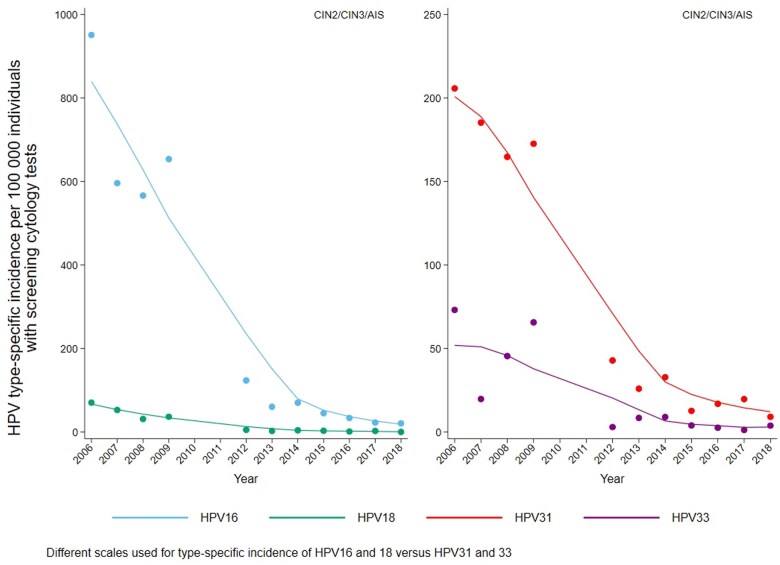
Results: When comparing C1 vs C3 among those aged 21-25 years, statistically significant reductions in hrHPV type-specific CIN2/CIN3/AIS incidence were observed for HPV16, HPV18, HPV31, and HPV33, with corresponding IRRs of 0.4 (95% confidence interval [95% CI] = 0.3 to 0.4), 0.3 (95% CI = 0.1 to 0.7), 0.6 (95% CI = 0.5 to 0.9), and 0.4 (95% CI = 0.1 to 0.8), respectively. The RDP comparing C1 vs C3 for HPV16/18-positive CIN2/CIN3/AIS was -43.8% (P < .001). When excluding HPV16/18 or HPV16/18/31/33 from all hrHPV types, the RDP was +56.6% and +92.5% (P < .001), respectively.
Conclusions: hrHPV type-specific CIN2/CIN3/AIS incidence decreased with statistical significance for vaccine types HPV16/18 and for HPV31 and HPV33. Although the HPV vaccine is highly beneficial and a top priority for preventing HPV-related cancer, the long-term vaccine impact in cohorts receiving the 4-valent HPV vaccine requires continued follow-up to assess genotype-specific distributions in the remaining CIN2+ lesions and cancers.
期刊介绍:
The Journal of the National Cancer Institute is a reputable publication that undergoes a peer-review process. It is available in both print (ISSN: 0027-8874) and online (ISSN: 1460-2105) formats, with 12 issues released annually. The journal's primary aim is to disseminate innovative and important discoveries in the field of cancer research, with specific emphasis on clinical, epidemiologic, behavioral, and health outcomes studies. Authors are encouraged to submit reviews, minireviews, and commentaries. The journal ensures that submitted manuscripts undergo a rigorous and expedited review to publish scientifically and medically significant findings in a timely manner.



 京公网安备 11010802042870号
京ICP备2023020795号-1
京公网安备 11010802042870号
京ICP备2023020795号-1

 分享
分享
 求助内容:
求助内容: 应助结果提醒方式:
 扫码关注我们
