Dionyssios Leftheriotis, Panagiota Flevari, Konstantinos A. Papathanasiou, Efstratios Karamanolis, Alexandra Gkatzia, Maria Polikandrioti, Gerasimos Filippatos
{"title":"High-Power Short-Duration Temperature-Controlled Radiofrequency Ablation for the Treatment of Outflow Tract Ventricular Arrhythmias","authors":"Dionyssios Leftheriotis, Panagiota Flevari, Konstantinos A. Papathanasiou, Efstratios Karamanolis, Alexandra Gkatzia, Maria Polikandrioti, Gerasimos Filippatos","doi":"10.1111/jce.16636","DOIUrl":null,"url":null,"abstract":"<div>\n \n \n <section>\n \n <h3> Introduction</h3>\n \n <p>The tissue temperature-controlled DiamondTemp ablation (DTA) catheter has been mainly used for atrial fibrillation ablation. We report our initial experience in using this catheter for the treatment of outflow premature ventricular contractions (PVCs) or repetitive non-sustained monomorphic ventricular tachycardias (VTs).</p>\n </section>\n \n <section>\n \n <h3> Methods</h3>\n \n <p>Twenty patients were studied: 10 with right ventricular outflow tract PVCs/VTs, eight with PVCs/VTs from the aortic sinus cusps, and two with left ventricular outflow tract PVCs. The DTA parameters were adjusted to a target-temperature of 60°C with 50 W power. Ablation success was defined as the absence of clinical VT/PVCs at the end of the procedure and during the next 48 h of continuous rhythm monitoring without antiarrhythmic drugs. All patients were reevaluated 2 months after the ablation.</p>\n </section>\n \n <section>\n \n <h3> Results</h3>\n \n <p>The average ablation duration was 262 (145–690) seconds and the average tissue temperature (T) was 50.4 ± 2.9°C. A mean number of 11 ± 6 lesions per case were applied. The average time of T > 50°C was 18 (12–20) seconds, that is 70% of the ablation time, and an average relative impedance drop of 13.8 ± 2.0% was recorded. No serious complications occurred, and no VT recurrence was observed until discharge and during the short follow-up period.</p>\n </section>\n \n <section>\n \n <h3> Conclusion</h3>\n \n <p>This initial evaluation suggests that the DTA system reached the adjusted temperature and power targets, and it can be effectively and safely applied for the treatment of outflow tract PVCs/VTs. This performance should be further evaluated by long-term randomized controlled trials in comparison to conventional ablation catheters.</p>\n </section>\n </div>","PeriodicalId":15178,"journal":{"name":"Journal of Cardiovascular Electrophysiology","volume":"36 5","pages":"996-1002"},"PeriodicalIF":2.6000,"publicationDate":"2025-03-11","publicationTypes":"Journal Article","fieldsOfStudy":null,"isOpenAccess":false,"openAccessPdf":"https://onlinelibrary.wiley.com/doi/epdf/10.1111/jce.16636","citationCount":"0","resultStr":null,"platform":"Semanticscholar","paperid":null,"PeriodicalName":"Journal of Cardiovascular Electrophysiology","FirstCategoryId":"3","ListUrlMain":"https://onlinelibrary.wiley.com/doi/10.1111/jce.16636","RegionNum":3,"RegionCategory":"医学","ArticlePicture":[],"TitleCN":null,"AbstractTextCN":null,"PMCID":null,"EPubDate":"","PubModel":"","JCR":"Q2","JCRName":"CARDIAC & CARDIOVASCULAR SYSTEMS","Score":null,"Total":0}
引用次数: 0
Abstract
Introduction
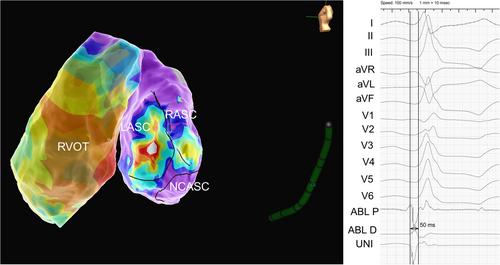
The tissue temperature-controlled DiamondTemp ablation (DTA) catheter has been mainly used for atrial fibrillation ablation. We report our initial experience in using this catheter for the treatment of outflow premature ventricular contractions (PVCs) or repetitive non-sustained monomorphic ventricular tachycardias (VTs).
Methods
Twenty patients were studied: 10 with right ventricular outflow tract PVCs/VTs, eight with PVCs/VTs from the aortic sinus cusps, and two with left ventricular outflow tract PVCs. The DTA parameters were adjusted to a target-temperature of 60°C with 50 W power. Ablation success was defined as the absence of clinical VT/PVCs at the end of the procedure and during the next 48 h of continuous rhythm monitoring without antiarrhythmic drugs. All patients were reevaluated 2 months after the ablation.
Results
The average ablation duration was 262 (145–690) seconds and the average tissue temperature (T) was 50.4 ± 2.9°C. A mean number of 11 ± 6 lesions per case were applied. The average time of T > 50°C was 18 (12–20) seconds, that is 70% of the ablation time, and an average relative impedance drop of 13.8 ± 2.0% was recorded. No serious complications occurred, and no VT recurrence was observed until discharge and during the short follow-up period.
Conclusion
This initial evaluation suggests that the DTA system reached the adjusted temperature and power targets, and it can be effectively and safely applied for the treatment of outflow tract PVCs/VTs. This performance should be further evaluated by long-term randomized controlled trials in comparison to conventional ablation catheters.
期刊介绍:
Journal of Cardiovascular Electrophysiology (JCE) keeps its readership well informed of the latest developments in the study and management of arrhythmic disorders. Edited by Bradley P. Knight, M.D., and a distinguished international editorial board, JCE is the leading journal devoted to the study of the electrophysiology of the heart.



 京公网安备 11010802042870号
京ICP备2023020795号-1
京公网安备 11010802042870号
京ICP备2023020795号-1

 分享
分享
 求助内容:
求助内容: 应助结果提醒方式:
 扫码关注我们
