Shogo Tokimori, Kai Funato, Kenji Wada, Tetsuya Matsuyama, Koichi Okamoto
{"title":"Emission Enhancement of ZnO Thin Films in Ultraviolet Wavelength Region Using Au Nano-Hemisphere on Al Mirror Structures.","authors":"Shogo Tokimori, Kai Funato, Kenji Wada, Tetsuya Matsuyama, Koichi Okamoto","doi":"10.3390/nano15050400","DOIUrl":null,"url":null,"abstract":"<p><p>Using a heterogeneous metal Nano Hemisphere on Mirror (NHoM) structure, composed of an Al<sub>2</sub>O<sub>3</sub> thin film and Au nano-hemispheres formed on a thick Al film, we successfully generated two distinct surface plasmon resonance (SPR) peaks: one in the ultraviolet (UV) wavelength range below 400 nm and another in the visible range between 600 and 700 nm. This NHoM structure can be fabricated through a straightforward process involving deposition, sputtering, and annealing, enabling rapid, large-area formation. By adjusting the thickness of the Al<sub>2</sub>O<sub>3</sub> spacer layer in the NHoM structure, we precisely controlled the localized surface plasmon resonance (LSPR) wavelength, spanning a wide range from the UV to the visible spectrum. Through this tuning, we enhanced the band-edge UV emission of the ZnO thin film by a factor of 35. Temperature-dependent measurements of emission intensity revealed that the NHoM structure increased the internal quantum efficiency (IQE) of the ZnO thin film from 8% to 19%. The heterometallic NHoM structure proposed in this study enables wide-ranging control of SPR wavelengths and demonstrates significant potential for applications in enhancing luminescence in the deep ultraviolet (DUV) region, where luminescence efficiency is typically low.</p>","PeriodicalId":18966,"journal":{"name":"Nanomaterials","volume":"15 5","pages":""},"PeriodicalIF":4.3000,"publicationDate":"2025-03-06","publicationTypes":"Journal Article","fieldsOfStudy":null,"isOpenAccess":false,"openAccessPdf":"https://www.ncbi.nlm.nih.gov/pmc/articles/PMC11901977/pdf/","citationCount":"0","resultStr":null,"platform":"Semanticscholar","paperid":null,"PeriodicalName":"Nanomaterials","FirstCategoryId":"88","ListUrlMain":"https://doi.org/10.3390/nano15050400","RegionNum":3,"RegionCategory":"材料科学","ArticlePicture":[],"TitleCN":null,"AbstractTextCN":null,"PMCID":null,"EPubDate":"","PubModel":"","JCR":"Q2","JCRName":"CHEMISTRY, MULTIDISCIPLINARY","Score":null,"Total":0}
引用次数: 0
Abstract
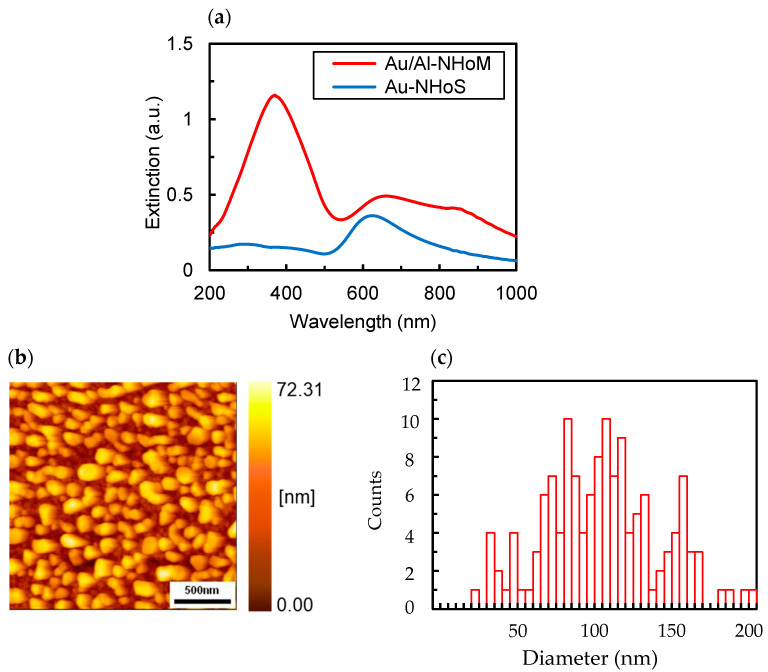
Using a heterogeneous metal Nano Hemisphere on Mirror (NHoM) structure, composed of an Al2O3 thin film and Au nano-hemispheres formed on a thick Al film, we successfully generated two distinct surface plasmon resonance (SPR) peaks: one in the ultraviolet (UV) wavelength range below 400 nm and another in the visible range between 600 and 700 nm. This NHoM structure can be fabricated through a straightforward process involving deposition, sputtering, and annealing, enabling rapid, large-area formation. By adjusting the thickness of the Al2O3 spacer layer in the NHoM structure, we precisely controlled the localized surface plasmon resonance (LSPR) wavelength, spanning a wide range from the UV to the visible spectrum. Through this tuning, we enhanced the band-edge UV emission of the ZnO thin film by a factor of 35. Temperature-dependent measurements of emission intensity revealed that the NHoM structure increased the internal quantum efficiency (IQE) of the ZnO thin film from 8% to 19%. The heterometallic NHoM structure proposed in this study enables wide-ranging control of SPR wavelengths and demonstrates significant potential for applications in enhancing luminescence in the deep ultraviolet (DUV) region, where luminescence efficiency is typically low.
期刊介绍:
Nanomaterials (ISSN 2076-4991) is an international and interdisciplinary scholarly open access journal. It publishes reviews, regular research papers, communications, and short notes that are relevant to any field of study that involves nanomaterials, with respect to their science and application. Thus, theoretical and experimental articles will be accepted, along with articles that deal with the synthesis and use of nanomaterials. Articles that synthesize information from multiple fields, and which place discoveries within a broader context, will be preferred. There is no restriction on the length of the papers. Our aim is to encourage scientists to publish their experimental and theoretical research in as much detail as possible. Full experimental or methodical details, or both, must be provided for research articles. Computed data or files regarding the full details of the experimental procedure, if unable to be published in a normal way, can be deposited as supplementary material. Nanomaterials is dedicated to a high scientific standard. All manuscripts undergo a rigorous reviewing process and decisions are based on the recommendations of independent reviewers.






 京公网安备 11010802042870号
京ICP备2023020795号-1
京公网安备 11010802042870号
京ICP备2023020795号-1

 分享
分享
 求助内容:
求助内容: 应助结果提醒方式:
 扫码关注我们
