{"title":"A cross-sectional survey analysis of patient and family knowledge, confidence, and perceived barriers to reporting patient deterioration.","authors":"Lisa Thiele, Arthas Flabouris, Campbell Thompson","doi":"10.1371/journal.pone.0319546","DOIUrl":null,"url":null,"abstract":"<p><strong>Background: </strong>The knowledge, confidence, and skills of healthcare consumers to identify acute clinical deterioration and appropriately escalate concerns remain largely undetermined. This gap is despite the widespread international introduction of consumer escalation systems intended to provide patients and family an avenue to escalate their concerns if worried about deterioration in their own or relative's condition during a hospital stay.</p><p><strong>Aim: </strong>To explore patient and family knowledge of acute clinical deterioration, and their confidence and perceived barriers to escalating their concerns.</p><p><strong>Design: </strong>Cross-sectional, in-person, consumer surveys across an Australian acute adult hospital. The study specific survey tool was developed through a multistage process with healthcare consumer input during creation and testing.</p><p><strong>Methods: </strong>Questions explored healthcare consumer knowledge, confidence, and perceived barriers in association with acute clinical deterioration, recognising deterioration, and escalating concerns. Descriptive and inferential analysis was completed, and knowledge, confidence, and barrier scores established. Association between scores and consumer type, gender, age, education level, prior experience with clinical deterioration or rapid response team review, and hospitalisation history in the last 12 months were assessed using multivariable linear regression.</p><p><strong>Results: </strong>133 surveys were completed. Knowledge scores varied across respondents. Awareness of the local consumer escalation system was low. A positive association was identified between knowledge and confidence that diminished with increasing barrier scores. A strong negative correlation was present between barriers and confidence. No significant difference existed in knowledge, confidence, or barrier scores based on consumer type, gender, education level, previous experience with deterioration or rapid response team review, or hospitalisation history.</p><p><strong>Conclusions: </strong>Limitations in patient and family knowledge may impede consumer escalation system success. Increasing knowledge may enhance patient and family confidence to identify deterioration and escalate concerns. However, barriers to consumer escalation decrease this potential. Interventions to increase consumer knowledge should therefore be accompanied by strategies to minimise barriers.</p>","PeriodicalId":20189,"journal":{"name":"PLoS ONE","volume":"20 3","pages":"e0319546"},"PeriodicalIF":2.6000,"publicationDate":"2025-03-11","publicationTypes":"Journal Article","fieldsOfStudy":null,"isOpenAccess":false,"openAccessPdf":"https://www.ncbi.nlm.nih.gov/pmc/articles/PMC11896061/pdf/","citationCount":"0","resultStr":null,"platform":"Semanticscholar","paperid":null,"PeriodicalName":"PLoS ONE","FirstCategoryId":"103","ListUrlMain":"https://doi.org/10.1371/journal.pone.0319546","RegionNum":3,"RegionCategory":"综合性期刊","ArticlePicture":[],"TitleCN":null,"AbstractTextCN":null,"PMCID":null,"EPubDate":"2025/1/1 0:00:00","PubModel":"eCollection","JCR":"Q1","JCRName":"MULTIDISCIPLINARY SCIENCES","Score":null,"Total":0}
引用次数: 0
Abstract
Background: The knowledge, confidence, and skills of healthcare consumers to identify acute clinical deterioration and appropriately escalate concerns remain largely undetermined. This gap is despite the widespread international introduction of consumer escalation systems intended to provide patients and family an avenue to escalate their concerns if worried about deterioration in their own or relative's condition during a hospital stay.
Aim: To explore patient and family knowledge of acute clinical deterioration, and their confidence and perceived barriers to escalating their concerns.
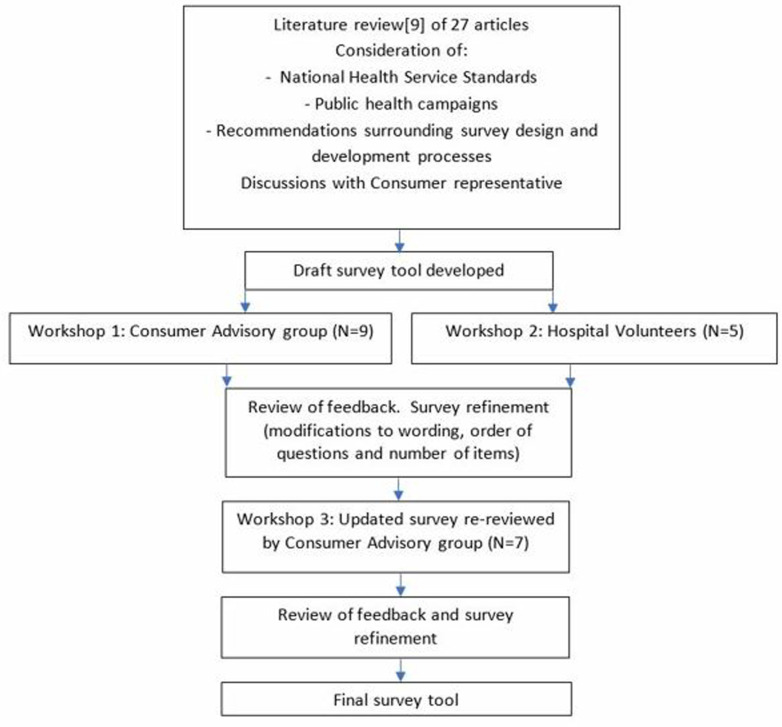
Design: Cross-sectional, in-person, consumer surveys across an Australian acute adult hospital. The study specific survey tool was developed through a multistage process with healthcare consumer input during creation and testing.
Methods: Questions explored healthcare consumer knowledge, confidence, and perceived barriers in association with acute clinical deterioration, recognising deterioration, and escalating concerns. Descriptive and inferential analysis was completed, and knowledge, confidence, and barrier scores established. Association between scores and consumer type, gender, age, education level, prior experience with clinical deterioration or rapid response team review, and hospitalisation history in the last 12 months were assessed using multivariable linear regression.
Results: 133 surveys were completed. Knowledge scores varied across respondents. Awareness of the local consumer escalation system was low. A positive association was identified between knowledge and confidence that diminished with increasing barrier scores. A strong negative correlation was present between barriers and confidence. No significant difference existed in knowledge, confidence, or barrier scores based on consumer type, gender, education level, previous experience with deterioration or rapid response team review, or hospitalisation history.
Conclusions: Limitations in patient and family knowledge may impede consumer escalation system success. Increasing knowledge may enhance patient and family confidence to identify deterioration and escalate concerns. However, barriers to consumer escalation decrease this potential. Interventions to increase consumer knowledge should therefore be accompanied by strategies to minimise barriers.
期刊介绍:
PLOS ONE is an international, peer-reviewed, open-access, online publication. PLOS ONE welcomes reports on primary research from any scientific discipline. It provides:
* Open-access—freely accessible online, authors retain copyright
* Fast publication times
* Peer review by expert, practicing researchers
* Post-publication tools to indicate quality and impact
* Community-based dialogue on articles
* Worldwide media coverage





 京公网安备 11010802042870号
京ICP备2023020795号-1
京公网安备 11010802042870号
京ICP备2023020795号-1

 分享
分享
 求助内容:
求助内容: 应助结果提醒方式:
 扫码关注我们
