Ina-Maria Rückert-Eheberg, Alexander Steger, Alexander Müller, Birgit Linkohr, Petra Barthel, Melanie Maier, Julia Allescher, Moritz F Sinner, Konstantinos D Rizas, Wolfgang Rathmann, Karl-Ludwig Laugwitz, Stefan Kääb, Annette Peters, Georg Schmidt
{"title":"Respiratory rate and its associations with disease and lifestyle factors in the general population - results from the KORA-FF4 study.","authors":"Ina-Maria Rückert-Eheberg, Alexander Steger, Alexander Müller, Birgit Linkohr, Petra Barthel, Melanie Maier, Julia Allescher, Moritz F Sinner, Konstantinos D Rizas, Wolfgang Rathmann, Karl-Ludwig Laugwitz, Stefan Kääb, Annette Peters, Georg Schmidt","doi":"10.1371/journal.pone.0318502","DOIUrl":null,"url":null,"abstract":"<p><strong>Objective: </strong>The aim of the study was to derive median age- and sex-specific respiratory rates in a population-based sample of adults and to identify disease and lifestyle factors associated with elevated respiratory rates.</p><p><strong>Methods: </strong>In the population-based KORA FF4 study conducted in Augsburg, Germany, 5-minute 12-lead resting electrocardiograms (ECGpro-system, AMEDTEC) were recorded in 2,224 participants from 39 to 88 years. Respiratory rate was derived from these electrocardiograms. Sex- and age-specific medians, IQRs, and percentiles were calculated. Associations of sociodemographic, disease, and lifestyle variables with elevated resting respiratory rate were assessed by univariable and multivariable logistic regression analyses.</p><p><strong>Results: </strong>Respiratory rate decreased slightly from youngest to middle-aged women and men and increased in old age. Overall, median (IQR) was 15.80 (3.16) breaths per minute (brpm). Five percent of the participants had values lower than 12.06 brpm, and five percent had values above 20.06 brpm (95th percentile). Elevated respiratory rates of ≥ 18.6 brpm were found in 13.8% (n = 308). In an adjusted logistic regression model, age, abdominal obesity, diabetes, COPD, smoking, and low education were significantly associated with elevated respiratory rate. Stratified analyses showed that education appeared to be more relevant in women, while the effect of diabetes was more pronounced in men.</p><p><strong>Conclusions: </strong>High respiratory rate may be an indicator of impaired health in the general population, especially regarding pulmonary and metabolic characteristics, and unfavorable lifestyle and living conditions. Individuals with an increased respiratory rate should therefore be examined and followed up more closely to recognize diseases and adverse progressions at an early stage and to possibly prevent them.</p>","PeriodicalId":20189,"journal":{"name":"PLoS ONE","volume":"20 3","pages":"e0318502"},"PeriodicalIF":2.6000,"publicationDate":"2025-03-11","publicationTypes":"Journal Article","fieldsOfStudy":null,"isOpenAccess":false,"openAccessPdf":"https://www.ncbi.nlm.nih.gov/pmc/articles/PMC11896064/pdf/","citationCount":"0","resultStr":null,"platform":"Semanticscholar","paperid":null,"PeriodicalName":"PLoS ONE","FirstCategoryId":"103","ListUrlMain":"https://doi.org/10.1371/journal.pone.0318502","RegionNum":3,"RegionCategory":"综合性期刊","ArticlePicture":[],"TitleCN":null,"AbstractTextCN":null,"PMCID":null,"EPubDate":"2025/1/1 0:00:00","PubModel":"eCollection","JCR":"Q1","JCRName":"MULTIDISCIPLINARY SCIENCES","Score":null,"Total":0}
引用次数: 0
Abstract
Objective: The aim of the study was to derive median age- and sex-specific respiratory rates in a population-based sample of adults and to identify disease and lifestyle factors associated with elevated respiratory rates.
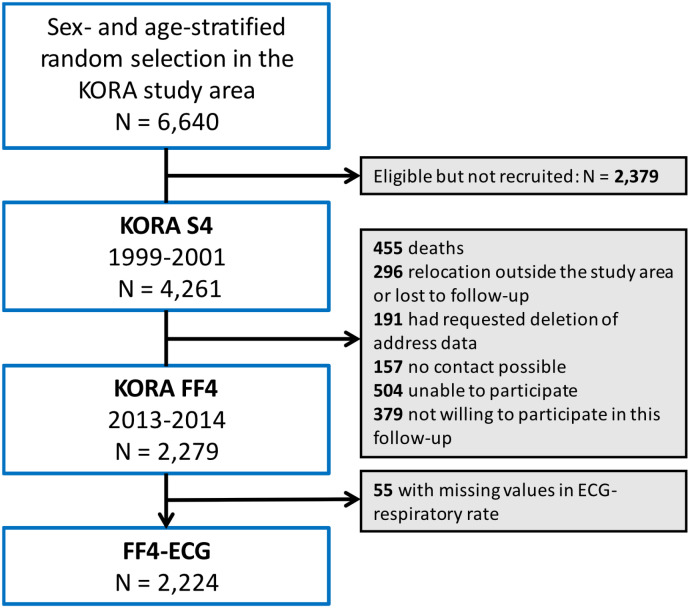
Methods: In the population-based KORA FF4 study conducted in Augsburg, Germany, 5-minute 12-lead resting electrocardiograms (ECGpro-system, AMEDTEC) were recorded in 2,224 participants from 39 to 88 years. Respiratory rate was derived from these electrocardiograms. Sex- and age-specific medians, IQRs, and percentiles were calculated. Associations of sociodemographic, disease, and lifestyle variables with elevated resting respiratory rate were assessed by univariable and multivariable logistic regression analyses.
Results: Respiratory rate decreased slightly from youngest to middle-aged women and men and increased in old age. Overall, median (IQR) was 15.80 (3.16) breaths per minute (brpm). Five percent of the participants had values lower than 12.06 brpm, and five percent had values above 20.06 brpm (95th percentile). Elevated respiratory rates of ≥ 18.6 brpm were found in 13.8% (n = 308). In an adjusted logistic regression model, age, abdominal obesity, diabetes, COPD, smoking, and low education were significantly associated with elevated respiratory rate. Stratified analyses showed that education appeared to be more relevant in women, while the effect of diabetes was more pronounced in men.
Conclusions: High respiratory rate may be an indicator of impaired health in the general population, especially regarding pulmonary and metabolic characteristics, and unfavorable lifestyle and living conditions. Individuals with an increased respiratory rate should therefore be examined and followed up more closely to recognize diseases and adverse progressions at an early stage and to possibly prevent them.
期刊介绍:
PLOS ONE is an international, peer-reviewed, open-access, online publication. PLOS ONE welcomes reports on primary research from any scientific discipline. It provides:
* Open-access—freely accessible online, authors retain copyright
* Fast publication times
* Peer review by expert, practicing researchers
* Post-publication tools to indicate quality and impact
* Community-based dialogue on articles
* Worldwide media coverage






 京公网安备 11010802042870号
京ICP备2023020795号-1
京公网安备 11010802042870号
京ICP备2023020795号-1

 分享
分享
 求助内容:
求助内容: 应助结果提醒方式:
 扫码关注我们
