Soo Borson, Rhoda Au, Anna H Chodos, Sam Gandy, Holly Jain, Amy Alagor, Kristi Cohn, Diana R Kerwin, Jacobo Mintzer, Stephanie Monroe, Delecia Robinson, Michelle M Mielke, Donna M Wilcock
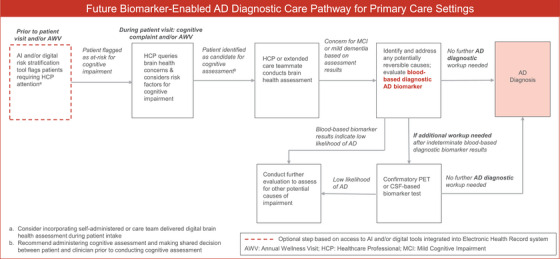
{"title":"Opportunities to encourage adoption of a biomarker-enabled care pathway for Alzheimer's in primary care.","authors":"Soo Borson, Rhoda Au, Anna H Chodos, Sam Gandy, Holly Jain, Amy Alagor, Kristi Cohn, Diana R Kerwin, Jacobo Mintzer, Stephanie Monroe, Delecia Robinson, Michelle M Mielke, Donna M Wilcock","doi":"10.1002/dad2.70095","DOIUrl":null,"url":null,"abstract":"<p><p>Identification of early-stage Alzheimer's disease (AD) remains a challenge due to limited specialist availability, diagnostic access, disease awareness, and cultural factors. Blood-based biomarkers (BBBM) could play a critical role in the identification and referral of patients suspected of AD to specialty care. A multidisciplinary AD Biomarker Task Force was convened to evaluate current biomarker use cases, define an optimal biomarker-enabled AD diagnostic care pathway, and understand factors impacting adoption. The Task Force identified opportunities to support biomarker-enabled AD diagnostic care pathway adoption, including streamlining risk assessment and screening by leveraging digital tools, activating primary care providers through education, generating data to expand applicability to diverse populations, and advocating for aligned policies and quality measures. Adoption of BBBMs in the primary care setting will be critical to improve early AD detection. However, challenges to pathway adoption persist and will require action from clinicians, payers, policy makers, and patients to address.</p><p><strong>Highlights: </strong>Blood-based biomarkers can streamline the identification of AD in primary care.Future biomarker-enabled diagnostic care pathways will leverage digital assessments.Education, data generation, and policy advocacy are vital to encourage BBBM use.Implementation of AD care pathways requires the activation of diverse stakeholders.</p>","PeriodicalId":53226,"journal":{"name":"Alzheimer''s and Dementia: Diagnosis, Assessment and Disease Monitoring","volume":"17 1","pages":"e70095"},"PeriodicalIF":4.4000,"publicationDate":"2025-03-11","publicationTypes":"Journal Article","fieldsOfStudy":null,"isOpenAccess":false,"openAccessPdf":"https://www.ncbi.nlm.nih.gov/pmc/articles/PMC11895972/pdf/","citationCount":"0","resultStr":null,"platform":"Semanticscholar","paperid":null,"PeriodicalName":"Alzheimer''s and Dementia: Diagnosis, Assessment and Disease Monitoring","FirstCategoryId":"1085","ListUrlMain":"https://doi.org/10.1002/dad2.70095","RegionNum":0,"RegionCategory":null,"ArticlePicture":[],"TitleCN":null,"AbstractTextCN":null,"PMCID":null,"EPubDate":"2025/1/1 0:00:00","PubModel":"eCollection","JCR":"Q1","JCRName":"CLINICAL NEUROLOGY","Score":null,"Total":0}
引用次数: 0
Abstract
Identification of early-stage Alzheimer's disease (AD) remains a challenge due to limited specialist availability, diagnostic access, disease awareness, and cultural factors. Blood-based biomarkers (BBBM) could play a critical role in the identification and referral of patients suspected of AD to specialty care. A multidisciplinary AD Biomarker Task Force was convened to evaluate current biomarker use cases, define an optimal biomarker-enabled AD diagnostic care pathway, and understand factors impacting adoption. The Task Force identified opportunities to support biomarker-enabled AD diagnostic care pathway adoption, including streamlining risk assessment and screening by leveraging digital tools, activating primary care providers through education, generating data to expand applicability to diverse populations, and advocating for aligned policies and quality measures. Adoption of BBBMs in the primary care setting will be critical to improve early AD detection. However, challenges to pathway adoption persist and will require action from clinicians, payers, policy makers, and patients to address.
Highlights: Blood-based biomarkers can streamline the identification of AD in primary care.Future biomarker-enabled diagnostic care pathways will leverage digital assessments.Education, data generation, and policy advocacy are vital to encourage BBBM use.Implementation of AD care pathways requires the activation of diverse stakeholders.
期刊介绍:
Alzheimer''s & Dementia: Diagnosis, Assessment & Disease Monitoring (DADM) is an open access, peer-reviewed, journal from the Alzheimer''s Association® that will publish new research that reports the discovery, development and validation of instruments, technologies, algorithms, and innovative processes. Papers will cover a range of topics interested in the early and accurate detection of individuals with memory complaints and/or among asymptomatic individuals at elevated risk for various forms of memory disorders. The expectation for published papers will be to translate fundamental knowledge about the neurobiology of the disease into practical reports that describe both the conceptual and methodological aspects of the submitted scientific inquiry. Published topics will explore the development of biomarkers, surrogate markers, and conceptual/methodological challenges. Publication priority will be given to papers that 1) describe putative surrogate markers that accurately track disease progression, 2) biomarkers that fulfill international regulatory requirements, 3) reports from large, well-characterized population-based cohorts that comprise the heterogeneity and diversity of asymptomatic individuals and 4) algorithmic development that considers multi-marker arrays (e.g., integrated-omics, genetics, biofluids, imaging, etc.) and advanced computational analytics and technologies.



 京公网安备 11010802042870号
京ICP备2023020795号-1
京公网安备 11010802042870号
京ICP备2023020795号-1

 分享
分享
 求助内容:
求助内容: 应助结果提醒方式:
 扫码关注我们
