Marius Huguet, Canan Pehlivan, François Ballereau, Antoine Dodane-Loyenet, Franck Fontanili, Thierry Garaix, Youri Yordanov, Vincent Augusto, Karim Tazarourte, Abdesslam Redjaline
{"title":"Indoor positioning systems provide insight into emergency department systems enabling proposal of designs to improve workflow.","authors":"Marius Huguet, Canan Pehlivan, François Ballereau, Antoine Dodane-Loyenet, Franck Fontanili, Thierry Garaix, Youri Yordanov, Vincent Augusto, Karim Tazarourte, Abdesslam Redjaline","doi":"10.1038/s43856-025-00793-y","DOIUrl":null,"url":null,"abstract":"<p><strong>Background: </strong>In this study, we implemented an indoor positioning system to track the activities of healthcare professionals during their shifts in an emergency department, aiming to gain a better understanding of the emergency care production process.</p><p><strong>Methods: </strong>An ultrawideband-based tracking system was used in an experiment at the emergency department of Le Corbusier Hospital in Firminy, France. Over a 46-day period, healthcare professionals, including assistant nurses, nurses, doctors, and managers, wore a sensor to record their location within the emergency department. We analyzed a substantial amount of quasi-real-time data to objectively assess physicians' time allocation and movement patterns and their correlation with the emergency department's occupancy. Additionally, we developed a user recognition algorithm (i.e., random forest classifier) capable of detecting the job category of the participant wearing the sensor.</p><p><strong>Results: </strong>The proportion of time spent on care-related activities ranges from 26% to 39% for doctors. In contrast, this share reaches approximately half of the time for triage nurses and intensive care unit nurses. The burden of non-care-related activities appears to be largely induced by the time spent on administrative duties and transit. For doctors, the share of non-care-related activities is found to be correlated with the occupancy level. The hourly distance walked by nurses (except triage nurses) is found to increase with occupancy, while for doctors, the walking distance remains invariant to patient load. The random forest classifier predicts job categories with 96% accuracy.</p><p><strong>Conclusions: </strong>Indoor tracking systems offer additional perspectives for enhancing the understanding of emergency department systems. The technology tested in this study demonstrates its potential to quantify physicians' time allocation and movements.</p>","PeriodicalId":72646,"journal":{"name":"Communications medicine","volume":"5 1","pages":"72"},"PeriodicalIF":5.4000,"publicationDate":"2025-03-11","publicationTypes":"Journal Article","fieldsOfStudy":null,"isOpenAccess":false,"openAccessPdf":"https://www.ncbi.nlm.nih.gov/pmc/articles/PMC11897186/pdf/","citationCount":"0","resultStr":null,"platform":"Semanticscholar","paperid":null,"PeriodicalName":"Communications medicine","FirstCategoryId":"1085","ListUrlMain":"https://doi.org/10.1038/s43856-025-00793-y","RegionNum":0,"RegionCategory":null,"ArticlePicture":[],"TitleCN":null,"AbstractTextCN":null,"PMCID":null,"EPubDate":"","PubModel":"","JCR":"Q1","JCRName":"MEDICINE, RESEARCH & EXPERIMENTAL","Score":null,"Total":0}
引用次数: 0
Abstract
Background: In this study, we implemented an indoor positioning system to track the activities of healthcare professionals during their shifts in an emergency department, aiming to gain a better understanding of the emergency care production process.
Methods: An ultrawideband-based tracking system was used in an experiment at the emergency department of Le Corbusier Hospital in Firminy, France. Over a 46-day period, healthcare professionals, including assistant nurses, nurses, doctors, and managers, wore a sensor to record their location within the emergency department. We analyzed a substantial amount of quasi-real-time data to objectively assess physicians' time allocation and movement patterns and their correlation with the emergency department's occupancy. Additionally, we developed a user recognition algorithm (i.e., random forest classifier) capable of detecting the job category of the participant wearing the sensor.
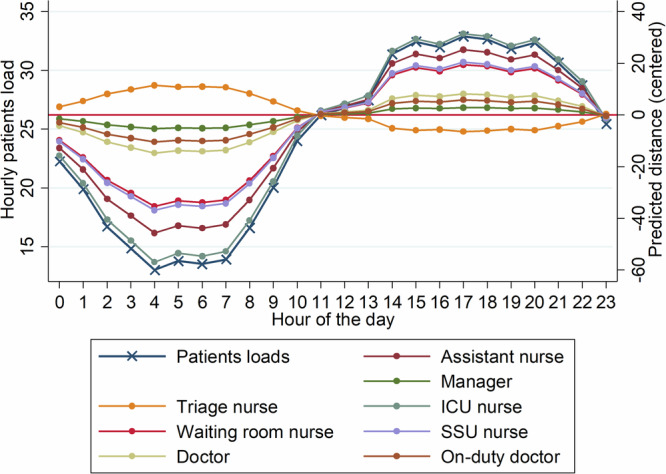
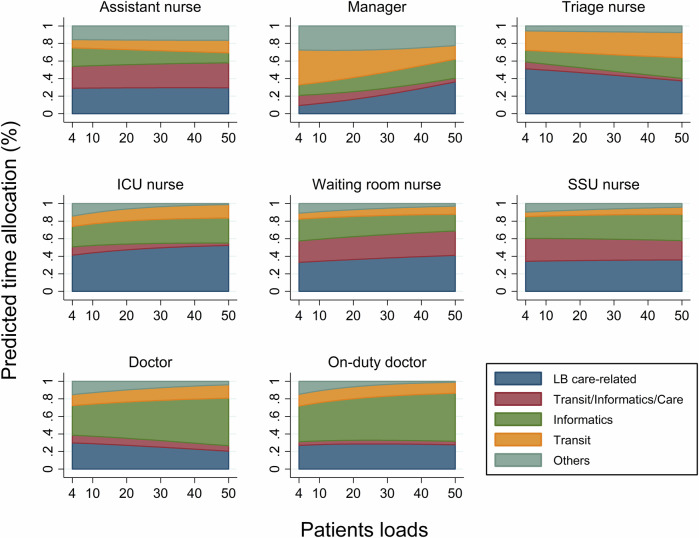
Results: The proportion of time spent on care-related activities ranges from 26% to 39% for doctors. In contrast, this share reaches approximately half of the time for triage nurses and intensive care unit nurses. The burden of non-care-related activities appears to be largely induced by the time spent on administrative duties and transit. For doctors, the share of non-care-related activities is found to be correlated with the occupancy level. The hourly distance walked by nurses (except triage nurses) is found to increase with occupancy, while for doctors, the walking distance remains invariant to patient load. The random forest classifier predicts job categories with 96% accuracy.
Conclusions: Indoor tracking systems offer additional perspectives for enhancing the understanding of emergency department systems. The technology tested in this study demonstrates its potential to quantify physicians' time allocation and movements.




 京公网安备 11010802042870号
京ICP备2023020795号-1
京公网安备 11010802042870号
京ICP备2023020795号-1

 分享
分享

 求助内容:
求助内容: 应助结果提醒方式:
 扫码关注我们
