Samuel J K Barnes, Megan Thomas, Peter V E McClintock, Aneta Stefanovska
{"title":"Theta and alpha connectivity in children with autism spectrum disorder.","authors":"Samuel J K Barnes, Megan Thomas, Peter V E McClintock, Aneta Stefanovska","doi":"10.1093/braincomms/fcaf084","DOIUrl":null,"url":null,"abstract":"<p><p>Spontaneous electroencephalography (EEG) measurements have demonstrated putative variations in the neural connectivity of subjects with autism spectrum disorder, as compared to neurotypical individuals. However, the exact nature of these connectivity differences has remained unknown, a question that we now address. Resting-state, eyes-open EEG data were recorded over 20 min from a cohort of 13 males aged 3-5 years with autism spectrum disorder, and nine neurotypical individuals as a control group. We use time-localized, phase-based methods of data analysis, including wavelet phase coherence and dynamical Bayesian inference. Several 3 min signal segments were analysed to evaluate the reproducibility of the proposed measures. In the autism spectrum disorder cohort, we demonstrate a significant (<i>P <</i> 0.05) reduction in functional connectivity strength across all frontal probe pairs. In addition, the percentage of time during which frontal regions were coupled was significantly reduced in the autism spectrum disorder group compared to the control group. These changes remained consistent across repeated measurements. To further validate the findings, an additional resting-state EEG dataset (eyes open and closed) from 67 individuals with autism spectrum disorder and 66 control group individuals (male, 5-15 years) was assessed. The functional connectivity results demonstrated a reduction in theta and alpha connectivity on a local, but not global, level. No association was found with age. The connectivity differences observed suggest the potential of theta and alpha connectivity as biomarkers for autism spectrum disorder. Additionally, the robustness to amplitude perturbations of the methods proposed here makes them particularly suitable for the clinical assessment of autism spectrum disorder and of the efficacy of therapeutic interventions.</p>","PeriodicalId":93915,"journal":{"name":"Brain communications","volume":"7 2","pages":"fcaf084"},"PeriodicalIF":4.5000,"publicationDate":"2025-02-19","publicationTypes":"Journal Article","fieldsOfStudy":null,"isOpenAccess":false,"openAccessPdf":"https://www.ncbi.nlm.nih.gov/pmc/articles/PMC11894932/pdf/","citationCount":"0","resultStr":null,"platform":"Semanticscholar","paperid":null,"PeriodicalName":"Brain communications","FirstCategoryId":"1085","ListUrlMain":"https://doi.org/10.1093/braincomms/fcaf084","RegionNum":0,"RegionCategory":null,"ArticlePicture":[],"TitleCN":null,"AbstractTextCN":null,"PMCID":null,"EPubDate":"2025/1/1 0:00:00","PubModel":"eCollection","JCR":"Q1","JCRName":"CLINICAL NEUROLOGY","Score":null,"Total":0}
引用次数: 0
Abstract
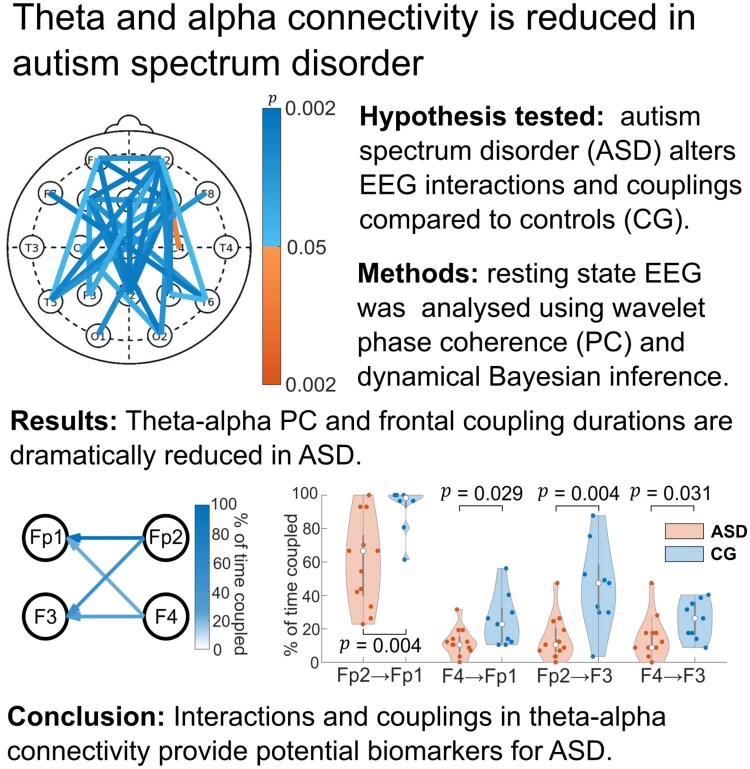
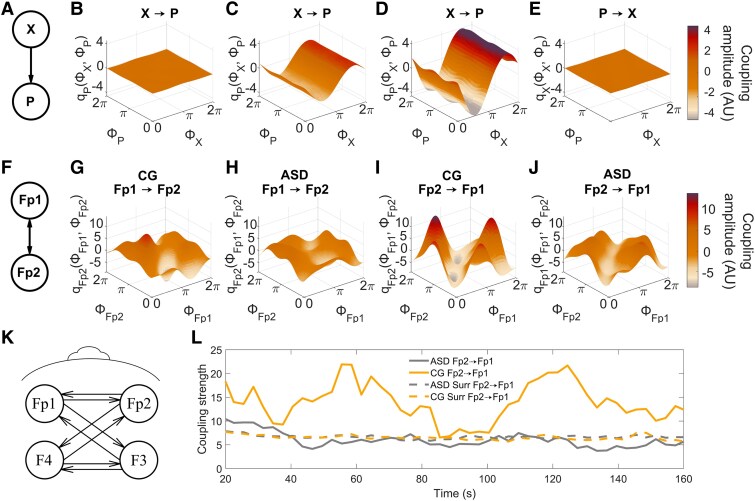
Spontaneous electroencephalography (EEG) measurements have demonstrated putative variations in the neural connectivity of subjects with autism spectrum disorder, as compared to neurotypical individuals. However, the exact nature of these connectivity differences has remained unknown, a question that we now address. Resting-state, eyes-open EEG data were recorded over 20 min from a cohort of 13 males aged 3-5 years with autism spectrum disorder, and nine neurotypical individuals as a control group. We use time-localized, phase-based methods of data analysis, including wavelet phase coherence and dynamical Bayesian inference. Several 3 min signal segments were analysed to evaluate the reproducibility of the proposed measures. In the autism spectrum disorder cohort, we demonstrate a significant (P < 0.05) reduction in functional connectivity strength across all frontal probe pairs. In addition, the percentage of time during which frontal regions were coupled was significantly reduced in the autism spectrum disorder group compared to the control group. These changes remained consistent across repeated measurements. To further validate the findings, an additional resting-state EEG dataset (eyes open and closed) from 67 individuals with autism spectrum disorder and 66 control group individuals (male, 5-15 years) was assessed. The functional connectivity results demonstrated a reduction in theta and alpha connectivity on a local, but not global, level. No association was found with age. The connectivity differences observed suggest the potential of theta and alpha connectivity as biomarkers for autism spectrum disorder. Additionally, the robustness to amplitude perturbations of the methods proposed here makes them particularly suitable for the clinical assessment of autism spectrum disorder and of the efficacy of therapeutic interventions.




 京公网安备 11010802042870号
京ICP备2023020795号-1
京公网安备 11010802042870号
京ICP备2023020795号-1

 分享
分享

 求助内容:
求助内容: 应助结果提醒方式:
 扫码关注我们
