Jens Terhaar, Friedrich A. Burger, Linus Vogt, Thomas L. Frölicher, Thomas F. Stocker
{"title":"Record sea surface temperature jump in 2023–2024 unlikely but not unexpected","authors":"Jens Terhaar, Friedrich A. Burger, Linus Vogt, Thomas L. Frölicher, Thomas F. Stocker","doi":"10.1038/s41586-025-08674-z","DOIUrl":null,"url":null,"abstract":"Global ocean surface temperatures were at record levels for more than a year from April 2023 onwards, exceeding the previous record in 2015–2016 by 0.25 °C on average between April 2023 and March 20241. The nearly global extent and unprecedented intensity of this event prompted questions about how exceptional it was and whether climate models can represent such record-shattering jumps in surface ocean temperatures2. Here we construct observation-based synthetic time series to show that a jump in global sea surface temperatures that breaks the previous record by at least 0.25 °C is a 1-in-512-year event under the current long-term warming trend (1-in-205-year to 1-in-1,185-year event; 95% confidence interval). Without a global warming trend, such an event would have been practically impossible. Using 270 simulations from a wide range of fully coupled climate models, we show that these models successfully simulate such record-shattering jumps in global ocean surface temperatures, underpinning the models’ usefulness in understanding the characteristics, drivers and consequences of such events. These model simulations suggest that the record-shattering jump in surface ocean temperatures in 2023–2024 was an extreme event after which surface ocean temperatures are expected to revert to the expected long-term warming trend. Observations and climate models suggest that the global sea surface temperature jump in 2023–2024 was not unexpected and would have been nearly impossible without anthropogenic warming.","PeriodicalId":18787,"journal":{"name":"Nature","volume":"639 8056","pages":"942-946"},"PeriodicalIF":48.5000,"publicationDate":"2025-03-12","publicationTypes":"Journal Article","fieldsOfStudy":null,"isOpenAccess":false,"openAccessPdf":"https://www.nature.com/articles/s41586-025-08674-z.pdf","citationCount":"0","resultStr":null,"platform":"Semanticscholar","paperid":null,"PeriodicalName":"Nature","FirstCategoryId":"103","ListUrlMain":"https://www.nature.com/articles/s41586-025-08674-z","RegionNum":1,"RegionCategory":"综合性期刊","ArticlePicture":[],"TitleCN":null,"AbstractTextCN":null,"PMCID":null,"EPubDate":"","PubModel":"","JCR":"Q1","JCRName":"MULTIDISCIPLINARY SCIENCES","Score":null,"Total":0}
引用次数: 0
Abstract
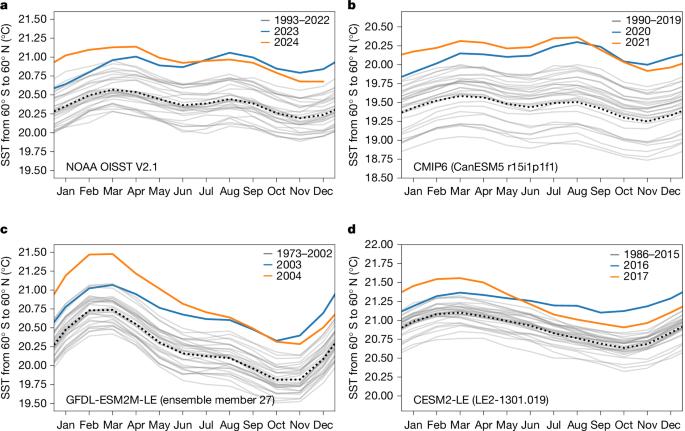
Global ocean surface temperatures were at record levels for more than a year from April 2023 onwards, exceeding the previous record in 2015–2016 by 0.25 °C on average between April 2023 and March 20241. The nearly global extent and unprecedented intensity of this event prompted questions about how exceptional it was and whether climate models can represent such record-shattering jumps in surface ocean temperatures2. Here we construct observation-based synthetic time series to show that a jump in global sea surface temperatures that breaks the previous record by at least 0.25 °C is a 1-in-512-year event under the current long-term warming trend (1-in-205-year to 1-in-1,185-year event; 95% confidence interval). Without a global warming trend, such an event would have been practically impossible. Using 270 simulations from a wide range of fully coupled climate models, we show that these models successfully simulate such record-shattering jumps in global ocean surface temperatures, underpinning the models’ usefulness in understanding the characteristics, drivers and consequences of such events. These model simulations suggest that the record-shattering jump in surface ocean temperatures in 2023–2024 was an extreme event after which surface ocean temperatures are expected to revert to the expected long-term warming trend. Observations and climate models suggest that the global sea surface temperature jump in 2023–2024 was not unexpected and would have been nearly impossible without anthropogenic warming.
期刊介绍:
Nature is a prestigious international journal that publishes peer-reviewed research in various scientific and technological fields. The selection of articles is based on criteria such as originality, importance, interdisciplinary relevance, timeliness, accessibility, elegance, and surprising conclusions. In addition to showcasing significant scientific advances, Nature delivers rapid, authoritative, insightful news, and interpretation of current and upcoming trends impacting science, scientists, and the broader public. The journal serves a dual purpose: firstly, to promptly share noteworthy scientific advances and foster discussions among scientists, and secondly, to ensure the swift dissemination of scientific results globally, emphasizing their significance for knowledge, culture, and daily life.





 京公网安备 11010802042870号
京ICP备2023020795号-1
京公网安备 11010802042870号
京ICP备2023020795号-1

 分享
分享
 求助内容:
求助内容: 应助结果提醒方式:
 扫码关注我们
