Ying Li, Wen-Tao Lyu, Guan-Ying Wang, Longke Li, Wen-Cheng Yan, En Wang
{"title":"Study of Ξc+→ΛK¯0π+ and search for the low-lying baryons Ξ(1/2−) and Σ(1/2−)","authors":"Ying Li, Wen-Tao Lyu, Guan-Ying Wang, Longke Li, Wen-Cheng Yan, En Wang","doi":"10.1103/physrevd.111.054011","DOIUrl":null,"url":null,"abstract":"Since searches for the low-lying excited baryons Ξ</a:mi>(</a:mo>1</a:mn>/</a:mo>2</a:mn>−</a:mo></a:msup>)</a:mo></a:math> and <f:math xmlns:f=\"http://www.w3.org/1998/Math/MathML\" display=\"inline\"><f:mi mathvariant=\"normal\">Σ</f:mi><f:mo stretchy=\"false\">(</f:mo><f:mn>1</f:mn><f:mo>/</f:mo><f:msup><f:mn>2</f:mn><f:mo>−</f:mo></f:msup><f:mo stretchy=\"false\">)</f:mo></f:math> are crucial to deepening our understanding of the light baryon spectrum, we have investigated the Cabibbo-favored process <k:math xmlns:k=\"http://www.w3.org/1998/Math/MathML\" display=\"inline\"><k:msubsup><k:mi mathvariant=\"normal\">Ξ</k:mi><k:mi>c</k:mi><k:mo>+</k:mo></k:msubsup><k:mo stretchy=\"false\">→</k:mo><k:mi mathvariant=\"normal\">Λ</k:mi><k:msup><k:mover accent=\"true\"><k:mi>K</k:mi><k:mo stretchy=\"false\">¯</k:mo></k:mover><k:mn>0</k:mn></k:msup><k:msup><k:mi>π</k:mi><k:mo>+</k:mo></k:msup></k:math> by taking into account the <r:math xmlns:r=\"http://www.w3.org/1998/Math/MathML\" display=\"inline\"><r:mi>S</r:mi></r:math>-wave pseudoscalar meson-octet baryon interactions within the chiral unitary approach, which could dynamically generate the resonances <t:math xmlns:t=\"http://www.w3.org/1998/Math/MathML\" display=\"inline\"><t:mi mathvariant=\"normal\">Ξ</t:mi><t:mo stretchy=\"false\">(</t:mo><t:mn>1</t:mn><t:mo>/</t:mo><t:msup><t:mn>2</t:mn><t:mo>−</t:mo></t:msup><t:mo stretchy=\"false\">)</t:mo></t:math> and <y:math xmlns:y=\"http://www.w3.org/1998/Math/MathML\" display=\"inline\"><y:mi mathvariant=\"normal\">Σ</y:mi><y:mo stretchy=\"false\">(</y:mo><y:mn>1</y:mn><y:mo>/</y:mo><y:msup><y:mn>2</y:mn><y:mo>−</y:mo></y:msup><y:mo stretchy=\"false\">)</y:mo></y:math>. The contributions from the excited kaons are double Cabibbo suppressed, and the contribution from the <db:math xmlns:db=\"http://www.w3.org/1998/Math/MathML\" display=\"inline\"><db:mi mathvariant=\"normal\">Σ</db:mi><db:mo stretchy=\"false\">(</db:mo><db:mn>1385</db:mn><db:mo stretchy=\"false\">)</db:mo></db:math> is also suppressed due to Korner-Pati-Woo theory; thus, those states are expected to play negligible contributions in this process. We have predicted the <ib:math xmlns:ib=\"http://www.w3.org/1998/Math/MathML\" display=\"inline\"><ib:msup><ib:mover accent=\"true\"><ib:mi>K</ib:mi><ib:mo stretchy=\"false\">¯</ib:mo></ib:mover><ib:mn>0</ib:mn></ib:msup><ib:mi mathvariant=\"normal\">Λ</ib:mi></ib:math> and <nb:math xmlns:nb=\"http://www.w3.org/1998/Math/MathML\" display=\"inline\"><nb:msup><nb:mi>π</nb:mi><nb:mo>+</nb:mo></nb:msup><nb:mi mathvariant=\"normal\">Λ</nb:mi></nb:math> invariant mass distributions, which have the clear signals of the <qb:math xmlns:qb=\"http://www.w3.org/1998/Math/MathML\" display=\"inline\"><qb:mi mathvariant=\"normal\">Ξ</qb:mi><qb:mo stretchy=\"false\">(</qb:mo><qb:mn>1</qb:mn><qb:mo>/</qb:mo><qb:msup><qb:mn>2</qb:mn><qb:mo>−</qb:mo></qb:msup><qb:mo stretchy=\"false\">)</qb:mo></qb:math> and <vb:math xmlns:vb=\"http://www.w3.org/1998/Math/MathML\" display=\"inline\"><vb:mi mathvariant=\"normal\">Σ</vb:mi><vb:mo stretchy=\"false\">(</vb:mo><vb:mn>1</vb:mn><vb:mo>/</vb:mo><vb:msup><vb:mn>2</vb:mn><vb:mo>−</vb:mo></vb:msup><vb:mo stretchy=\"false\">)</vb:mo></vb:math>. Thus, the Ξ</ac:mi>c</ac:mi>+</ac:mo></ac:msubsup>→</ac:mo>Λ</ac:mi>K</ac:mi>¯</ac:mo></ac:mover>0</ac:mn></ac:msup>π</ac:mi>+</ac:mo></ac:msup></ac:math> is an ideal process to search for the low-lying baryons <hc:math xmlns:hc=\"http://www.w3.org/1998/Math/MathML\" display=\"inline\"><hc:mi mathvariant=\"normal\">Ξ</hc:mi><hc:mo stretchy=\"false\">(</hc:mo><hc:mn>1</hc:mn><hc:mo>/</hc:mo><hc:msup><hc:mn>2</hc:mn><hc:mo>−</hc:mo></hc:msup><hc:mo stretchy=\"false\">)</hc:mo></hc:math> and <mc:math xmlns:mc=\"http://www.w3.org/1998/Math/MathML\" display=\"inline\"><mc:mi mathvariant=\"normal\">Σ</mc:mi><mc:mo stretchy=\"false\">(</mc:mo><mc:mn>1</mc:mn><mc:mo>/</mc:mo><mc:msup><mc:mn>2</mc:mn><mc:mo>−</mc:mo></mc:msup><mc:mo stretchy=\"false\">)</mc:mo></mc:math>, and we make a call for a precise measurements of this process in experiments, such as Belle II, LHCb, and the proposed Super Tau-Charm Facility. <jats:supplementary-material> <jats:copyright-statement>Published by the American Physical Society</jats:copyright-statement> <jats:copyright-year>2025</jats:copyright-year> </jats:permissions> </jats:supplementary-material>","PeriodicalId":20167,"journal":{"name":"Physical Review D","volume":"59 1","pages":""},"PeriodicalIF":5.3000,"publicationDate":"2025-03-12","publicationTypes":"Journal Article","fieldsOfStudy":null,"isOpenAccess":false,"openAccessPdf":"","citationCount":"0","resultStr":null,"platform":"Semanticscholar","paperid":null,"PeriodicalName":"Physical Review D","FirstCategoryId":"101","ListUrlMain":"https://doi.org/10.1103/physrevd.111.054011","RegionNum":2,"RegionCategory":"物理与天体物理","ArticlePicture":[],"TitleCN":null,"AbstractTextCN":null,"PMCID":null,"EPubDate":"","PubModel":"","JCR":"Q1","JCRName":"Physics and Astronomy","Score":null,"Total":0}
引用次数: 0
Abstract
Since searches for the low-lying excited baryons Ξ(1/2−) and Σ(1/2−) are crucial to deepening our understanding of the light baryon spectrum, we have investigated the Cabibbo-favored process Ξc+→ΛK¯0π+ by taking into account the S-wave pseudoscalar meson-octet baryon interactions within the chiral unitary approach, which could dynamically generate the resonances Ξ(1/2−) and Σ(1/2−). The contributions from the excited kaons are double Cabibbo suppressed, and the contribution from the Σ(1385) is also suppressed due to Korner-Pati-Woo theory; thus, those states are expected to play negligible contributions in this process. We have predicted the K¯0Λ and π+Λ invariant mass distributions, which have the clear signals of the Ξ(1/2−) and Σ(1/2−). Thus, the Ξc+→ΛK¯0π+ is an ideal process to search for the low-lying baryons Ξ(1/2−) and Σ(1/2−), and we make a call for a precise measurements of this process in experiments, such as Belle II, LHCb, and the proposed Super Tau-Charm Facility. Published by the American Physical Society2025
期刊介绍:
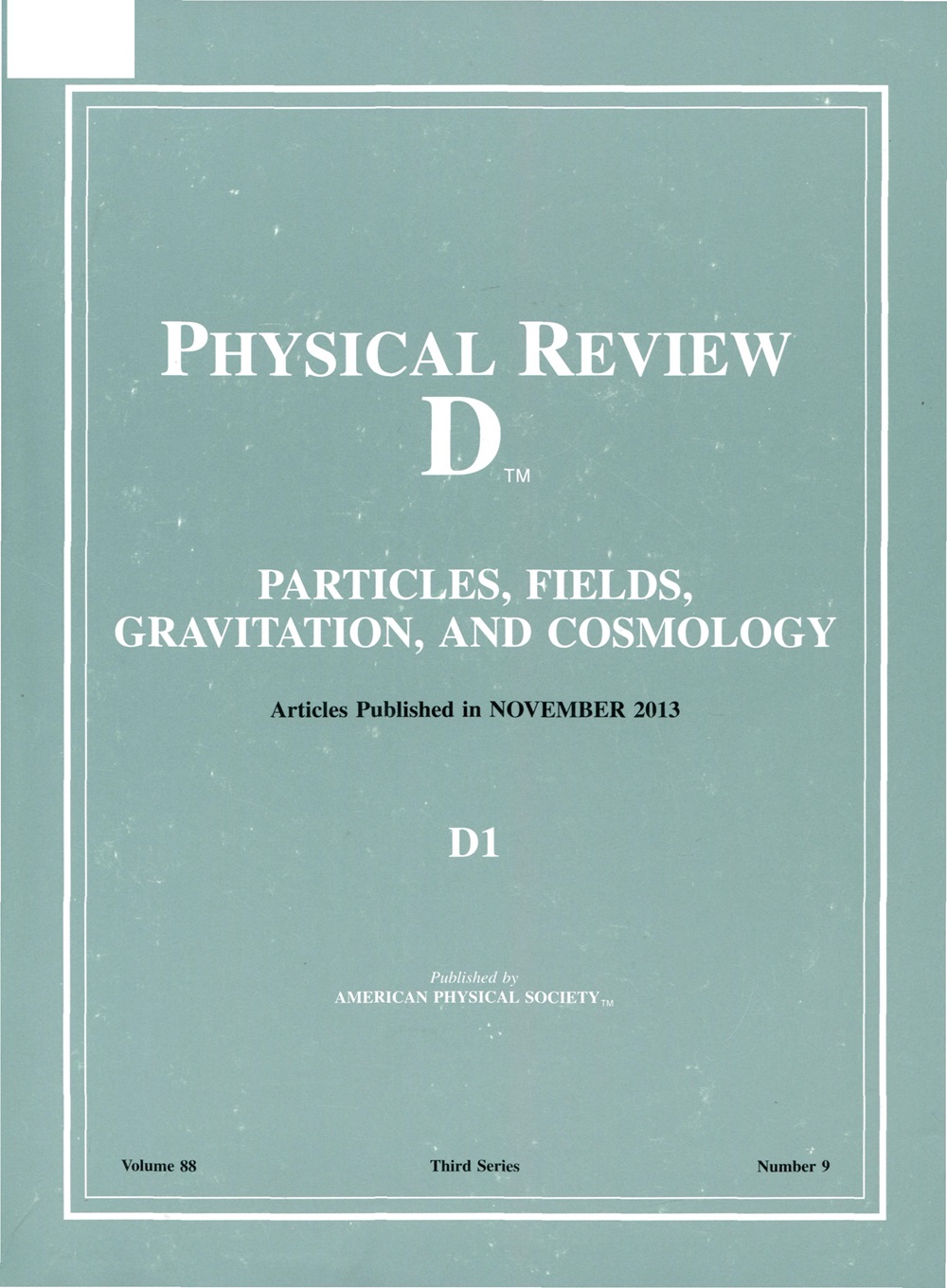
Physical Review D (PRD) is a leading journal in elementary particle physics, field theory, gravitation, and cosmology and is one of the top-cited journals in high-energy physics.
PRD covers experimental and theoretical results in all aspects of particle physics, field theory, gravitation and cosmology, including:
Particle physics experiments,
Electroweak interactions,
Strong interactions,
Lattice field theories, lattice QCD,
Beyond the standard model physics,
Phenomenological aspects of field theory, general methods,
Gravity, cosmology, cosmic rays,
Astrophysics and astroparticle physics,
General relativity,
Formal aspects of field theory, field theory in curved space,
String theory, quantum gravity, gauge/gravity duality.



 京公网安备 11010802042870号
京ICP备2023020795号-1
京公网安备 11010802042870号
京ICP备2023020795号-1

 分享
分享
 求助内容:
求助内容: 应助结果提醒方式:
 扫码关注我们
