{"title":"Enhancing transport and decay models for faecal indicator organisms in nearshore coastal waters","authors":"Man Yue Lam, Reza Ahmadian","doi":"10.1016/j.envpol.2025.126055","DOIUrl":null,"url":null,"abstract":"<div><div>Pathogens in nearshore coastal waters have far-reaching public health and economic implications. Faecal indicator organisms (FIOs) are commonly monitored and modelled to indicate pathogen levels in waterbodies. FIO decay modelling is an integral part of numerical hydro-epidemiological models to simulate the die-off of FIOs in the water bodies. This paper identifies the limitations of one of the comprehensive and widely used FIO decay models, developed by Stapleton et al. and enhances the model by remedying the limitations. The identified limitations are: (i) the decay rates for dark or highly irradiated environments are not accurately presented, and (ii) the effect of salinity is not included. Two enhanced models have been developed, namely (i) the ClipStap model, devised by imposing a minimum decay rate to the Stapleton model, and (ii) the RevStap model, devised by extrapolating the decay rate-irradiation slope at a reference irradiation (<span><math><mrow><mn>260</mn><mspace></mspace><mi>W</mi><mo>/</mo><msup><mi>m</mi><mn>2</mn></msup></mrow></math></span>) down to lower irradiation regions. The enhanced models reproduced the literature-reported dark decay rates better and significantly improved the agreement between the modelled and measured decay rate. The enhanced decay models were tested by including them in a hydro-epidemiological model for a data-rich case study, namely Swansea Bay, UK. Results show that the RevStap model improved FIO prediction in some cases. Besides the enhanced models, this research attributes the diurnal variations of FIO to the combined action of riverine FIO inflows, tide action, and FIO decay. These insights on the effect of irradiation and diurnal FIO variations are critical for assessing the impact of water quality on human activities and nearshore ecology.</div></div>","PeriodicalId":311,"journal":{"name":"Environmental Pollution","volume":"372 ","pages":"Article 126055"},"PeriodicalIF":7.3000,"publicationDate":"2025-03-13","publicationTypes":"Journal Article","fieldsOfStudy":null,"isOpenAccess":false,"openAccessPdf":"","citationCount":"0","resultStr":null,"platform":"Semanticscholar","paperid":null,"PeriodicalName":"Environmental Pollution","FirstCategoryId":"93","ListUrlMain":"https://www.sciencedirect.com/science/article/pii/S0269749125004282","RegionNum":2,"RegionCategory":"环境科学与生态学","ArticlePicture":[],"TitleCN":null,"AbstractTextCN":null,"PMCID":null,"EPubDate":"","PubModel":"","JCR":"Q1","JCRName":"ENVIRONMENTAL SCIENCES","Score":null,"Total":0}
引用次数: 0
Abstract
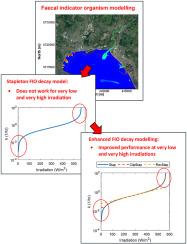
Pathogens in nearshore coastal waters have far-reaching public health and economic implications. Faecal indicator organisms (FIOs) are commonly monitored and modelled to indicate pathogen levels in waterbodies. FIO decay modelling is an integral part of numerical hydro-epidemiological models to simulate the die-off of FIOs in the water bodies. This paper identifies the limitations of one of the comprehensive and widely used FIO decay models, developed by Stapleton et al. and enhances the model by remedying the limitations. The identified limitations are: (i) the decay rates for dark or highly irradiated environments are not accurately presented, and (ii) the effect of salinity is not included. Two enhanced models have been developed, namely (i) the ClipStap model, devised by imposing a minimum decay rate to the Stapleton model, and (ii) the RevStap model, devised by extrapolating the decay rate-irradiation slope at a reference irradiation () down to lower irradiation regions. The enhanced models reproduced the literature-reported dark decay rates better and significantly improved the agreement between the modelled and measured decay rate. The enhanced decay models were tested by including them in a hydro-epidemiological model for a data-rich case study, namely Swansea Bay, UK. Results show that the RevStap model improved FIO prediction in some cases. Besides the enhanced models, this research attributes the diurnal variations of FIO to the combined action of riverine FIO inflows, tide action, and FIO decay. These insights on the effect of irradiation and diurnal FIO variations are critical for assessing the impact of water quality on human activities and nearshore ecology.
期刊介绍:
Environmental Pollution is an international peer-reviewed journal that publishes high-quality research papers and review articles covering all aspects of environmental pollution and its impacts on ecosystems and human health.
Subject areas include, but are not limited to:
• Sources and occurrences of pollutants that are clearly defined and measured in environmental compartments, food and food-related items, and human bodies;
• Interlinks between contaminant exposure and biological, ecological, and human health effects, including those of climate change;
• Contaminants of emerging concerns (including but not limited to antibiotic resistant microorganisms or genes, microplastics/nanoplastics, electronic wastes, light, and noise) and/or their biological, ecological, or human health effects;
• Laboratory and field studies on the remediation/mitigation of environmental pollution via new techniques and with clear links to biological, ecological, or human health effects;
• Modeling of pollution processes, patterns, or trends that is of clear environmental and/or human health interest;
• New techniques that measure and examine environmental occurrences, transport, behavior, and effects of pollutants within the environment or the laboratory, provided that they can be clearly used to address problems within regional or global environmental compartments.




 京公网安备 11010802042870号
京ICP备2023020795号-1
京公网安备 11010802042870号
京ICP备2023020795号-1

 分享
分享
 求助内容:
求助内容: 应助结果提醒方式:
 扫码关注我们
