Sustainable H2-rich bio-syngas production from high moisture wastes: Steam gasification of hydrochars obtained from apple pomace in single and binary solvent systems
Mariusz Wądrzyk, Przemysław Grzywacz, Marek Plata, Piotr Soprych, Rafał Janus, Marek Lewandowski, Łukasz Korzeniowski
{"title":"Sustainable H2-rich bio-syngas production from high moisture wastes: Steam gasification of hydrochars obtained from apple pomace in single and binary solvent systems","authors":"Mariusz Wądrzyk, Przemysław Grzywacz, Marek Plata, Piotr Soprych, Rafał Janus, Marek Lewandowski, Łukasz Korzeniowski","doi":"10.1016/j.renene.2025.122772","DOIUrl":null,"url":null,"abstract":"<div><div>Innovative solutions dedicated to valorization of high moisture content wastes into perspective groups of products like hydrocarbons or hydrogen are sought. Herein, we propose a two-stage processing route involving hydrothermal processing of apple pomace (AP) with the subsequent steam gasification. AP was converted into hydrochar using either a single solvent (water or ethanol) or a binary solvent (water mixed with ethanol). The effect of the medium type on the change in the yield and quality of the resultant hydrochar was studied, including comprehensive characterization. The subsequent step was to upgrade the resultant hydrochars through steam gasification at 900 °C. A noticeable influence of the application of a type of solvent medium on the conversion level of the pristine structure, as well as on the effectiveness of steam gasification, was noted. Syngas included hydrogen, methane, carbon dioxide, and carbon monoxide, with hydrogen being the dominant component (56–60 %). The high share of methane in bio-syngas translates into a relatively high energy potential of the residual gas after possible hydrogen separation. The aqueous system produced the most reactive and high-yielding hydrochar, while the ethanol system exhibited the lowest values due to differences in porous structure, elemental composition, and structure of surface functional groups.</div></div>","PeriodicalId":419,"journal":{"name":"Renewable Energy","volume":"245 ","pages":"Article 122772"},"PeriodicalIF":9.1000,"publicationDate":"2025-03-01","publicationTypes":"Journal Article","fieldsOfStudy":null,"isOpenAccess":false,"openAccessPdf":"","citationCount":"0","resultStr":null,"platform":"Semanticscholar","paperid":null,"PeriodicalName":"Renewable Energy","FirstCategoryId":"5","ListUrlMain":"https://www.sciencedirect.com/science/article/pii/S0960148125004343","RegionNum":1,"RegionCategory":"工程技术","ArticlePicture":[],"TitleCN":null,"AbstractTextCN":null,"PMCID":null,"EPubDate":"","PubModel":"","JCR":"Q1","JCRName":"ENERGY & FUELS","Score":null,"Total":0}
引用次数: 0
Abstract
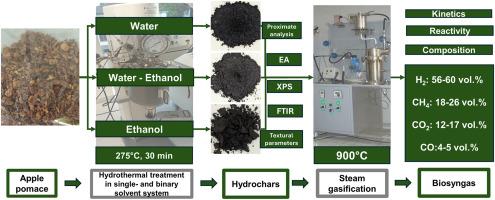
Innovative solutions dedicated to valorization of high moisture content wastes into perspective groups of products like hydrocarbons or hydrogen are sought. Herein, we propose a two-stage processing route involving hydrothermal processing of apple pomace (AP) with the subsequent steam gasification. AP was converted into hydrochar using either a single solvent (water or ethanol) or a binary solvent (water mixed with ethanol). The effect of the medium type on the change in the yield and quality of the resultant hydrochar was studied, including comprehensive characterization. The subsequent step was to upgrade the resultant hydrochars through steam gasification at 900 °C. A noticeable influence of the application of a type of solvent medium on the conversion level of the pristine structure, as well as on the effectiveness of steam gasification, was noted. Syngas included hydrogen, methane, carbon dioxide, and carbon monoxide, with hydrogen being the dominant component (56–60 %). The high share of methane in bio-syngas translates into a relatively high energy potential of the residual gas after possible hydrogen separation. The aqueous system produced the most reactive and high-yielding hydrochar, while the ethanol system exhibited the lowest values due to differences in porous structure, elemental composition, and structure of surface functional groups.
期刊介绍:
Renewable Energy journal is dedicated to advancing knowledge and disseminating insights on various topics and technologies within renewable energy systems and components. Our mission is to support researchers, engineers, economists, manufacturers, NGOs, associations, and societies in staying updated on new developments in their respective fields and applying alternative energy solutions to current practices.
As an international, multidisciplinary journal in renewable energy engineering and research, we strive to be a premier peer-reviewed platform and a trusted source of original research and reviews in the field of renewable energy. Join us in our endeavor to drive innovation and progress in sustainable energy solutions.



 京公网安备 11010802042870号
京ICP备2023020795号-1
京公网安备 11010802042870号
京ICP备2023020795号-1

 分享
分享
 求助内容:
求助内容: 应助结果提醒方式:
 扫码关注我们
