Mei-ci SUN , Shuo-lin QI , Yun-he ZHAO , Chun-xia CHEN , Li-chao TAN , Zhong-li HU , Xiao-liang WU , Wen-li ZHANG
{"title":"Advances in the use of biomass-derived carbons for sodium-ion batteries","authors":"Mei-ci SUN , Shuo-lin QI , Yun-he ZHAO , Chun-xia CHEN , Li-chao TAN , Zhong-li HU , Xiao-liang WU , Wen-li ZHANG","doi":"10.1016/S1872-5805(25)60953-X","DOIUrl":null,"url":null,"abstract":"<div><div>Sodium-ion batteries (SIBs) have emerged as a promising alternative to commercial lithium-ion batteries because of the similar properties of Li and Na as well as the abundance and accessibility of sodium resources. The development of anode materials with a high capacity, excellent rate performance, and long cycle life is the key to the industrialization of SIBs. Biomass-derived carbon (BDC) anode materials synthesized from resource-rich, low-cost, and renewable biomass have been extensively researched and their excellent sodium storage performance has been proven, making them the most promising new low-cost and high-performance anode material for SIBs. This review first introduces the sources of BDCs, including waste biomass such as plants, animals, and microorganisms, and then describes several methods for preparing BDC anode materials, including carbonization, chemical activation, and template methods. The storage mechanism and kinetic process of Na<sup>+</sup> in BDCs are then considered as well as their structure control. The electrochemical properties of sodium-ion storage in BDCs with different structures are examined, and suggestions for future research are made.</div><div><span><figure><span><img><ol><li><span><span>Download: <span>Download high-res image (181KB)</span></span></span></li><li><span><span>Download: <span>Download full-size image</span></span></span></li></ol></span></figure></span></div></div>","PeriodicalId":19719,"journal":{"name":"New Carbon Materials","volume":"40 1","pages":"Pages 1-49"},"PeriodicalIF":5.7000,"publicationDate":"2025-02-01","publicationTypes":"Journal Article","fieldsOfStudy":null,"isOpenAccess":false,"openAccessPdf":"","citationCount":"0","resultStr":null,"platform":"Semanticscholar","paperid":null,"PeriodicalName":"New Carbon Materials","FirstCategoryId":"88","ListUrlMain":"https://www.sciencedirect.com/science/article/pii/S187258052560953X","RegionNum":3,"RegionCategory":"材料科学","ArticlePicture":[],"TitleCN":null,"AbstractTextCN":null,"PMCID":null,"EPubDate":"2025/3/13 0:00:00","PubModel":"Epub","JCR":"Q2","JCRName":"Materials Science","Score":null,"Total":0}
引用次数: 0
Abstract
Sodium-ion batteries (SIBs) have emerged as a promising alternative to commercial lithium-ion batteries because of the similar properties of Li and Na as well as the abundance and accessibility of sodium resources. The development of anode materials with a high capacity, excellent rate performance, and long cycle life is the key to the industrialization of SIBs. Biomass-derived carbon (BDC) anode materials synthesized from resource-rich, low-cost, and renewable biomass have been extensively researched and their excellent sodium storage performance has been proven, making them the most promising new low-cost and high-performance anode material for SIBs. This review first introduces the sources of BDCs, including waste biomass such as plants, animals, and microorganisms, and then describes several methods for preparing BDC anode materials, including carbonization, chemical activation, and template methods. The storage mechanism and kinetic process of Na+ in BDCs are then considered as well as their structure control. The electrochemical properties of sodium-ion storage in BDCs with different structures are examined, and suggestions for future research are made.
期刊介绍:
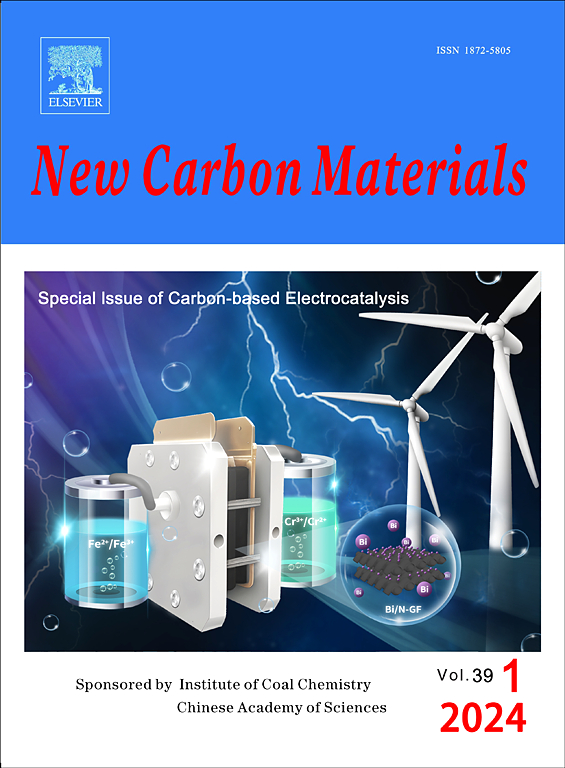
New Carbon Materials is a scholarly journal that publishes original research papers focusing on the physics, chemistry, and technology of organic substances that serve as precursors for creating carbonaceous solids with aromatic or tetrahedral bonding. The scope of materials covered by the journal extends from diamond and graphite to a variety of forms including chars, semicokes, mesophase substances, carbons, carbon fibers, carbynes, fullerenes, and carbon nanotubes. The journal's objective is to showcase the latest research findings and advancements in the areas of formation, structure, properties, behaviors, and technological applications of carbon materials. Additionally, the journal includes papers on the secondary production of new carbon and composite materials, such as carbon-carbon composites, derived from the aforementioned carbons. Research papers on organic substances will be considered for publication only if they have a direct relevance to the resulting carbon materials.



 京公网安备 11010802042870号
京ICP备2023020795号-1
京公网安备 11010802042870号
京ICP备2023020795号-1

 分享
分享
 求助内容:
求助内容: 应助结果提醒方式:
 扫码关注我们
