Explainable Prediction of Long-Term Glycated Hemoglobin Response Change in Finnish Patients with Type 2 Diabetes Following Drug Initiation Using Evidence-Based Machine Learning Approaches.
Gunjan Chandra, Piia Lavikainen, Pekka Siirtola, Satu Tamminen, Anusha Ihalapathirana, Tiina Laatikainen, Janne Martikainen, Juha Röning
{"title":"Explainable Prediction of Long-Term Glycated Hemoglobin Response Change in Finnish Patients with Type 2 Diabetes Following Drug Initiation Using Evidence-Based Machine Learning Approaches.","authors":"Gunjan Chandra, Piia Lavikainen, Pekka Siirtola, Satu Tamminen, Anusha Ihalapathirana, Tiina Laatikainen, Janne Martikainen, Juha Röning","doi":"10.2147/CLEP.S505966","DOIUrl":null,"url":null,"abstract":"<p><strong>Purpose: </strong>This study applied machine learning (ML) and explainable artificial intelligence (XAI) to predict changes in HbA1c levels, a critical biomarker for monitoring glycemic control, within 12 months of initiating a new antidiabetic drug in patients diagnosed with type 2 diabetes. It also aimed to identify the predictors associated with these changes.</p><p><strong>Patients and methods: </strong>Electronic health records (EHR) from 10,139 type 2 diabetes patients in North Karelia, Finland, were used to train models integrating randomized controlled trial (RCT)-derived HbA1c change values as predictors, creating offset models that integrate RCT insights with real-world data. Various ML models-including linear regression (LR), multi-layer perceptron (MLP), ridge regression (RR), random forest (RF), and XGBoost (XGB)-were evaluated using <i>R²</i> and RMSE metrics. Baseline models used data at or before drug initiation, while follow-up models included the first post-drug HbA1c measurement, improving performance by incorporating dynamic patient data. Model performance was also compared to expected HbA1c changes from clinical trials.</p><p><strong>Results: </strong>Results showed that ML models outperform RCT model, while LR, MLP, and RR models had comparable performance, RF and XGB models exhibited overfitting. The follow-up MLP model outperformed the baseline MLP model, with higher <i>R²</i> scores (0.74, 0.65) and lower RMSE values (6.94, 7.62), compared to the baseline model (R²: 0.52, 0.54; RMSE: 9.27, 9.50). Key predictors of HbA1c change included baseline and post-drug initiation HbA1c values, fasting plasma glucose, and HDL cholesterol.</p><p><strong>Conclusion: </strong>Using EHR and ML models allows for the development of more realistic and individualized predictions of HbA1c changes, accounting for more diverse patient populations and their heterogeneous nature, offering more tailored and effective treatment strategies for managing T2D. The use of XAI provided insights into the influence of specific predictors, enhancing model interpretability and clinical relevance. Future research will explore treatment selection models.</p>","PeriodicalId":10362,"journal":{"name":"Clinical Epidemiology","volume":"17 ","pages":"225-240"},"PeriodicalIF":3.2000,"publicationDate":"2025-03-08","publicationTypes":"Journal Article","fieldsOfStudy":null,"isOpenAccess":false,"openAccessPdf":"https://www.ncbi.nlm.nih.gov/pmc/articles/PMC11899941/pdf/","citationCount":"0","resultStr":null,"platform":"Semanticscholar","paperid":null,"PeriodicalName":"Clinical Epidemiology","FirstCategoryId":"3","ListUrlMain":"https://doi.org/10.2147/CLEP.S505966","RegionNum":2,"RegionCategory":"医学","ArticlePicture":[],"TitleCN":null,"AbstractTextCN":null,"PMCID":null,"EPubDate":"2025/1/1 0:00:00","PubModel":"eCollection","JCR":"Q1","JCRName":"PUBLIC, ENVIRONMENTAL & OCCUPATIONAL HEALTH","Score":null,"Total":0}
引用次数: 0
Abstract
Purpose: This study applied machine learning (ML) and explainable artificial intelligence (XAI) to predict changes in HbA1c levels, a critical biomarker for monitoring glycemic control, within 12 months of initiating a new antidiabetic drug in patients diagnosed with type 2 diabetes. It also aimed to identify the predictors associated with these changes.
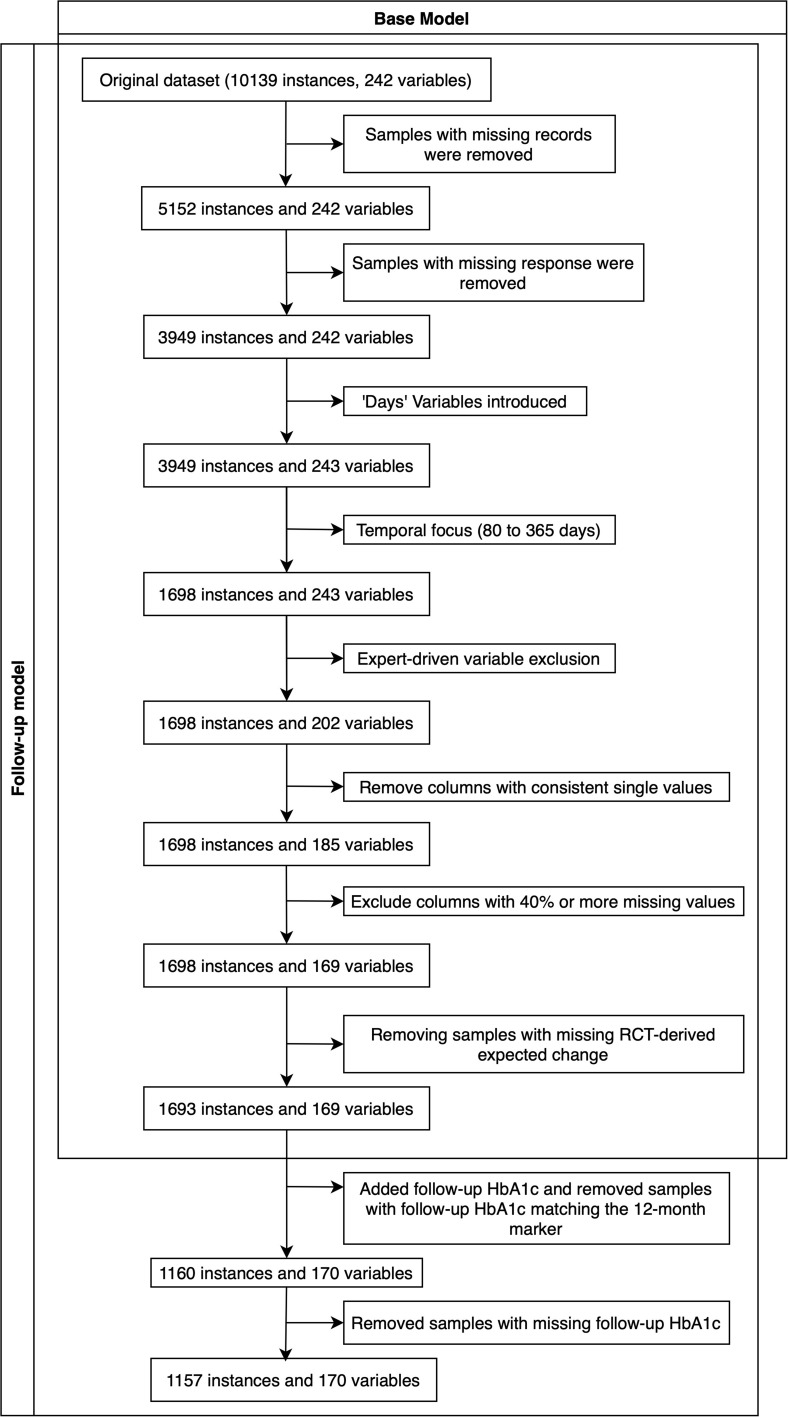
Patients and methods: Electronic health records (EHR) from 10,139 type 2 diabetes patients in North Karelia, Finland, were used to train models integrating randomized controlled trial (RCT)-derived HbA1c change values as predictors, creating offset models that integrate RCT insights with real-world data. Various ML models-including linear regression (LR), multi-layer perceptron (MLP), ridge regression (RR), random forest (RF), and XGBoost (XGB)-were evaluated using R² and RMSE metrics. Baseline models used data at or before drug initiation, while follow-up models included the first post-drug HbA1c measurement, improving performance by incorporating dynamic patient data. Model performance was also compared to expected HbA1c changes from clinical trials.
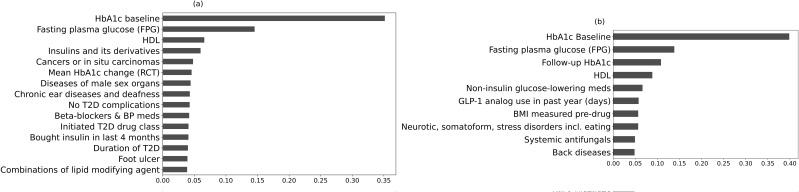
Results: Results showed that ML models outperform RCT model, while LR, MLP, and RR models had comparable performance, RF and XGB models exhibited overfitting. The follow-up MLP model outperformed the baseline MLP model, with higher R² scores (0.74, 0.65) and lower RMSE values (6.94, 7.62), compared to the baseline model (R²: 0.52, 0.54; RMSE: 9.27, 9.50). Key predictors of HbA1c change included baseline and post-drug initiation HbA1c values, fasting plasma glucose, and HDL cholesterol.
Conclusion: Using EHR and ML models allows for the development of more realistic and individualized predictions of HbA1c changes, accounting for more diverse patient populations and their heterogeneous nature, offering more tailored and effective treatment strategies for managing T2D. The use of XAI provided insights into the influence of specific predictors, enhancing model interpretability and clinical relevance. Future research will explore treatment selection models.
期刊介绍:
Clinical Epidemiology is an international, peer reviewed, open access journal. Clinical Epidemiology focuses on the application of epidemiological principles and questions relating to patients and clinical care in terms of prevention, diagnosis, prognosis, and treatment.
Clinical Epidemiology welcomes papers covering these topics in form of original research and systematic reviews.
Clinical Epidemiology has a special interest in international electronic medical patient records and other routine health care data, especially as applied to safety of medical interventions, clinical utility of diagnostic procedures, understanding short- and long-term clinical course of diseases, clinical epidemiological and biostatistical methods, and systematic reviews.
When considering submission of a paper utilizing publicly-available data, authors should ensure that such studies add significantly to the body of knowledge and that they use appropriate validated methods for identifying health outcomes.
The journal has launched special series describing existing data sources for clinical epidemiology, international health care systems and validation studies of algorithms based on databases and registries.




 京公网安备 11010802042870号
京ICP备2023020795号-1
京公网安备 11010802042870号
京ICP备2023020795号-1

 分享
分享
 求助内容:
求助内容: 应助结果提醒方式:
 扫码关注我们
