Haijun He, Xi Xiong, Yi Zheng, Jialong Hou, Tao Jiang, Weiwei Quan, Jiani Huang, Jiaxue Xu, Keke Chen, Jingjing Qian, Jinlai Cai, Yao Lu, Mengjia Lian, Chenglong Xie, Ji Luo
{"title":"Parkin characteristics and blood biomarkers of Parkinson's disease in WPBLC study.","authors":"Haijun He, Xi Xiong, Yi Zheng, Jialong Hou, Tao Jiang, Weiwei Quan, Jiani Huang, Jiaxue Xu, Keke Chen, Jingjing Qian, Jinlai Cai, Yao Lu, Mengjia Lian, Chenglong Xie, Ji Luo","doi":"10.3389/fnagi.2025.1511272","DOIUrl":null,"url":null,"abstract":"<p><strong>Background: </strong>The exact mechanisms of PD are unclear, but Parkin-mediated mitophagy dysfunction is believed to play a key role. We investigated whether blood levels of Parkin and other biomarkers are linked to the risk of developing PD.</p><p><strong>Methods: </strong>Baseline blood measures of Parkin and other biomarkers, including Homocysteine, carcinoembryonic antigen, Urea, total proteins, total cholesterol, creatine kinase, and albumin, were collected from 197 clinically diagnosed Parkinson's disease participants and 107 age-matched healthy controls in Wenzhou Parkinson's Biomarkers and Living Characteristics study. We conducted bioinformatics analysis using three datasets from the GEO database: GSE90514 (Cohort 1: PD = 4, HC = 4), GSE7621 (Cohort 2: PD = 16, HC = 9), and GSE205450 (Cohort 3: PD = 69, HC = 81).</p><p><strong>Results: </strong>Using a bioinformatic approach, we identified dysregulated biological processes in PD patients with PRKN mutations. Compared to controls, significant abnormalities were observed in blood levels of Parkin, Hcy, total proteins, urea, albumin, and CEA in PD patients. A model incorporating Parkin, Hcy, total proteins, and urea effectively distinguished PD from healthy controls, achieving a higher accuracy (AUC 0.841) than other biomarker combinations. Gene set enrichment analysis suggested that pathways such as PINK1-Parkin-mediated mitophagy, urea cycle, cysteine degradation, and riboflavin metabolism may be involved in PRKN mutation. Additionally, the link between Parkin and PD was partially mediated by CEA and albumin, not by Hcy, total proteins, or urea.</p><p><strong>Conclusion: </strong>Our findings indicate that blood Parkin levels may be a minimally invasive biomarker for PD diagnosis. The model, which included Parkin, Hcy, total proteins, and urea, effectively distinguished PD from HC with greater accuracy.</p>","PeriodicalId":12450,"journal":{"name":"Frontiers in Aging Neuroscience","volume":"17 ","pages":"1511272"},"PeriodicalIF":4.5000,"publicationDate":"2025-02-26","publicationTypes":"Journal Article","fieldsOfStudy":null,"isOpenAccess":false,"openAccessPdf":"https://www.ncbi.nlm.nih.gov/pmc/articles/PMC11897490/pdf/","citationCount":"0","resultStr":null,"platform":"Semanticscholar","paperid":null,"PeriodicalName":"Frontiers in Aging Neuroscience","FirstCategoryId":"3","ListUrlMain":"https://doi.org/10.3389/fnagi.2025.1511272","RegionNum":2,"RegionCategory":"医学","ArticlePicture":[],"TitleCN":null,"AbstractTextCN":null,"PMCID":null,"EPubDate":"2025/1/1 0:00:00","PubModel":"eCollection","JCR":"Q2","JCRName":"GERIATRICS & GERONTOLOGY","Score":null,"Total":0}
引用次数: 0
Abstract
Background: The exact mechanisms of PD are unclear, but Parkin-mediated mitophagy dysfunction is believed to play a key role. We investigated whether blood levels of Parkin and other biomarkers are linked to the risk of developing PD.
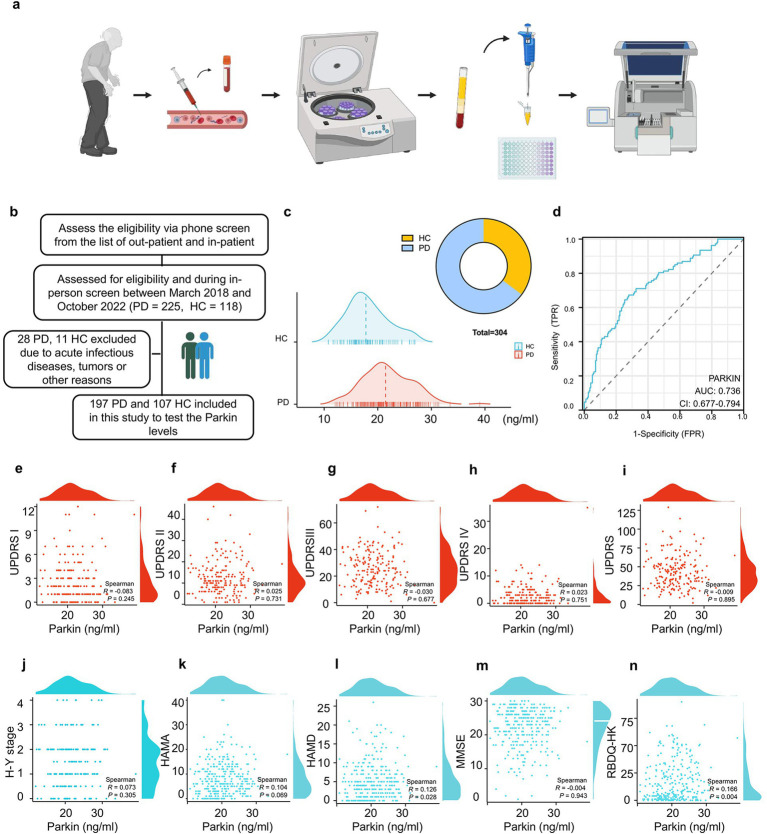
Methods: Baseline blood measures of Parkin and other biomarkers, including Homocysteine, carcinoembryonic antigen, Urea, total proteins, total cholesterol, creatine kinase, and albumin, were collected from 197 clinically diagnosed Parkinson's disease participants and 107 age-matched healthy controls in Wenzhou Parkinson's Biomarkers and Living Characteristics study. We conducted bioinformatics analysis using three datasets from the GEO database: GSE90514 (Cohort 1: PD = 4, HC = 4), GSE7621 (Cohort 2: PD = 16, HC = 9), and GSE205450 (Cohort 3: PD = 69, HC = 81).
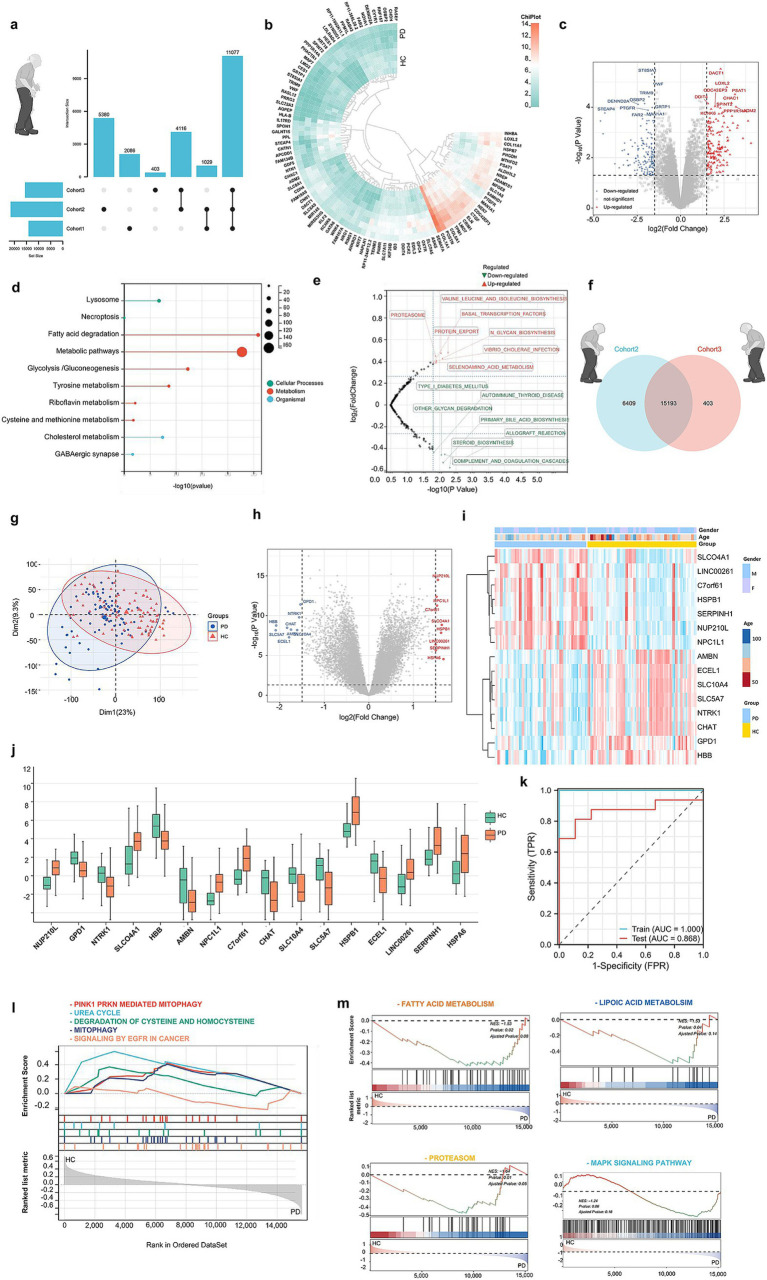
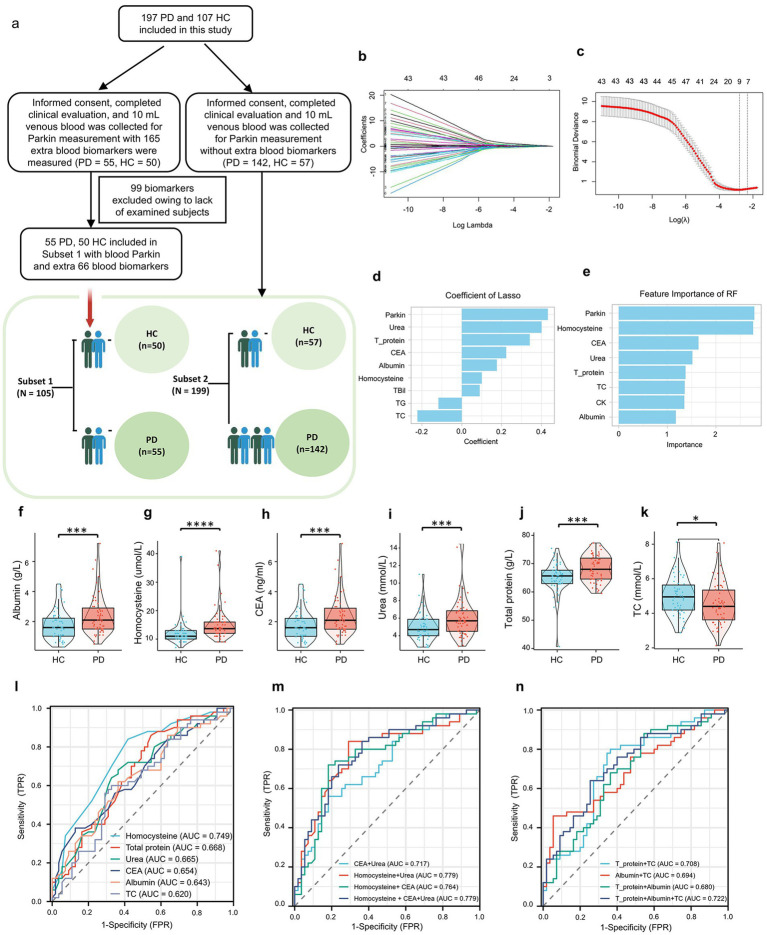
Results: Using a bioinformatic approach, we identified dysregulated biological processes in PD patients with PRKN mutations. Compared to controls, significant abnormalities were observed in blood levels of Parkin, Hcy, total proteins, urea, albumin, and CEA in PD patients. A model incorporating Parkin, Hcy, total proteins, and urea effectively distinguished PD from healthy controls, achieving a higher accuracy (AUC 0.841) than other biomarker combinations. Gene set enrichment analysis suggested that pathways such as PINK1-Parkin-mediated mitophagy, urea cycle, cysteine degradation, and riboflavin metabolism may be involved in PRKN mutation. Additionally, the link between Parkin and PD was partially mediated by CEA and albumin, not by Hcy, total proteins, or urea.
Conclusion: Our findings indicate that blood Parkin levels may be a minimally invasive biomarker for PD diagnosis. The model, which included Parkin, Hcy, total proteins, and urea, effectively distinguished PD from HC with greater accuracy.
期刊介绍:
Frontiers in Aging Neuroscience is a leading journal in its field, publishing rigorously peer-reviewed research that advances our understanding of the mechanisms of Central Nervous System aging and age-related neural diseases. Specialty Chief Editor Thomas Wisniewski at the New York University School of Medicine is supported by an outstanding Editorial Board of international researchers. This multidisciplinary open-access journal is at the forefront of disseminating and communicating scientific knowledge and impactful discoveries to researchers, academics, clinicians and the public worldwide.



 京公网安备 11010802042870号
京ICP备2023020795号-1
京公网安备 11010802042870号
京ICP备2023020795号-1

 分享
分享
 求助内容:
求助内容: 应助结果提醒方式:
 扫码关注我们
