Lauren E Lewis, Devin J Mills, Brandon G Bergman, Thomas G Kimball, William Gerber
{"title":"Examining the dualistic model of passion in addiction recovery.","authors":"Lauren E Lewis, Devin J Mills, Brandon G Bergman, Thomas G Kimball, William Gerber","doi":"10.3389/fpubh.2025.1519430","DOIUrl":null,"url":null,"abstract":"<p><strong>Introduction: </strong>Addiction recovery can be conceptualized as multidimensional changes to health and wellness including changes in substance use, physical and mental health, and social relationships. These outcomes are often measured through recovery capital which recognizes the various resources, both internal and external, that one may use to enhance their recovery. Internal and external resources can also be accumulated by engaging in an activity an individual is passionate about, explained by the dualistic model of passion (DMP) as enhancing mental and spiritual well-being, health, and personal growth, thereby fostering positive emotions, community involvement, deeper relationships, and heightened performance across various life domains. Evidence indicates that both RC and the DMP contribute to improved health outcomes including life satisfaction and well-being; however, the DMP has not yet been applied to addiction recovery science. The current study aimed to contribute to the growing body of research on addiction recovery by exploring the way passion may influence recovery outcomes. Further, the study investigated how the differences in passion type [e.g., harmonious (HP) and obsessive (OP)] impacted RC.</p><p><strong>Methods: </strong>Participants for the study (<i>N</i> = 346; <i>M</i> <sub>age</sub> = 42.1; 53.2% Male) included individuals who self-reported being in recovery from alcohol and/or drugs and completed an online survey through Amazon's Mechanical Turk platform.</p><p><strong>Results: </strong>A significant bivariate correlation was found between HP and RC (<i>r</i> = 0.42, <i>p</i> < 0.001), and mean comparisons showed significant differences for individuals endorsing HP as they scored higher on a measure of RC (<i>M</i> = 4.69) than did their peers endorsing OP (<i>M</i> = 4.26). Finally, a regression analysis found that HP predicted RC (<i>B</i> = 0.19, <i>p</i> < 0.001), even when time in recovery and mental health variables such as depression and anxiety were included in the model.</p><p><strong>Discussion: </strong>This study offers novel evidence for an association between the DMP and recovery outcomes warranting future research.</p>","PeriodicalId":12548,"journal":{"name":"Frontiers in Public Health","volume":"13 ","pages":"1519430"},"PeriodicalIF":3.4000,"publicationDate":"2025-02-26","publicationTypes":"Journal Article","fieldsOfStudy":null,"isOpenAccess":false,"openAccessPdf":"https://www.ncbi.nlm.nih.gov/pmc/articles/PMC11897514/pdf/","citationCount":"0","resultStr":null,"platform":"Semanticscholar","paperid":null,"PeriodicalName":"Frontiers in Public Health","FirstCategoryId":"3","ListUrlMain":"https://doi.org/10.3389/fpubh.2025.1519430","RegionNum":3,"RegionCategory":"医学","ArticlePicture":[],"TitleCN":null,"AbstractTextCN":null,"PMCID":null,"EPubDate":"2025/1/1 0:00:00","PubModel":"eCollection","JCR":"Q2","JCRName":"PUBLIC, ENVIRONMENTAL & OCCUPATIONAL HEALTH","Score":null,"Total":0}
引用次数: 0
Abstract
Introduction: Addiction recovery can be conceptualized as multidimensional changes to health and wellness including changes in substance use, physical and mental health, and social relationships. These outcomes are often measured through recovery capital which recognizes the various resources, both internal and external, that one may use to enhance their recovery. Internal and external resources can also be accumulated by engaging in an activity an individual is passionate about, explained by the dualistic model of passion (DMP) as enhancing mental and spiritual well-being, health, and personal growth, thereby fostering positive emotions, community involvement, deeper relationships, and heightened performance across various life domains. Evidence indicates that both RC and the DMP contribute to improved health outcomes including life satisfaction and well-being; however, the DMP has not yet been applied to addiction recovery science. The current study aimed to contribute to the growing body of research on addiction recovery by exploring the way passion may influence recovery outcomes. Further, the study investigated how the differences in passion type [e.g., harmonious (HP) and obsessive (OP)] impacted RC.
Methods: Participants for the study (N = 346; Mage = 42.1; 53.2% Male) included individuals who self-reported being in recovery from alcohol and/or drugs and completed an online survey through Amazon's Mechanical Turk platform.
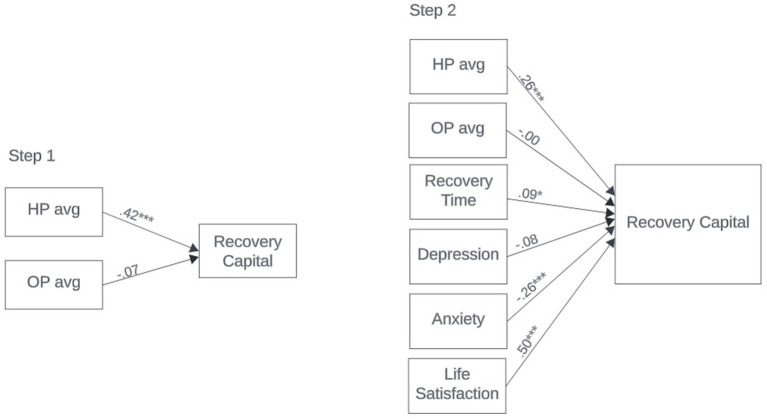
Results: A significant bivariate correlation was found between HP and RC (r = 0.42, p < 0.001), and mean comparisons showed significant differences for individuals endorsing HP as they scored higher on a measure of RC (M = 4.69) than did their peers endorsing OP (M = 4.26). Finally, a regression analysis found that HP predicted RC (B = 0.19, p < 0.001), even when time in recovery and mental health variables such as depression and anxiety were included in the model.
Discussion: This study offers novel evidence for an association between the DMP and recovery outcomes warranting future research.
期刊介绍:
Frontiers in Public Health is a multidisciplinary open-access journal which publishes rigorously peer-reviewed research and is at the forefront of disseminating and communicating scientific knowledge and impactful discoveries to researchers, academics, clinicians, policy makers and the public worldwide. The journal aims at overcoming current fragmentation in research and publication, promoting consistency in pursuing relevant scientific themes, and supporting finding dissemination and translation into practice.
Frontiers in Public Health is organized into Specialty Sections that cover different areas of research in the field. Please refer to the author guidelines for details on article types and the submission process.



 京公网安备 11010802042870号
京ICP备2023020795号-1
京公网安备 11010802042870号
京ICP备2023020795号-1

 分享
分享
 求助内容:
求助内容: 应助结果提醒方式:
 扫码关注我们
