José Adrián Montenegro-Espinosa, José Francisco López-Gil
{"title":"Does Sex Matter in the Link Between Self-Efficacy and Mediterranean Diet Adherence in Adolescents? Insights from the EHDLA Study.","authors":"José Adrián Montenegro-Espinosa, José Francisco López-Gil","doi":"10.3390/nu17050880","DOIUrl":null,"url":null,"abstract":"<p><p><b>Background/Purpose:</b> To our knowledge, no previous study has analyzed the associations between self-efficacy and adherence to the Mediterranean diet (MedDiet) in adolescents, nor have sex-based differences in this relationship been examined. The aim of the current study was to examine the relationship between self-efficacy and MedDiet adherence in Spanish adolescents. <b>Methods:</b> This research was cross-sectional and involved 619 adolescents (56.5% girls) who were part of the Eating Habits and Activities of Daily Living (EHDLA) project. Self-efficacy was assessed using a 10-item scale (general self-efficacy scale), which yielded scores ranging from 20 to 100 points. The Mediterranean Diet Quality Index for Children and Adolescents (KIDMED), which consists of a 16-item questionnaire with scores ranging from -4 to 12, was used to evaluate adherence to the MedDiet. Unhealthy behaviors related to the MedDiet were assigned a score of -1, whereas healthy behaviors received a score of +1. <b>Results:</b> Overall, for each 20-point increase in self-efficacy, boys had a greater non-significant likelihood of having optimal MedDiet adherence (1.33%, 95% confidence interval [CI] -5.15 to 7.82, <i>p</i> = 0.687). Conversely, girls had a greater significant likelihood of having optimal MedDiet adherence per further point in self-efficacy (7.40%, 95% CI 2.28 to 12.53, <i>p</i> = 0.005). Individually, among boys, a 20-point increase in self-efficacy was associated with a 4.8% higher probability of having a dairy product for breakfast (95% CI 0.2 to 9.4, <i>p</i> = 0.042). Among girls, the same increase in self-efficacy was linked to a greater probability of consuming fruit or fruit juice daily (6.8%, 95% CI 2.2 to 11.4, <i>p</i> = 0.004), eating a second fruit every day (8.6%, 95% CI 3.4 to 13.8, <i>p</i> = 0.001), consuming fish regularly (6.2%, 95% CI 1.1 to 11.2, <i>p</i> = 0.017), enjoying pulses and eating them more than once a week (4.5%, 95% CI 0.3 to 8.8, <i>p</i> = 0.035), having cereals or grains for breakfast (5.4%, 95% CI 0.4 to 10.5, <i>p</i> = 0.035), and regularly consuming nuts (5.2%, 95% CI 0.2 to 10.2, <i>p</i> = 0.041). Additionally, increases in self-efficacy was associated with a 5.0% lower probability of skipping breakfast (95% CI -8.8 to -1.1, <i>p</i> = 0.012). <b>Conclusions:</b> Our results revealed a significant association between self-efficacy and MedDiet adherence among girls, whereas the relationship between self-efficacy and the MedDiet in boys was not significant. These results suggest that interventions aimed at improving adolescent dietary patterns should consider incorporating strategies to increase self-efficacy, potentially with sex-specific approaches.</p>","PeriodicalId":19486,"journal":{"name":"Nutrients","volume":"17 5","pages":""},"PeriodicalIF":5.0000,"publicationDate":"2025-02-28","publicationTypes":"Journal Article","fieldsOfStudy":null,"isOpenAccess":false,"openAccessPdf":"https://www.ncbi.nlm.nih.gov/pmc/articles/PMC11902149/pdf/","citationCount":"0","resultStr":null,"platform":"Semanticscholar","paperid":null,"PeriodicalName":"Nutrients","FirstCategoryId":"3","ListUrlMain":"https://doi.org/10.3390/nu17050880","RegionNum":2,"RegionCategory":"医学","ArticlePicture":[],"TitleCN":null,"AbstractTextCN":null,"PMCID":null,"EPubDate":"","PubModel":"","JCR":"Q1","JCRName":"NUTRITION & DIETETICS","Score":null,"Total":0}
引用次数: 0
Abstract
Background/Purpose: To our knowledge, no previous study has analyzed the associations between self-efficacy and adherence to the Mediterranean diet (MedDiet) in adolescents, nor have sex-based differences in this relationship been examined. The aim of the current study was to examine the relationship between self-efficacy and MedDiet adherence in Spanish adolescents. Methods: This research was cross-sectional and involved 619 adolescents (56.5% girls) who were part of the Eating Habits and Activities of Daily Living (EHDLA) project. Self-efficacy was assessed using a 10-item scale (general self-efficacy scale), which yielded scores ranging from 20 to 100 points. The Mediterranean Diet Quality Index for Children and Adolescents (KIDMED), which consists of a 16-item questionnaire with scores ranging from -4 to 12, was used to evaluate adherence to the MedDiet. Unhealthy behaviors related to the MedDiet were assigned a score of -1, whereas healthy behaviors received a score of +1. Results: Overall, for each 20-point increase in self-efficacy, boys had a greater non-significant likelihood of having optimal MedDiet adherence (1.33%, 95% confidence interval [CI] -5.15 to 7.82, p = 0.687). Conversely, girls had a greater significant likelihood of having optimal MedDiet adherence per further point in self-efficacy (7.40%, 95% CI 2.28 to 12.53, p = 0.005). Individually, among boys, a 20-point increase in self-efficacy was associated with a 4.8% higher probability of having a dairy product for breakfast (95% CI 0.2 to 9.4, p = 0.042). Among girls, the same increase in self-efficacy was linked to a greater probability of consuming fruit or fruit juice daily (6.8%, 95% CI 2.2 to 11.4, p = 0.004), eating a second fruit every day (8.6%, 95% CI 3.4 to 13.8, p = 0.001), consuming fish regularly (6.2%, 95% CI 1.1 to 11.2, p = 0.017), enjoying pulses and eating them more than once a week (4.5%, 95% CI 0.3 to 8.8, p = 0.035), having cereals or grains for breakfast (5.4%, 95% CI 0.4 to 10.5, p = 0.035), and regularly consuming nuts (5.2%, 95% CI 0.2 to 10.2, p = 0.041). Additionally, increases in self-efficacy was associated with a 5.0% lower probability of skipping breakfast (95% CI -8.8 to -1.1, p = 0.012). Conclusions: Our results revealed a significant association between self-efficacy and MedDiet adherence among girls, whereas the relationship between self-efficacy and the MedDiet in boys was not significant. These results suggest that interventions aimed at improving adolescent dietary patterns should consider incorporating strategies to increase self-efficacy, potentially with sex-specific approaches.
期刊介绍:
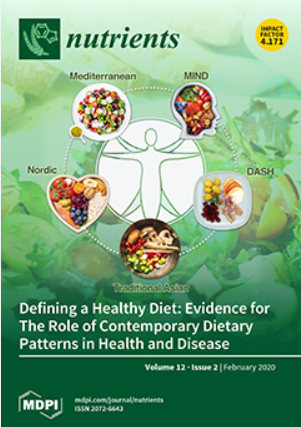
Nutrients (ISSN 2072-6643) is an international, peer-reviewed open access advanced forum for studies related to Human Nutrition. It publishes reviews, regular research papers and short communications. Our aim is to encourage scientists to publish their experimental and theoretical results in as much detail as possible. There is no restriction on the length of the papers. The full experimental details must be provided so that the results can be reproduced.





 京公网安备 11010802042870号
京ICP备2023020795号-1
京公网安备 11010802042870号
京ICP备2023020795号-1

 分享
分享
 求助内容:
求助内容: 应助结果提醒方式:
 扫码关注我们
