{"title":"Polyunsaturated Fatty Acids and Reduced Risk of Low Muscle Mass in Adults.","authors":"Haiyu Zou, Liangrong Zheng, Chunlai Zeng","doi":"10.3390/nu17050858","DOIUrl":null,"url":null,"abstract":"<p><p><b>Background</b>: We aimed to evaluate the effects of both joint and individual types of fatty acids on low muscle mass in adults. <b>Methods</b>: We enrolled 8842 adults selected from the National Health and Nutrition Examination Survey (NHANES). Multivariate adjusted weighted logistic regression models were employed to evaluate the connection between fatty acids and low muscle mass. We used restricted cubic splines (RCSs) to determine whether the relationship is linear or non-linear, while stratified analyses and interaction effects were also assessed. Weighted quantile sum (WQS) analysis assessed the impact of joint and individual types of fatty acids on low muscle mass. Additionally, mediation analysis determined the direct and indirect implications of polyunsaturated fatty acids on low muscle mass. <b>Results</b>: A total of 8842 participants were included in this study, of which 705 were identified as having low muscle mass. The logistic regression analyses identified a significant linear correlation between all three types of fatty acids and low-muscle-mass risk. Additionally, the WQS analysis demonstrated that a fatty acid mixture was inversely associated with low-muscle-mass risk, with polyunsaturated fatty acids being recognized as the principal component. Moreover, inflammation may mediate the relationship between polyunsaturated fatty acids and low muscle mass, accounting for 3.75% of the effect size (<i>p</i> < 0.001) through white blood cell count. We further examined linoleic acid (LA) and alpha-linolenic acid (ALA), and each unit increase in LA and ALA intake was linked to a decrease in low-muscle-mass risk by 0.29 (95% CI: 0.64-0.79, <i>p</i> < 0.001) and 0.27 (95% CI: 0.66-0.81, <i>p</i> < 0.001), respectively. <b>Conclusions</b>: These findings indicate that polyunsaturated fatty acids (especially LA and ALA) may effectively mitigate low-muscle-mass risk.</p>","PeriodicalId":19486,"journal":{"name":"Nutrients","volume":"17 5","pages":""},"PeriodicalIF":5.0000,"publicationDate":"2025-02-28","publicationTypes":"Journal Article","fieldsOfStudy":null,"isOpenAccess":false,"openAccessPdf":"https://www.ncbi.nlm.nih.gov/pmc/articles/PMC11902165/pdf/","citationCount":"0","resultStr":null,"platform":"Semanticscholar","paperid":null,"PeriodicalName":"Nutrients","FirstCategoryId":"3","ListUrlMain":"https://doi.org/10.3390/nu17050858","RegionNum":2,"RegionCategory":"医学","ArticlePicture":[],"TitleCN":null,"AbstractTextCN":null,"PMCID":null,"EPubDate":"","PubModel":"","JCR":"Q1","JCRName":"NUTRITION & DIETETICS","Score":null,"Total":0}
引用次数: 0
Abstract
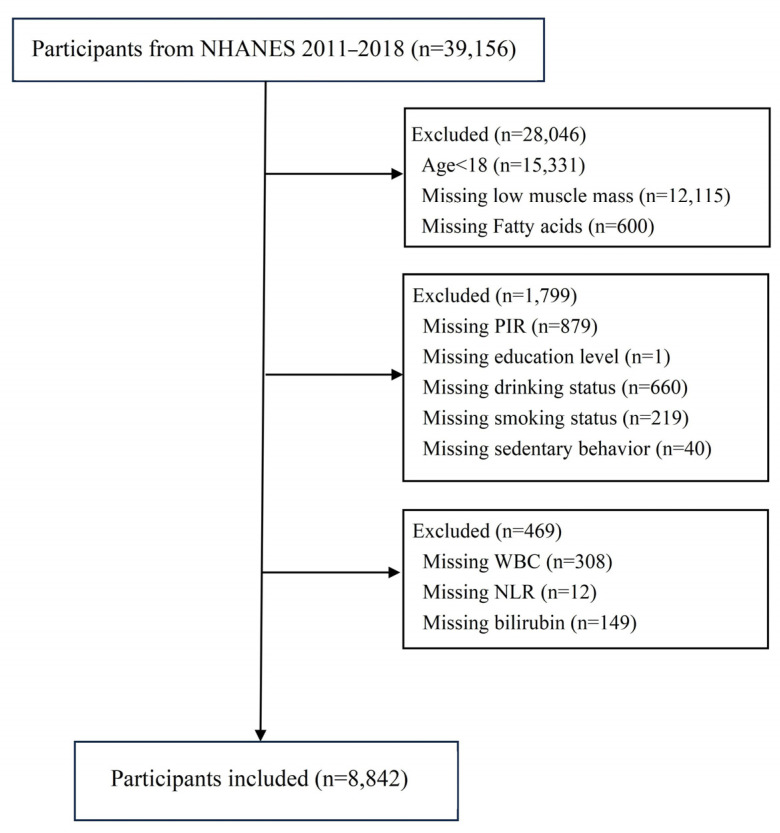
Background: We aimed to evaluate the effects of both joint and individual types of fatty acids on low muscle mass in adults. Methods: We enrolled 8842 adults selected from the National Health and Nutrition Examination Survey (NHANES). Multivariate adjusted weighted logistic regression models were employed to evaluate the connection between fatty acids and low muscle mass. We used restricted cubic splines (RCSs) to determine whether the relationship is linear or non-linear, while stratified analyses and interaction effects were also assessed. Weighted quantile sum (WQS) analysis assessed the impact of joint and individual types of fatty acids on low muscle mass. Additionally, mediation analysis determined the direct and indirect implications of polyunsaturated fatty acids on low muscle mass. Results: A total of 8842 participants were included in this study, of which 705 were identified as having low muscle mass. The logistic regression analyses identified a significant linear correlation between all three types of fatty acids and low-muscle-mass risk. Additionally, the WQS analysis demonstrated that a fatty acid mixture was inversely associated with low-muscle-mass risk, with polyunsaturated fatty acids being recognized as the principal component. Moreover, inflammation may mediate the relationship between polyunsaturated fatty acids and low muscle mass, accounting for 3.75% of the effect size (p < 0.001) through white blood cell count. We further examined linoleic acid (LA) and alpha-linolenic acid (ALA), and each unit increase in LA and ALA intake was linked to a decrease in low-muscle-mass risk by 0.29 (95% CI: 0.64-0.79, p < 0.001) and 0.27 (95% CI: 0.66-0.81, p < 0.001), respectively. Conclusions: These findings indicate that polyunsaturated fatty acids (especially LA and ALA) may effectively mitigate low-muscle-mass risk.
期刊介绍:
Nutrients (ISSN 2072-6643) is an international, peer-reviewed open access advanced forum for studies related to Human Nutrition. It publishes reviews, regular research papers and short communications. Our aim is to encourage scientists to publish their experimental and theoretical results in as much detail as possible. There is no restriction on the length of the papers. The full experimental details must be provided so that the results can be reproduced.





 京公网安备 11010802042870号
京ICP备2023020795号-1
京公网安备 11010802042870号
京ICP备2023020795号-1

 分享
分享
 求助内容:
求助内容: 应助结果提醒方式:
 扫码关注我们
