Wouter Rosseels, Laurent Godinas, Papay Jallah, Robin Vos, Lieven Dupont, Dirk Kuypers, Thomas Vanhoutte, Kathleen J Claes
{"title":"Thrombotic Microangiopathy: A Devastating Complication After Lung Transplantation.","authors":"Wouter Rosseels, Laurent Godinas, Papay Jallah, Robin Vos, Lieven Dupont, Dirk Kuypers, Thomas Vanhoutte, Kathleen J Claes","doi":"10.1097/TXD.0000000000001758","DOIUrl":null,"url":null,"abstract":"<p><strong>Background: </strong>Thrombotic microangiopathy (TMA) following lung transplantation (LTx) is a rare but severe complication. The pathogenesis is poorly understood, and various risk factors have been suggested. In this study, we aimed to evaluate diagnostic accuracy, identify risk factors, and assess renal, pulmonary, and overall survival of TMA in this patient group.</p><p><strong>Methods: </strong>We performed a case-control retrospective study of patients with TMA after LTX between January 1, 2000, and January 1, 2021. Controls were selected based on underlying lung disease, age, sex, cytomegalovirus risk, and immunosuppressive regimen. Overall survival data were collected for the whole lung transplant group.</p><p><strong>Results: </strong>A total of 29 TMA cases (2.9%) were identified out of 1025 LTx. Median time to development of TMA was 5.9 mo, 76% occurred in the first 12 mo. In the TMA group a higher rate of HLA donor-specific antibodies (11% versus 1%; <i>P</i> = 0.05), a lower median time to onset of chronic lung allograft dysfunction (37 versus 91 mo; <i>P</i> = 0.0017), a higher rate of cytomegalovirus infection (45% versus 19%; <i>P</i> = 0.02), and a higher prevalence of end-stage renal disease (24% versus 6%; <i>P</i> = 0.03) and overall death (97% versus 44%; <i>P</i> < 0.0001) was found. Diagnostic assessment of TMA was complete in 48% of patients, with Coombs testing missing in 52% and a disintegrin and metalloproteinase with thrombospondin type 1 motif 13 activity not assessed in 59%.</p><p><strong>Conclusions: </strong>TMA poses a significant risk of end-stage renal disease and mortality after LTx. Challenges remain in standardizing diagnostic criteria and understanding its pathogenesis, underscoring the need for unified protocols in diagnosis and standardized screening. This study identifies potential risk factors and temporal patterns for TMA occurrence, providing crucial insights for future treatment strategies.</p>","PeriodicalId":23225,"journal":{"name":"Transplantation Direct","volume":"11 4","pages":"e1758"},"PeriodicalIF":1.9000,"publicationDate":"2025-03-10","publicationTypes":"Journal Article","fieldsOfStudy":null,"isOpenAccess":false,"openAccessPdf":"https://www.ncbi.nlm.nih.gov/pmc/articles/PMC11896099/pdf/","citationCount":"0","resultStr":null,"platform":"Semanticscholar","paperid":null,"PeriodicalName":"Transplantation Direct","FirstCategoryId":"1085","ListUrlMain":"https://doi.org/10.1097/TXD.0000000000001758","RegionNum":0,"RegionCategory":null,"ArticlePicture":[],"TitleCN":null,"AbstractTextCN":null,"PMCID":null,"EPubDate":"2025/4/1 0:00:00","PubModel":"eCollection","JCR":"Q3","JCRName":"TRANSPLANTATION","Score":null,"Total":0}
引用次数: 0
Abstract
Background: Thrombotic microangiopathy (TMA) following lung transplantation (LTx) is a rare but severe complication. The pathogenesis is poorly understood, and various risk factors have been suggested. In this study, we aimed to evaluate diagnostic accuracy, identify risk factors, and assess renal, pulmonary, and overall survival of TMA in this patient group.
Methods: We performed a case-control retrospective study of patients with TMA after LTX between January 1, 2000, and January 1, 2021. Controls were selected based on underlying lung disease, age, sex, cytomegalovirus risk, and immunosuppressive regimen. Overall survival data were collected for the whole lung transplant group.
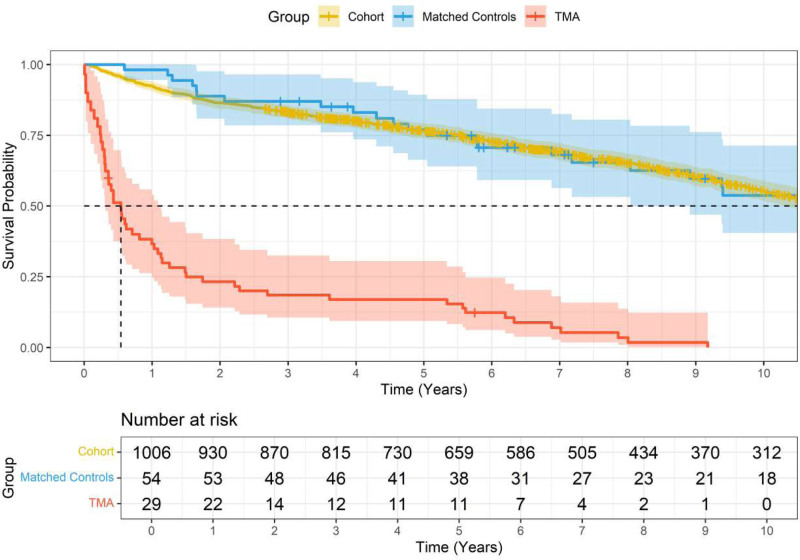
Results: A total of 29 TMA cases (2.9%) were identified out of 1025 LTx. Median time to development of TMA was 5.9 mo, 76% occurred in the first 12 mo. In the TMA group a higher rate of HLA donor-specific antibodies (11% versus 1%; P = 0.05), a lower median time to onset of chronic lung allograft dysfunction (37 versus 91 mo; P = 0.0017), a higher rate of cytomegalovirus infection (45% versus 19%; P = 0.02), and a higher prevalence of end-stage renal disease (24% versus 6%; P = 0.03) and overall death (97% versus 44%; P < 0.0001) was found. Diagnostic assessment of TMA was complete in 48% of patients, with Coombs testing missing in 52% and a disintegrin and metalloproteinase with thrombospondin type 1 motif 13 activity not assessed in 59%.
Conclusions: TMA poses a significant risk of end-stage renal disease and mortality after LTx. Challenges remain in standardizing diagnostic criteria and understanding its pathogenesis, underscoring the need for unified protocols in diagnosis and standardized screening. This study identifies potential risk factors and temporal patterns for TMA occurrence, providing crucial insights for future treatment strategies.






 京公网安备 11010802042870号
京ICP备2023020795号-1
京公网安备 11010802042870号
京ICP备2023020795号-1

 分享
分享
 求助内容:
求助内容: 应助结果提醒方式:
 扫码关注我们
