Diana Zhang, Shayesteh Jahanfar, Judy B Rabinowitz, Joshua Dower, Fei Song, Cherng-Horng Wu, Xiao Hu, Phillip Tracy, Mark Basik, Arielle Medford, Po-Han Lin, Chiun-Sheng Huang, Francois-Clement Bidard, Shufang Renault, Lori Pai, Mary Buss, Heather A Parsons, Ilana Schlam
{"title":"Role of circulating tumor DNA in early-stage triple-negative breast cancer: a systematic review and meta-analysis.","authors":"Diana Zhang, Shayesteh Jahanfar, Judy B Rabinowitz, Joshua Dower, Fei Song, Cherng-Horng Wu, Xiao Hu, Phillip Tracy, Mark Basik, Arielle Medford, Po-Han Lin, Chiun-Sheng Huang, Francois-Clement Bidard, Shufang Renault, Lori Pai, Mary Buss, Heather A Parsons, Ilana Schlam","doi":"10.1186/s13058-025-01986-y","DOIUrl":null,"url":null,"abstract":"<p><strong>Background: </strong>Triple-negative breast cancer (TNBC) accounts for 15% of all breast cancers and carries a worse prognosis relative to other breast cancer subtypes. This systematic review and meta-analysis evaluated the prognostic value of circulating tumor DNA (ctDNA) in early-stage TNBC.</p><p><strong>Methods: </strong>A literature search was conducted using Ovid Medline, Elsevier EMBASE, Cochrane Central Register of Controlled Trials, and Web of Science Databases for publications up to 11/16/2023. Results were uploaded to Covidence and assessed by two independent reviewers. Studies assessing the use of ctDNA to predict recurrence free survival and related outcomes as well as overall survival were included. All recurrence outcomes were combined during analysis. Statistical analysis was performed using Revman Web. Log-hazard ratios (HR) were pooled for studies reporting recurrence and death as a time-to-event outcomes. Odds ratios (OR) were calculated and pooled for studies reporting patient-level data on recurrence, death, and pathological complete response (pCR). Prospero ID: CRD42023492529.</p><p><strong>Results: </strong>A total of 3,526 publications were identified through our literature search, and 20 publications (n = 1202 patients) were included in the meta-analysis. In studies that reported recurrence as a time-to-event outcome, post-neoadjuvant (before or after surgery) ctDNA + status was associated with a higher likelihood of disease recurrence (HR 4.12, 95% confidence interval [CI] 2.81-6.04). For studies that reported patient-level data, post-neoadjuvant ctDNA + status was associated with higher odds of disease recurrence (OR 6.72, 95% CI 3.61-12.54). Pooled log-HR also revealed that ctDNA + status in the post-neoadjuvant setting (before or after surgery) was associated with worse overall survival (HR 3.26, 95% CI 1.88-5.63).</p><p><strong>Conclusions: </strong>Our findings suggest that ctDNA could be used as a prognostic biomarker to anticipate the risk of relapse. However, it remains unclear if therapeutic intervention for patients who are ctDNA + can improve outcomes. While more studies are needed before incorporating ctDNA into clinical practice, the findings of this meta-analysis are reassuring and show the promise of ctDNA as a biomarker.</p>","PeriodicalId":49227,"journal":{"name":"Breast Cancer Research","volume":"27 1","pages":"38"},"PeriodicalIF":5.6000,"publicationDate":"2025-03-12","publicationTypes":"Journal Article","fieldsOfStudy":null,"isOpenAccess":false,"openAccessPdf":"https://www.ncbi.nlm.nih.gov/pmc/articles/PMC11905660/pdf/","citationCount":"0","resultStr":null,"platform":"Semanticscholar","paperid":null,"PeriodicalName":"Breast Cancer Research","FirstCategoryId":"3","ListUrlMain":"https://doi.org/10.1186/s13058-025-01986-y","RegionNum":1,"RegionCategory":"医学","ArticlePicture":[],"TitleCN":null,"AbstractTextCN":null,"PMCID":null,"EPubDate":"","PubModel":"","JCR":"Q1","JCRName":"Medicine","Score":null,"Total":0}
引用次数: 0
Abstract
Background: Triple-negative breast cancer (TNBC) accounts for 15% of all breast cancers and carries a worse prognosis relative to other breast cancer subtypes. This systematic review and meta-analysis evaluated the prognostic value of circulating tumor DNA (ctDNA) in early-stage TNBC.
Methods: A literature search was conducted using Ovid Medline, Elsevier EMBASE, Cochrane Central Register of Controlled Trials, and Web of Science Databases for publications up to 11/16/2023. Results were uploaded to Covidence and assessed by two independent reviewers. Studies assessing the use of ctDNA to predict recurrence free survival and related outcomes as well as overall survival were included. All recurrence outcomes were combined during analysis. Statistical analysis was performed using Revman Web. Log-hazard ratios (HR) were pooled for studies reporting recurrence and death as a time-to-event outcomes. Odds ratios (OR) were calculated and pooled for studies reporting patient-level data on recurrence, death, and pathological complete response (pCR). Prospero ID: CRD42023492529.
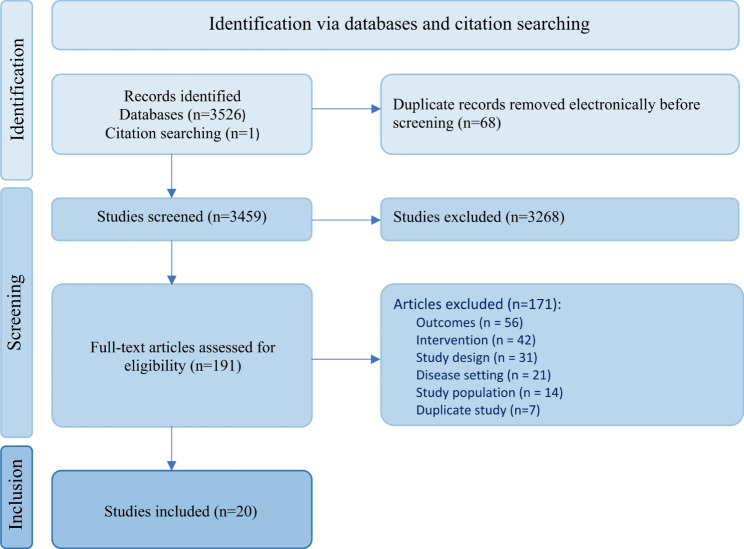
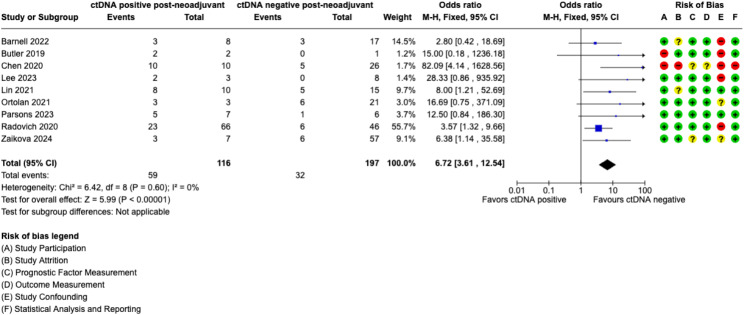
Results: A total of 3,526 publications were identified through our literature search, and 20 publications (n = 1202 patients) were included in the meta-analysis. In studies that reported recurrence as a time-to-event outcome, post-neoadjuvant (before or after surgery) ctDNA + status was associated with a higher likelihood of disease recurrence (HR 4.12, 95% confidence interval [CI] 2.81-6.04). For studies that reported patient-level data, post-neoadjuvant ctDNA + status was associated with higher odds of disease recurrence (OR 6.72, 95% CI 3.61-12.54). Pooled log-HR also revealed that ctDNA + status in the post-neoadjuvant setting (before or after surgery) was associated with worse overall survival (HR 3.26, 95% CI 1.88-5.63).
Conclusions: Our findings suggest that ctDNA could be used as a prognostic biomarker to anticipate the risk of relapse. However, it remains unclear if therapeutic intervention for patients who are ctDNA + can improve outcomes. While more studies are needed before incorporating ctDNA into clinical practice, the findings of this meta-analysis are reassuring and show the promise of ctDNA as a biomarker.
期刊介绍:
Breast Cancer Research, an international, peer-reviewed online journal, publishes original research, reviews, editorials, and reports. It features open-access research articles of exceptional interest across all areas of biology and medicine relevant to breast cancer. This includes normal mammary gland biology, with a special emphasis on the genetic, biochemical, and cellular basis of breast cancer. In addition to basic research, the journal covers preclinical, translational, and clinical studies with a biological basis, including Phase I and Phase II trials.




 京公网安备 11010802042870号
京ICP备2023020795号-1
京公网安备 11010802042870号
京ICP备2023020795号-1

 分享
分享
 求助内容:
求助内容: 应助结果提醒方式:
 扫码关注我们
