Combustion enhancement and emission reduction in an IC engine by adopting ZnO nanoparticles with calophyllum biodiesel/diesel/propanol blend: A case study of General Regression Neural Network (GRNN) modelling
M. Srinivasarao , Ch. Srinivasarao , A. Swarna Kumari , Bikkavolu Joga Rao , Pullagura Gandhi , Seepana PraveenKumar , Olusegun D. Samuel , Ahmad Mustafa , Christopher C. Enweremadu , Noureddine Elboughdiri
{"title":"Combustion enhancement and emission reduction in an IC engine by adopting ZnO nanoparticles with calophyllum biodiesel/diesel/propanol blend: A case study of General Regression Neural Network (GRNN) modelling","authors":"M. Srinivasarao , Ch. Srinivasarao , A. Swarna Kumari , Bikkavolu Joga Rao , Pullagura Gandhi , Seepana PraveenKumar , Olusegun D. Samuel , Ahmad Mustafa , Christopher C. Enweremadu , Noureddine Elboughdiri","doi":"10.1016/j.indcrop.2025.120812","DOIUrl":null,"url":null,"abstract":"<div><div>Even though higher alcohols (HAs) and nanoparticles have the tendency to enhance engine behaviours (EBs), namely performance, emissions, and combustion characteristics, and ensure a greener environment, the absence of a reliable model to predict and model the appropriate HA dosage to blend with nanoparticles in green diesel (GD) has affected the biodiesel and automotive industries. For the first time, a study adopted a generalized regression neural network (GRNN) to investigate the influence of propanol-2 as one of the HAs, zinc oxide (ZnO) as one of the nanoparticles, and Calophyllum biodiesel (CB) as GD on EBs. The study focused on the effect of adding propanol-2 and ZnO fuel enhancers on the engine features and performance, combustion, and emissions of a CB blend (CB20) in an internal combustion (IC) engine. The results showed improved engine performance, with brake thermal efficiency increasing by 0.06 %, 1.71 %, and 3.91 %, and specific fuel consumption reduced by 5.83 %, 7.4 %, and 11.53 %, respectively, compared to CB20 fuel. The highest cylinder pressure of 70.84 bar was observed at the 120 ppm nano additive blend, while the highest heat release rate (HRR) of 36.65 J/℃A was observed at the same concentration of nano additives. Furthermore, the inclusion of ZnO nano condiments caused a decrease in carbon monoxide (CO), hydrocarbon (HC), nitrogen oxide (NOx), and smoke emissions by 38.7 %, 14.9 %, 4.8 %, and 2.48 %, respectively, at higher dosages of nano additives in the CB20 blend. A computational model based on a GRNN was constructed for further analysis of engine efficiency and emissions behaviour. The GRNN model accurately predicted output variables for various blends, with correlation coefficient (R) values varying from 0.98284 to 0.99959, with lesser RMSE and MAPE values within acceptable boundaries. The highest cylinder pressure of 70.84 bar was observed at the 120 ppm nano additive blend, while the highest heat release rate (HRR) of 36.65 J/℃A was observed at the same concentration of nano additives. Furthermore, the inclusion of ZnO nano condiments caused a decrease in carbon monoxide (CO), hydrocarbon (HC), nitrogen oxide (NOx), and smoke emissions by 38.7 %, 14.9 %, 4.8 %, and 2.48 %, respectively, at higher dosages of nano additives in the CB20 blend. A computational model based on a GRNN was constructed for further analysis of engine efficiency and emissions behaviour. The GRNN model accurately predicted output variables for various blends, with correlation coefficient (R) values varying from 0.98284 to 0.99959, with lesser RMSE and MAPE values within acceptable boundaries. The results also showed that the GRNN models are advantageous for network simplicity and require less data, making them reliable tools for predicting and modelling EP of the latest fuel for researchers and stakeholders in the automotive industry.</div></div>","PeriodicalId":13581,"journal":{"name":"Industrial Crops and Products","volume":"227 ","pages":"Article 120812"},"PeriodicalIF":6.2000,"publicationDate":"2025-03-14","publicationTypes":"Journal Article","fieldsOfStudy":null,"isOpenAccess":false,"openAccessPdf":"","citationCount":"0","resultStr":null,"platform":"Semanticscholar","paperid":null,"PeriodicalName":"Industrial Crops and Products","FirstCategoryId":"97","ListUrlMain":"https://www.sciencedirect.com/science/article/pii/S0926669025003589","RegionNum":1,"RegionCategory":"农林科学","ArticlePicture":[],"TitleCN":null,"AbstractTextCN":null,"PMCID":null,"EPubDate":"","PubModel":"","JCR":"Q1","JCRName":"AGRICULTURAL ENGINEERING","Score":null,"Total":0}
引用次数: 0
Abstract
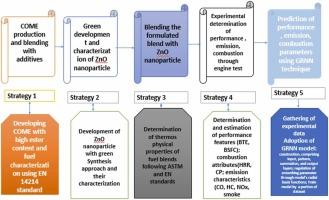
Even though higher alcohols (HAs) and nanoparticles have the tendency to enhance engine behaviours (EBs), namely performance, emissions, and combustion characteristics, and ensure a greener environment, the absence of a reliable model to predict and model the appropriate HA dosage to blend with nanoparticles in green diesel (GD) has affected the biodiesel and automotive industries. For the first time, a study adopted a generalized regression neural network (GRNN) to investigate the influence of propanol-2 as one of the HAs, zinc oxide (ZnO) as one of the nanoparticles, and Calophyllum biodiesel (CB) as GD on EBs. The study focused on the effect of adding propanol-2 and ZnO fuel enhancers on the engine features and performance, combustion, and emissions of a CB blend (CB20) in an internal combustion (IC) engine. The results showed improved engine performance, with brake thermal efficiency increasing by 0.06 %, 1.71 %, and 3.91 %, and specific fuel consumption reduced by 5.83 %, 7.4 %, and 11.53 %, respectively, compared to CB20 fuel. The highest cylinder pressure of 70.84 bar was observed at the 120 ppm nano additive blend, while the highest heat release rate (HRR) of 36.65 J/℃A was observed at the same concentration of nano additives. Furthermore, the inclusion of ZnO nano condiments caused a decrease in carbon monoxide (CO), hydrocarbon (HC), nitrogen oxide (NOx), and smoke emissions by 38.7 %, 14.9 %, 4.8 %, and 2.48 %, respectively, at higher dosages of nano additives in the CB20 blend. A computational model based on a GRNN was constructed for further analysis of engine efficiency and emissions behaviour. The GRNN model accurately predicted output variables for various blends, with correlation coefficient (R) values varying from 0.98284 to 0.99959, with lesser RMSE and MAPE values within acceptable boundaries. The highest cylinder pressure of 70.84 bar was observed at the 120 ppm nano additive blend, while the highest heat release rate (HRR) of 36.65 J/℃A was observed at the same concentration of nano additives. Furthermore, the inclusion of ZnO nano condiments caused a decrease in carbon monoxide (CO), hydrocarbon (HC), nitrogen oxide (NOx), and smoke emissions by 38.7 %, 14.9 %, 4.8 %, and 2.48 %, respectively, at higher dosages of nano additives in the CB20 blend. A computational model based on a GRNN was constructed for further analysis of engine efficiency and emissions behaviour. The GRNN model accurately predicted output variables for various blends, with correlation coefficient (R) values varying from 0.98284 to 0.99959, with lesser RMSE and MAPE values within acceptable boundaries. The results also showed that the GRNN models are advantageous for network simplicity and require less data, making them reliable tools for predicting and modelling EP of the latest fuel for researchers and stakeholders in the automotive industry.
期刊介绍:
Industrial Crops and Products is an International Journal publishing academic and industrial research on industrial (defined as non-food/non-feed) crops and products. Papers concern both crop-oriented and bio-based materials from crops-oriented research, and should be of interest to an international audience, hypothesis driven, and where comparisons are made statistics performed.



 京公网安备 11010802042870号
京ICP备2023020795号-1
京公网安备 11010802042870号
京ICP备2023020795号-1

 分享
分享
 求助内容:
求助内容: 应助结果提醒方式:
 扫码关注我们
