Qingyu Guo , Mingxuan Wang , Yujue Yang , Guorui Liu , Qiuting Yang , Linjun Qin , Lili Yang , Minghui Zheng
{"title":"Source apportionment of polychlorinated dibenzo-p-dioxin/furans and polychlorinated biphenyls in soil from the Gyirong Valley in the Himalayas","authors":"Qingyu Guo , Mingxuan Wang , Yujue Yang , Guorui Liu , Qiuting Yang , Linjun Qin , Lili Yang , Minghui Zheng","doi":"10.1016/j.envpol.2025.126066","DOIUrl":null,"url":null,"abstract":"<div><div>The Tibetan Plateau is an important area for persistent organic pollutants (POPs) research because of high-altitude condensation and global distillation. However, the sources of the POPs in remote regions have not been quantified, which is critical for global control of POPs. The Gyirong Valley in the Himalayas bordering Nepal serves as an important pathway for cross-border transport of POPs to the Tibetan Plateau. In this study, the occurrences of polychlorinated dibenzo-<em>p</em>-dioxin/furans (PCDD/Fs) and polychlorinated biphenyls (PCBs) as typical POPs were investigated in surface soil samples collected along the Gyirong Valley. The PCDD/F and PCB congener profiles and positive matrix factorization were used to identify sources and quantify their contribution to PCDD/Fs and PCBs in the valley. The main source of PCDD/Fs was long-range atmospheric transport (LRAT), while the main sources of PCBs were domestic burning of coal and wood (27.3 %), LRAT (23.7 %), by-products from pigments, paints, and dyes (42.4 %) and industrial activities related to maintenance, disassembly or accidental releases of electrical equipment (6.5 %). A backward trajectory simulation indicated that the Indian monsoon played a dominant role in facilitating the transport of POPs from Nepal through the Gyirong Valley to the Tibetan Plateau. These results for the occurrences, distribution characteristics, and primary sources of PCDD/Fs and PCBs in the Himalayas will be helpful for POPs risk assessments and control in remote regions.</div></div>","PeriodicalId":311,"journal":{"name":"Environmental Pollution","volume":"372 ","pages":"Article 126066"},"PeriodicalIF":7.3000,"publicationDate":"2025-05-01","publicationTypes":"Journal Article","fieldsOfStudy":null,"isOpenAccess":false,"openAccessPdf":"","citationCount":"0","resultStr":null,"platform":"Semanticscholar","paperid":null,"PeriodicalName":"Environmental Pollution","FirstCategoryId":"93","ListUrlMain":"https://www.sciencedirect.com/science/article/pii/S0269749125004397","RegionNum":2,"RegionCategory":"环境科学与生态学","ArticlePicture":[],"TitleCN":null,"AbstractTextCN":null,"PMCID":null,"EPubDate":"2025/3/13 0:00:00","PubModel":"Epub","JCR":"Q1","JCRName":"ENVIRONMENTAL SCIENCES","Score":null,"Total":0}
引用次数: 0
Abstract
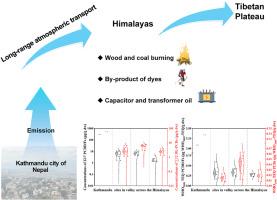
The Tibetan Plateau is an important area for persistent organic pollutants (POPs) research because of high-altitude condensation and global distillation. However, the sources of the POPs in remote regions have not been quantified, which is critical for global control of POPs. The Gyirong Valley in the Himalayas bordering Nepal serves as an important pathway for cross-border transport of POPs to the Tibetan Plateau. In this study, the occurrences of polychlorinated dibenzo-p-dioxin/furans (PCDD/Fs) and polychlorinated biphenyls (PCBs) as typical POPs were investigated in surface soil samples collected along the Gyirong Valley. The PCDD/F and PCB congener profiles and positive matrix factorization were used to identify sources and quantify their contribution to PCDD/Fs and PCBs in the valley. The main source of PCDD/Fs was long-range atmospheric transport (LRAT), while the main sources of PCBs were domestic burning of coal and wood (27.3 %), LRAT (23.7 %), by-products from pigments, paints, and dyes (42.4 %) and industrial activities related to maintenance, disassembly or accidental releases of electrical equipment (6.5 %). A backward trajectory simulation indicated that the Indian monsoon played a dominant role in facilitating the transport of POPs from Nepal through the Gyirong Valley to the Tibetan Plateau. These results for the occurrences, distribution characteristics, and primary sources of PCDD/Fs and PCBs in the Himalayas will be helpful for POPs risk assessments and control in remote regions.
期刊介绍:
Environmental Pollution is an international peer-reviewed journal that publishes high-quality research papers and review articles covering all aspects of environmental pollution and its impacts on ecosystems and human health.
Subject areas include, but are not limited to:
• Sources and occurrences of pollutants that are clearly defined and measured in environmental compartments, food and food-related items, and human bodies;
• Interlinks between contaminant exposure and biological, ecological, and human health effects, including those of climate change;
• Contaminants of emerging concerns (including but not limited to antibiotic resistant microorganisms or genes, microplastics/nanoplastics, electronic wastes, light, and noise) and/or their biological, ecological, or human health effects;
• Laboratory and field studies on the remediation/mitigation of environmental pollution via new techniques and with clear links to biological, ecological, or human health effects;
• Modeling of pollution processes, patterns, or trends that is of clear environmental and/or human health interest;
• New techniques that measure and examine environmental occurrences, transport, behavior, and effects of pollutants within the environment or the laboratory, provided that they can be clearly used to address problems within regional or global environmental compartments.




 京公网安备 11010802042870号
京ICP备2023020795号-1
京公网安备 11010802042870号
京ICP备2023020795号-1

 分享
分享
 求助内容:
求助内容: 应助结果提醒方式:
 扫码关注我们
