Anne Marb , Yiqun Ma , Federica Nobile , Robert Dubrow , Patrick L. Kinney , Massimo Stafoggia , Kai Chen , Annette Peters , Susanne Breitner
{"title":"Short-term exposure to ambient nitrogen dioxide and fine particulate matter and cause-specific mortality: A causal modeling approach in four regions","authors":"Anne Marb , Yiqun Ma , Federica Nobile , Robert Dubrow , Patrick L. Kinney , Massimo Stafoggia , Kai Chen , Annette Peters , Susanne Breitner","doi":"10.1016/j.envpol.2025.126059","DOIUrl":null,"url":null,"abstract":"<div><div>Ambient air pollution still represents a major health burden. While the link between short-term air pollution exposures and mortality has been well-documented globally, few studies have applied causal modeling approaches. Therefore, we aimed to quantify the relationship between day-to-day changes in ambient particulate matter with an aerodynamic diameter ≤2.5 μm (PM<sub>2.5</sub>) and nitrogen dioxide (NO<sub>2</sub>) levels and changes in daily natural, cardiovascular (including all-cardiovascular, cardiac, and stroke), as well as respiratory mortality rates using a causal modeling framework. Daily air pollution data and cause-specific death counts at the county, district, or municipality level from California (US), Jiangsu (China), Germany, and Lazio (Italy) were obtained for the years 2015–2019, including urban and rural populations. We used interactive fixed effects models to analyze the effects of air pollutants across different lag periods (0–2, 3–7, and 0–7 days after exposure) while accounting for both measured and unmeasured time-varying spatial unit-specific confounding factors. We observed increases in daily cardiovascular deaths (per 1 million people) per a 10 μg/m<sup>3</sup> increase in daily NO<sub>2</sub> at lag 0–7: 0.18 (95 % confidence interval: 0.02, 0.38) in California, 0.23 (0.14, 0.32) in Jiangsu, 0.48 (0.27, 0.70) in Germany, and −0.35 (−2.63, 1.92) in Lazio. For PM<sub>2.5</sub>, the related increases in cardiovascular mortality rates were 0.00 (−0.18, 0.18) in California, 0.04 (0.00, 0.09) in Jiangsu, 0.22 (0.06, 0.37) in Germany, and 1.96 (0.76, 3.16) in Lazio. Additionally, associations were seen for natural, cardiac, stroke, and respiratory mortality, particularly pronounced among individuals aged 75 and older. These associations were strongest with prolonged exposures and remained consistent even in two-pollutant models. This study, using a causal modeling approach and including urban and rural populations, contributes to the growing body of evidence linking increases in short-term exposure to NO<sub>2</sub> and PM<sub>2.5</sub> with increased cause-specific mortality rates.</div></div>","PeriodicalId":311,"journal":{"name":"Environmental Pollution","volume":"372 ","pages":"Article 126059"},"PeriodicalIF":7.3000,"publicationDate":"2025-05-01","publicationTypes":"Journal Article","fieldsOfStudy":null,"isOpenAccess":false,"openAccessPdf":"","citationCount":"0","resultStr":null,"platform":"Semanticscholar","paperid":null,"PeriodicalName":"Environmental Pollution","FirstCategoryId":"93","ListUrlMain":"https://www.sciencedirect.com/science/article/pii/S0269749125004324","RegionNum":2,"RegionCategory":"环境科学与生态学","ArticlePicture":[],"TitleCN":null,"AbstractTextCN":null,"PMCID":null,"EPubDate":"2025/3/13 0:00:00","PubModel":"Epub","JCR":"Q1","JCRName":"ENVIRONMENTAL SCIENCES","Score":null,"Total":0}
引用次数: 0
Abstract
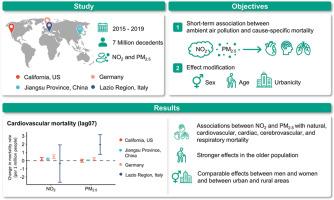
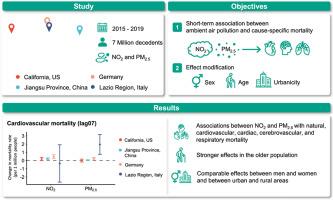
Ambient air pollution still represents a major health burden. While the link between short-term air pollution exposures and mortality has been well-documented globally, few studies have applied causal modeling approaches. Therefore, we aimed to quantify the relationship between day-to-day changes in ambient particulate matter with an aerodynamic diameter ≤2.5 μm (PM2.5) and nitrogen dioxide (NO2) levels and changes in daily natural, cardiovascular (including all-cardiovascular, cardiac, and stroke), as well as respiratory mortality rates using a causal modeling framework. Daily air pollution data and cause-specific death counts at the county, district, or municipality level from California (US), Jiangsu (China), Germany, and Lazio (Italy) were obtained for the years 2015–2019, including urban and rural populations. We used interactive fixed effects models to analyze the effects of air pollutants across different lag periods (0–2, 3–7, and 0–7 days after exposure) while accounting for both measured and unmeasured time-varying spatial unit-specific confounding factors. We observed increases in daily cardiovascular deaths (per 1 million people) per a 10 μg/m3 increase in daily NO2 at lag 0–7: 0.18 (95 % confidence interval: 0.02, 0.38) in California, 0.23 (0.14, 0.32) in Jiangsu, 0.48 (0.27, 0.70) in Germany, and −0.35 (−2.63, 1.92) in Lazio. For PM2.5, the related increases in cardiovascular mortality rates were 0.00 (−0.18, 0.18) in California, 0.04 (0.00, 0.09) in Jiangsu, 0.22 (0.06, 0.37) in Germany, and 1.96 (0.76, 3.16) in Lazio. Additionally, associations were seen for natural, cardiac, stroke, and respiratory mortality, particularly pronounced among individuals aged 75 and older. These associations were strongest with prolonged exposures and remained consistent even in two-pollutant models. This study, using a causal modeling approach and including urban and rural populations, contributes to the growing body of evidence linking increases in short-term exposure to NO2 and PM2.5 with increased cause-specific mortality rates.
期刊介绍:
Environmental Pollution is an international peer-reviewed journal that publishes high-quality research papers and review articles covering all aspects of environmental pollution and its impacts on ecosystems and human health.
Subject areas include, but are not limited to:
• Sources and occurrences of pollutants that are clearly defined and measured in environmental compartments, food and food-related items, and human bodies;
• Interlinks between contaminant exposure and biological, ecological, and human health effects, including those of climate change;
• Contaminants of emerging concerns (including but not limited to antibiotic resistant microorganisms or genes, microplastics/nanoplastics, electronic wastes, light, and noise) and/or their biological, ecological, or human health effects;
• Laboratory and field studies on the remediation/mitigation of environmental pollution via new techniques and with clear links to biological, ecological, or human health effects;
• Modeling of pollution processes, patterns, or trends that is of clear environmental and/or human health interest;
• New techniques that measure and examine environmental occurrences, transport, behavior, and effects of pollutants within the environment or the laboratory, provided that they can be clearly used to address problems within regional or global environmental compartments.



 京公网安备 11010802042870号
京ICP备2023020795号-1
京公网安备 11010802042870号
京ICP备2023020795号-1

 分享
分享
 求助内容:
求助内容: 应助结果提醒方式:
 扫码关注我们
