Suppression of interfacial water layer with solid contact using an ultrathin, water-repellent, and Zn2+-selective layer for Ah-level zinc metal batteries†
Ziwei Xu, Junpeng Li, Yifan Fu, Junjie Ba, Fengxue Duan, Yingjin Wei, Chunzhong Wang, Kangning Zhao and Yizhan Wang
{"title":"Suppression of interfacial water layer with solid contact using an ultrathin, water-repellent, and Zn2+-selective layer for Ah-level zinc metal batteries†","authors":"Ziwei Xu, Junpeng Li, Yifan Fu, Junjie Ba, Fengxue Duan, Yingjin Wei, Chunzhong Wang, Kangning Zhao and Yizhan Wang","doi":"10.1039/D4EE05905K","DOIUrl":null,"url":null,"abstract":"<p >The failure of zinc metal batteries usually occurs due to the instability of the protection layer of the zinc metal anode caused by water penetration and metal dissolution during long-term operation, leading to an uncontrollably erratic electrode/electrolyte interface and the hydrogen evolution reaction. Herein, we propose an ultrathin, water-repellent, and Zn<small><sup>2+</sup></small>-selective layer to prevent the formation of the undesirable water layer and avoid water penetration. This interface, with an ultrathin thickness of 16.9 nm, was composed of a water-repellent didodecyldimethylammonium organic top layer and an open three-dimensional framework structure of inorganic layer with subnanometer pores and redox-active Fe centers that functioned as faradaic ion pumps, facilitating rapid Zn<small><sup>2+</sup></small> transport. Consequently, the ultrathin solid contact layer acted as a semi-permeable membrane with a low water permeance of 0.000028 mol m<small><sup>−2</sup></small> h<small><sup>−1</sup></small> Pa<small><sup>−1</sup></small> while facilitating fast Zn<small><sup>2+</sup></small> transport, thus suppressing the hydrogen evolution reaction. As a result, this layer enabled over 10 000 stable plating/stripping cycles at 5 mA cm<small><sup>−2</sup></small> with an average Coulombic efficiency of 99.91%. At a high rate of 150C, the Zn–I<small><sub>2</sub></small> cell operated for an unprecedented 65 000 cycles. Moreover, Ah-level Zn–I<small><sub>2</sub></small> pouch cells were fabricated, demonstrating scalable applicability towards grid-scale energy storage devices. Our work demonstrates the importance of designing stable and functional interface layers for metal anodes towards achieving high-energy metal batteries.</p>","PeriodicalId":72,"journal":{"name":"Energy & Environmental Science","volume":" 9","pages":" 4251-4261"},"PeriodicalIF":30.8000,"publicationDate":"2025-03-14","publicationTypes":"Journal Article","fieldsOfStudy":null,"isOpenAccess":false,"openAccessPdf":"","citationCount":"0","resultStr":null,"platform":"Semanticscholar","paperid":null,"PeriodicalName":"Energy & Environmental Science","FirstCategoryId":"88","ListUrlMain":"https://pubs.rsc.org/en/content/articlelanding/2025/ee/d4ee05905k","RegionNum":1,"RegionCategory":"材料科学","ArticlePicture":[],"TitleCN":null,"AbstractTextCN":null,"PMCID":null,"EPubDate":"","PubModel":"","JCR":"Q1","JCRName":"CHEMISTRY, MULTIDISCIPLINARY","Score":null,"Total":0}
引用次数: 0
Abstract
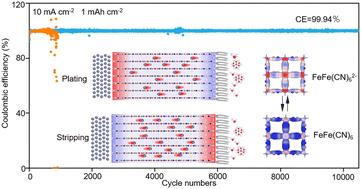
The failure of zinc metal batteries usually occurs due to the instability of the protection layer of the zinc metal anode caused by water penetration and metal dissolution during long-term operation, leading to an uncontrollably erratic electrode/electrolyte interface and the hydrogen evolution reaction. Herein, we propose an ultrathin, water-repellent, and Zn2+-selective layer to prevent the formation of the undesirable water layer and avoid water penetration. This interface, with an ultrathin thickness of 16.9 nm, was composed of a water-repellent didodecyldimethylammonium organic top layer and an open three-dimensional framework structure of inorganic layer with subnanometer pores and redox-active Fe centers that functioned as faradaic ion pumps, facilitating rapid Zn2+ transport. Consequently, the ultrathin solid contact layer acted as a semi-permeable membrane with a low water permeance of 0.000028 mol m−2 h−1 Pa−1 while facilitating fast Zn2+ transport, thus suppressing the hydrogen evolution reaction. As a result, this layer enabled over 10 000 stable plating/stripping cycles at 5 mA cm−2 with an average Coulombic efficiency of 99.91%. At a high rate of 150C, the Zn–I2 cell operated for an unprecedented 65 000 cycles. Moreover, Ah-level Zn–I2 pouch cells were fabricated, demonstrating scalable applicability towards grid-scale energy storage devices. Our work demonstrates the importance of designing stable and functional interface layers for metal anodes towards achieving high-energy metal batteries.
期刊介绍:
Energy & Environmental Science, a peer-reviewed scientific journal, publishes original research and review articles covering interdisciplinary topics in the (bio)chemical and (bio)physical sciences, as well as chemical engineering disciplines. Published monthly by the Royal Society of Chemistry (RSC), a not-for-profit publisher, Energy & Environmental Science is recognized as a leading journal. It boasts an impressive impact factor of 8.500 as of 2009, ranking 8th among 140 journals in the category "Chemistry, Multidisciplinary," second among 71 journals in "Energy & Fuels," second among 128 journals in "Engineering, Chemical," and first among 181 scientific journals in "Environmental Sciences."
Energy & Environmental Science publishes various types of articles, including Research Papers (original scientific work), Review Articles, Perspectives, and Minireviews (feature review-type articles of broad interest), Communications (original scientific work of an urgent nature), Opinions (personal, often speculative viewpoints or hypotheses on current topics), and Analysis Articles (in-depth examination of energy-related issues).



 京公网安备 11010802042870号
京ICP备2023020795号-1
京公网安备 11010802042870号
京ICP备2023020795号-1

 分享
分享
 求助内容:
求助内容: 应助结果提醒方式:
 扫码关注我们
