{"title":"Uncertainty-aware fuzzy knowledge embedding method for generalized structural performance prediction","authors":"Xiang-Yu Wang, Xin-Rui Ma, Shi-Zhi Chen","doi":"10.1111/mice.13457","DOIUrl":null,"url":null,"abstract":"<p>Structural performance prediction for structures and their components is a critical issue for ensuring the safety of civil engineering structures. Thus, enhancing the reliability of the prediction models with better generalization capability and quantifying the uncertainties of their predictions is significant. However, existing mechanism-driven and data-driven prediction models for reliable engineering applications incorporate complicated modifications on models and are sensitive to the precision of relevant prior knowledge. Focusing on these issues, a novel and concise data-driven approach, named “R2CU” (stands for transforming regression to classification with uncertainty-aware), is proposed to introduce the relative <i>fuzzy prior knowledge</i> into the data-driven prediction models. To enhance generalization capacity, the conventional regression task is transformed into a classification task based on the fuzzy prior knowledge and the experimental data. Then the aleatoric and epistemic uncertainty of the prediction is estimated to provide the confidence interval, which reflects the prediction's trustworthiness. A validation case study based on shear capacity prediction of reinforced concrete (RC) deep beams is carried out. The result proved that the model's generalization capability for extrapolating has been effectively enhanced with the proposed approach (the prediction precision was raised 80%). Meanwhile, the uncertainties within the model's prediction are rationally estimated, which made the proposed approach a practical alternative for structural performance prediction.</p>","PeriodicalId":156,"journal":{"name":"Computer-Aided Civil and Infrastructure Engineering","volume":"40 17","pages":"2546-2560"},"PeriodicalIF":9.1000,"publicationDate":"2025-03-14","publicationTypes":"Journal Article","fieldsOfStudy":null,"isOpenAccess":false,"openAccessPdf":"https://onlinelibrary.wiley.com/doi/epdf/10.1111/mice.13457","citationCount":"0","resultStr":null,"platform":"Semanticscholar","paperid":null,"PeriodicalName":"Computer-Aided Civil and Infrastructure Engineering","FirstCategoryId":"5","ListUrlMain":"https://onlinelibrary.wiley.com/doi/10.1111/mice.13457","RegionNum":1,"RegionCategory":"工程技术","ArticlePicture":[],"TitleCN":null,"AbstractTextCN":null,"PMCID":null,"EPubDate":"","PubModel":"","JCR":"Q1","JCRName":"COMPUTER SCIENCE, INTERDISCIPLINARY APPLICATIONS","Score":null,"Total":0}
引用次数: 0
Abstract
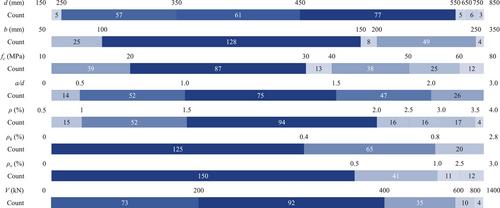
Structural performance prediction for structures and their components is a critical issue for ensuring the safety of civil engineering structures. Thus, enhancing the reliability of the prediction models with better generalization capability and quantifying the uncertainties of their predictions is significant. However, existing mechanism-driven and data-driven prediction models for reliable engineering applications incorporate complicated modifications on models and are sensitive to the precision of relevant prior knowledge. Focusing on these issues, a novel and concise data-driven approach, named “R2CU” (stands for transforming regression to classification with uncertainty-aware), is proposed to introduce the relative fuzzy prior knowledge into the data-driven prediction models. To enhance generalization capacity, the conventional regression task is transformed into a classification task based on the fuzzy prior knowledge and the experimental data. Then the aleatoric and epistemic uncertainty of the prediction is estimated to provide the confidence interval, which reflects the prediction's trustworthiness. A validation case study based on shear capacity prediction of reinforced concrete (RC) deep beams is carried out. The result proved that the model's generalization capability for extrapolating has been effectively enhanced with the proposed approach (the prediction precision was raised 80%). Meanwhile, the uncertainties within the model's prediction are rationally estimated, which made the proposed approach a practical alternative for structural performance prediction.
期刊介绍:
Computer-Aided Civil and Infrastructure Engineering stands as a scholarly, peer-reviewed archival journal, serving as a vital link between advancements in computer technology and civil and infrastructure engineering. The journal serves as a distinctive platform for the publication of original articles, spotlighting novel computational techniques and inventive applications of computers. Specifically, it concentrates on recent progress in computer and information technologies, fostering the development and application of emerging computing paradigms.
Encompassing a broad scope, the journal addresses bridge, construction, environmental, highway, geotechnical, structural, transportation, and water resources engineering. It extends its reach to the management of infrastructure systems, covering domains such as highways, bridges, pavements, airports, and utilities. The journal delves into areas like artificial intelligence, cognitive modeling, concurrent engineering, database management, distributed computing, evolutionary computing, fuzzy logic, genetic algorithms, geometric modeling, internet-based technologies, knowledge discovery and engineering, machine learning, mobile computing, multimedia technologies, networking, neural network computing, optimization and search, parallel processing, robotics, smart structures, software engineering, virtual reality, and visualization techniques.




 京公网安备 11010802042870号
京ICP备2023020795号-1
京公网安备 11010802042870号
京ICP备2023020795号-1

 分享
分享
 求助内容:
求助内容: 应助结果提醒方式:
 扫码关注我们
