Jihang Liu, Doris Keh Ting Ng, Yul Koh, Subhranu Samanta, Weiguo Chen, Md Hazwani Khairy Md Husni, Merugu Srinivas, Qingxin Zhang, Fuu Ming Kai, Peter Hyun Kee Chang, Yao Zhu
{"title":"High-Performance Piezoelectric Micro Diaphragm Hydrogen Sensor","authors":"Jihang Liu, Doris Keh Ting Ng, Yul Koh, Subhranu Samanta, Weiguo Chen, Md Hazwani Khairy Md Husni, Merugu Srinivas, Qingxin Zhang, Fuu Ming Kai, Peter Hyun Kee Chang, Yao Zhu","doi":"10.1021/acssensors.4c03069","DOIUrl":null,"url":null,"abstract":"Highly sensitive, selective, and compact hydrogen (H<sub>2</sub>) sensors for safety and process monitoring are needed due to the growing adoption of H<sub>2</sub> as a clean energy carrier. Current resonant frequency-based H<sub>2</sub> sensors face a critical challenge in simultaneously achieving high sensitivity, low operating frequency, and miniaturization while maintaining a high figure of merit (FOM). This study addresses these challenges by introducing a novel piezoelectric micro diagram (PMD) H<sub>2</sub> sensor that achieves an unprecedented FOM exceeding 10<sup>4</sup>. The sensor uniquely integrates a PMD resonator with a palladium (Pd) sensing layer, operating on a stress-based mechanism distinct from traditional mass-loading principles. Despite a low operating frequency of 150 kHz, the sensor demonstrates a remarkable sensitivity of 18.5 kHz/% H<sub>2</sub>. Comprehensive characterization also reveals a minimal cross-sensitivity to humidity and common gases and a compact form factor (600 μm lateral length) suitable for IC integration. The sensor’s performance was systematically evaluated across various Pd thicknesses (40–125 nm) and piezoelectric stack covering ratios (50% and 70%), revealing a trade-off between sensitivity and response time. This PMD H<sub>2</sub> sensor represents a significant advancement in resonant frequency-based H<sub>2</sub> sensing, offering superior sensitivity, compact size, and robust performance for diverse applications in H<sub>2</sub> detection and monitoring.","PeriodicalId":24,"journal":{"name":"ACS Sensors","volume":"16 1","pages":""},"PeriodicalIF":9.1000,"publicationDate":"2025-03-13","publicationTypes":"Journal Article","fieldsOfStudy":null,"isOpenAccess":false,"openAccessPdf":"","citationCount":"0","resultStr":null,"platform":"Semanticscholar","paperid":null,"PeriodicalName":"ACS Sensors","FirstCategoryId":"92","ListUrlMain":"https://doi.org/10.1021/acssensors.4c03069","RegionNum":1,"RegionCategory":"化学","ArticlePicture":[],"TitleCN":null,"AbstractTextCN":null,"PMCID":null,"EPubDate":"","PubModel":"","JCR":"Q1","JCRName":"CHEMISTRY, ANALYTICAL","Score":null,"Total":0}
引用次数: 0
Abstract
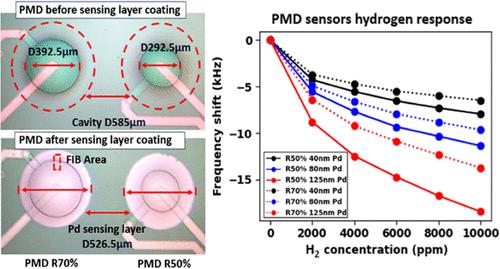
Highly sensitive, selective, and compact hydrogen (H2) sensors for safety and process monitoring are needed due to the growing adoption of H2 as a clean energy carrier. Current resonant frequency-based H2 sensors face a critical challenge in simultaneously achieving high sensitivity, low operating frequency, and miniaturization while maintaining a high figure of merit (FOM). This study addresses these challenges by introducing a novel piezoelectric micro diagram (PMD) H2 sensor that achieves an unprecedented FOM exceeding 104. The sensor uniquely integrates a PMD resonator with a palladium (Pd) sensing layer, operating on a stress-based mechanism distinct from traditional mass-loading principles. Despite a low operating frequency of 150 kHz, the sensor demonstrates a remarkable sensitivity of 18.5 kHz/% H2. Comprehensive characterization also reveals a minimal cross-sensitivity to humidity and common gases and a compact form factor (600 μm lateral length) suitable for IC integration. The sensor’s performance was systematically evaluated across various Pd thicknesses (40–125 nm) and piezoelectric stack covering ratios (50% and 70%), revealing a trade-off between sensitivity and response time. This PMD H2 sensor represents a significant advancement in resonant frequency-based H2 sensing, offering superior sensitivity, compact size, and robust performance for diverse applications in H2 detection and monitoring.
期刊介绍:
ACS Sensors is a peer-reviewed research journal that focuses on the dissemination of new and original knowledge in the field of sensor science, particularly those that selectively sense chemical or biological species or processes. The journal covers a broad range of topics, including but not limited to biosensors, chemical sensors, gas sensors, intracellular sensors, single molecule sensors, cell chips, and microfluidic devices. It aims to publish articles that address conceptual advances in sensing technology applicable to various types of analytes or application papers that report on the use of existing sensing concepts in new ways or for new analytes.



 京公网安备 11010802042870号
京ICP备2023020795号-1
京公网安备 11010802042870号
京ICP备2023020795号-1

 分享
分享
 求助内容:
求助内容: 应助结果提醒方式:
 扫码关注我们
