Xinyu Du , Yi Liu , Wei Zhao , Lin Fan , Song Mo , Lei Zhai , Minhui He , Dan Peng , Qiuhong Mou , Gong Wang
{"title":"3D printing of heat-resistant thermosetting polyimide composite with high dimensional accuracy and mechanical property","authors":"Xinyu Du , Yi Liu , Wei Zhao , Lin Fan , Song Mo , Lei Zhai , Minhui He , Dan Peng , Qiuhong Mou , Gong Wang","doi":"10.1016/j.compositesb.2025.112394","DOIUrl":null,"url":null,"abstract":"<div><div>3D printing of polyimide parts with high heat resistance, dimensional accuracy and mechanical property is quite challenging because the manufacturing requirements restrict molecular structural design. Hence, combination of molecular design of thermosetting polyimide oligomer and a two-step reactive 3D printing strategy is conducted. Siloxane-containing phenylethynyl-terminated polyimide oligomer powders with milled carbon fibers are developed, which can be precured with laser scanning in a selective laser sintering (SLS) equipment, forming self-standing green parts with complex geometries. These green parts can be thermally postcured to polyimide parts with high dimensional stability. The linear shrinkage in Z axis is less than 4.74 %. Oligomers experience crosslinking of phenylethynyl groups and oxidation crosslinking of siloxane units during SLS and postcuring. Therefore, the printed polyimide parts give a tensile strength of 82 MPa and a glass transition temperature of 419 °C. Honeycombs fabricated by this strategy give higher specific compression strength and can withstand temperature as high as 400 °C. The wear-resistant self-lubricating materials prepared by this approach exhibit a reliable tribological property after atomic oxygen and ultraviolet irradiations. These findings will provide useful insight for designing and fabricating structural components with complex shapes that might be applied in aerospace extreme environment.</div></div>","PeriodicalId":10660,"journal":{"name":"Composites Part B: Engineering","volume":"298 ","pages":"Article 112394"},"PeriodicalIF":14.2000,"publicationDate":"2025-03-10","publicationTypes":"Journal Article","fieldsOfStudy":null,"isOpenAccess":false,"openAccessPdf":"","citationCount":"0","resultStr":null,"platform":"Semanticscholar","paperid":null,"PeriodicalName":"Composites Part B: Engineering","FirstCategoryId":"5","ListUrlMain":"https://www.sciencedirect.com/science/article/pii/S1359836825002860","RegionNum":1,"RegionCategory":"材料科学","ArticlePicture":[],"TitleCN":null,"AbstractTextCN":null,"PMCID":null,"EPubDate":"","PubModel":"","JCR":"Q1","JCRName":"ENGINEERING, MULTIDISCIPLINARY","Score":null,"Total":0}
引用次数: 0
Abstract
3D printing of polyimide parts with high heat resistance, dimensional accuracy and mechanical property is quite challenging because the manufacturing requirements restrict molecular structural design. Hence, combination of molecular design of thermosetting polyimide oligomer and a two-step reactive 3D printing strategy is conducted. Siloxane-containing phenylethynyl-terminated polyimide oligomer powders with milled carbon fibers are developed, which can be precured with laser scanning in a selective laser sintering (SLS) equipment, forming self-standing green parts with complex geometries. These green parts can be thermally postcured to polyimide parts with high dimensional stability. The linear shrinkage in Z axis is less than 4.74 %. Oligomers experience crosslinking of phenylethynyl groups and oxidation crosslinking of siloxane units during SLS and postcuring. Therefore, the printed polyimide parts give a tensile strength of 82 MPa and a glass transition temperature of 419 °C. Honeycombs fabricated by this strategy give higher specific compression strength and can withstand temperature as high as 400 °C. The wear-resistant self-lubricating materials prepared by this approach exhibit a reliable tribological property after atomic oxygen and ultraviolet irradiations. These findings will provide useful insight for designing and fabricating structural components with complex shapes that might be applied in aerospace extreme environment.
期刊介绍:
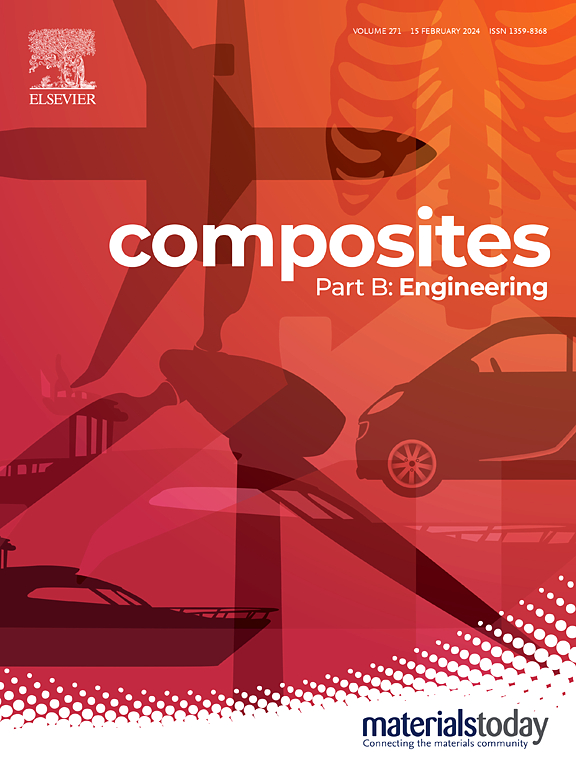
Composites Part B: Engineering is a journal that publishes impactful research of high quality on composite materials. This research is supported by fundamental mechanics and materials science and engineering approaches. The targeted research can cover a wide range of length scales, ranging from nano to micro and meso, and even to the full product and structure level. The journal specifically focuses on engineering applications that involve high performance composites. These applications can range from low volume and high cost to high volume and low cost composite development.
The main goal of the journal is to provide a platform for the prompt publication of original and high quality research. The emphasis is on design, development, modeling, validation, and manufacturing of engineering details and concepts. The journal welcomes both basic research papers and proposals for review articles. Authors are encouraged to address challenges across various application areas. These areas include, but are not limited to, aerospace, automotive, and other surface transportation. The journal also covers energy-related applications, with a focus on renewable energy. Other application areas include infrastructure, off-shore and maritime projects, health care technology, and recreational products.



 京公网安备 11010802042870号
京ICP备2023020795号-1
京公网安备 11010802042870号
京ICP备2023020795号-1

 分享
分享
 求助内容:
求助内容: 应助结果提醒方式:
 扫码关注我们
