Hui Qiao , Jiangtao Wu , Dongmei Zhang , Jicheng Cui , Wenxia Zhang , Yingqi Li
{"title":"Engineering nanodiamond platform for tumor light up and high-performance cancer treatment","authors":"Hui Qiao , Jiangtao Wu , Dongmei Zhang , Jicheng Cui , Wenxia Zhang , Yingqi Li","doi":"10.1016/j.partic.2025.02.018","DOIUrl":null,"url":null,"abstract":"<div><div>Many small molecule chemotherapy drugs suffer from the disadvantages of poor water solubility, tumor off-target and resistance to chemotherapeutics, resulting in severe toxic side effects. Herein, a folic acid-targeted nanodiamond drug delivery system (NPF/D) was fabricated. The fluorescence of doxorubicin (DOX) is quenched when DOX is immobilized on the nanodiamond (ND) through disulfide bonds, which can be broken by overexpressed endogenous glutathione (GSH) within tumor cells to lead to drug release and GSH depletion, thereby selectively killing cancer cells instead of normal cells and increasing cancer cells sensitivity to chemotherapy drugs. In addition, the NPF/D system can overcome drug efflux and improve the efficacy of chemotherapy against drug resistance. It was of great importance that NPF/D effectively accumulated at the tumor site and significantly inhibited tumor growth, where the tumor volume was reduced by about 3 times compared to the control group. Interestingly, the combination of NPF/D with Toll-like receptor 7 agonist imiquimod (R837) and programmed cell death ligand 1 antibody (<em>anti</em>-PD-L1) markedly inhibited distant tumor growth, indicating good immune response. Therefore, such a nanodiamond nanoplatform with the integration of various functions has successfully demonstrated its promise for safe and efficient cancer treatment.</div></div>","PeriodicalId":401,"journal":{"name":"Particuology","volume":"99 ","pages":"Pages 162-172"},"PeriodicalIF":4.3000,"publicationDate":"2025-04-01","publicationTypes":"Journal Article","fieldsOfStudy":null,"isOpenAccess":false,"openAccessPdf":"","citationCount":"0","resultStr":null,"platform":"Semanticscholar","paperid":null,"PeriodicalName":"Particuology","FirstCategoryId":"88","ListUrlMain":"https://www.sciencedirect.com/science/article/pii/S1674200125000549","RegionNum":2,"RegionCategory":"材料科学","ArticlePicture":[],"TitleCN":null,"AbstractTextCN":null,"PMCID":null,"EPubDate":"2025/3/5 0:00:00","PubModel":"Epub","JCR":"Q2","JCRName":"ENGINEERING, CHEMICAL","Score":null,"Total":0}
引用次数: 0
Abstract
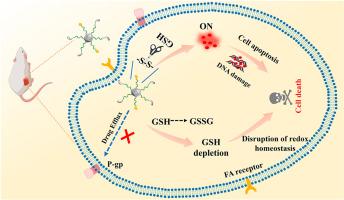
Many small molecule chemotherapy drugs suffer from the disadvantages of poor water solubility, tumor off-target and resistance to chemotherapeutics, resulting in severe toxic side effects. Herein, a folic acid-targeted nanodiamond drug delivery system (NPF/D) was fabricated. The fluorescence of doxorubicin (DOX) is quenched when DOX is immobilized on the nanodiamond (ND) through disulfide bonds, which can be broken by overexpressed endogenous glutathione (GSH) within tumor cells to lead to drug release and GSH depletion, thereby selectively killing cancer cells instead of normal cells and increasing cancer cells sensitivity to chemotherapy drugs. In addition, the NPF/D system can overcome drug efflux and improve the efficacy of chemotherapy against drug resistance. It was of great importance that NPF/D effectively accumulated at the tumor site and significantly inhibited tumor growth, where the tumor volume was reduced by about 3 times compared to the control group. Interestingly, the combination of NPF/D with Toll-like receptor 7 agonist imiquimod (R837) and programmed cell death ligand 1 antibody (anti-PD-L1) markedly inhibited distant tumor growth, indicating good immune response. Therefore, such a nanodiamond nanoplatform with the integration of various functions has successfully demonstrated its promise for safe and efficient cancer treatment.
期刊介绍:
The word ‘particuology’ was coined to parallel the discipline for the science and technology of particles.
Particuology is an interdisciplinary journal that publishes frontier research articles and critical reviews on the discovery, formulation and engineering of particulate materials, processes and systems. It especially welcomes contributions utilising advanced theoretical, modelling and measurement methods to enable the discovery and creation of new particulate materials, and the manufacturing of functional particulate-based products, such as sensors.
Papers are handled by Thematic Editors who oversee contributions from specific subject fields. These fields are classified into: Particle Synthesis and Modification; Particle Characterization and Measurement; Granular Systems and Bulk Solids Technology; Fluidization and Particle-Fluid Systems; Aerosols; and Applications of Particle Technology.
Key topics concerning the creation and processing of particulates include:
-Modelling and simulation of particle formation, collective behaviour of particles and systems for particle production over a broad spectrum of length scales
-Mining of experimental data for particle synthesis and surface properties to facilitate the creation of new materials and processes
-Particle design and preparation including controlled response and sensing functionalities in formation, delivery systems and biological systems, etc.
-Experimental and computational methods for visualization and analysis of particulate system.
These topics are broadly relevant to the production of materials, pharmaceuticals and food, and to the conversion of energy resources to fuels and protection of the environment.



 京公网安备 11010802042870号
京ICP备2023020795号-1
京公网安备 11010802042870号
京ICP备2023020795号-1

 分享
分享
 求助内容:
求助内容: 应助结果提醒方式:
 扫码关注我们
