Moxin Yu , Yuhang Sun , Wenxu Shi , Xiaoting Wang , Chen Zhang , Qingping Ke
{"title":"Synthesis of high-performance magnetic biochar for adsorption of Ni2+ and Co2+from spent lithium-ion battery effluent","authors":"Moxin Yu , Yuhang Sun , Wenxu Shi , Xiaoting Wang , Chen Zhang , Qingping Ke","doi":"10.1016/j.hazadv.2025.100627","DOIUrl":null,"url":null,"abstract":"<div><div>The recovery of heavy metal ion pollutants, particularly Ni<sup>2+</sup> and Co<sup>2+</sup>, from lithium-ion battery effluent represents a pivotal focus in contemporary environmental research. In this study, the magnetic biochar (ISBC<sub>x-y</sub>) was synthesized co-hydrothermal method using aloe vera skin (AL) as raw material and Fe<sub>2</sub>(SO<sub>4</sub>)<sub>3</sub> as and Fe and sulfur source, respectively. The structural and chemical properties of the as-prepared ISBC<sub>x-y</sub> was characterized by BET, SEM, FTIR, and Zeta analysis, and its adsorption performance for Ni<sup>2+</sup>and Co<sup>2+</sup> in waste water was also evaluated. The results show that ISBC<sub>5-1</sub> exhibited a lamellar-like surface with many small flakes, demonstrating a specific surface area of 38 m<sup>2</sup><strong>/</strong>g and a total pore volume of 0.06 cm<sup>3</sup><strong>/</strong>g, featuring a hierarchical porous structure. The surface chemistry of ISBC<sub>5-1</sub> is enriched with active functional groups, such as O, S, and Fe, facilitating efficient interactions with Ni<sup>2+</sup> and Co<sup>2+</sup> via mechanisms including ion exchange, electrostatic adsorption, complexation, and co-precipitation. Adsorption studies revealed that ISBC<sub>5-1</sub>′s interaction with these metal ions conformed to the Langmuir adsorption isotherm and pseudo-second-order kinetic model, highlighting predominantly chemical adsorption characteristics. Theoretical maximum adsorption capacities calculated from the Langmuir model indicate impressive values of 153.14 mg/g for Ni<sup>2+</sup> and 163.67 mg/g for Co<sup>2+</sup>. In addition, at pH 10, ISBC<sub>5-1</sub> achieves a removal efficiency of nearly 100% for Ni<sup>2+</sup> and Co<sup>2+</sup>, underscoring the significant potential of ISBC<sub>5-1</sub> for effective wastewater treatment applications.</div></div>","PeriodicalId":73763,"journal":{"name":"Journal of hazardous materials advances","volume":"18 ","pages":"Article 100627"},"PeriodicalIF":7.7000,"publicationDate":"2025-02-01","publicationTypes":"Journal Article","fieldsOfStudy":null,"isOpenAccess":false,"openAccessPdf":"","citationCount":"0","resultStr":null,"platform":"Semanticscholar","paperid":null,"PeriodicalName":"Journal of hazardous materials advances","FirstCategoryId":"1085","ListUrlMain":"https://www.sciencedirect.com/science/article/pii/S2772416625000397","RegionNum":0,"RegionCategory":null,"ArticlePicture":[],"TitleCN":null,"AbstractTextCN":null,"PMCID":null,"EPubDate":"","PubModel":"","JCR":"Q2","JCRName":"ENGINEERING, ENVIRONMENTAL","Score":null,"Total":0}
引用次数: 0
Abstract
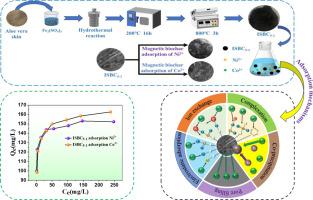
The recovery of heavy metal ion pollutants, particularly Ni2+ and Co2+, from lithium-ion battery effluent represents a pivotal focus in contemporary environmental research. In this study, the magnetic biochar (ISBCx-y) was synthesized co-hydrothermal method using aloe vera skin (AL) as raw material and Fe2(SO4)3 as and Fe and sulfur source, respectively. The structural and chemical properties of the as-prepared ISBCx-y was characterized by BET, SEM, FTIR, and Zeta analysis, and its adsorption performance for Ni2+and Co2+ in waste water was also evaluated. The results show that ISBC5-1 exhibited a lamellar-like surface with many small flakes, demonstrating a specific surface area of 38 m2/g and a total pore volume of 0.06 cm3/g, featuring a hierarchical porous structure. The surface chemistry of ISBC5-1 is enriched with active functional groups, such as O, S, and Fe, facilitating efficient interactions with Ni2+ and Co2+ via mechanisms including ion exchange, electrostatic adsorption, complexation, and co-precipitation. Adsorption studies revealed that ISBC5-1′s interaction with these metal ions conformed to the Langmuir adsorption isotherm and pseudo-second-order kinetic model, highlighting predominantly chemical adsorption characteristics. Theoretical maximum adsorption capacities calculated from the Langmuir model indicate impressive values of 153.14 mg/g for Ni2+ and 163.67 mg/g for Co2+. In addition, at pH 10, ISBC5-1 achieves a removal efficiency of nearly 100% for Ni2+ and Co2+, underscoring the significant potential of ISBC5-1 for effective wastewater treatment applications.




 京公网安备 11010802042870号
京ICP备2023020795号-1
京公网安备 11010802042870号
京ICP备2023020795号-1

 分享
分享
 求助内容:
求助内容: 应助结果提醒方式:
 扫码关注我们
