{"title":"Food oxylipins: Formation, distribution, analysis and implications for health","authors":"Di Rao, Shimin Wu","doi":"10.1016/j.tifs.2025.104968","DOIUrl":null,"url":null,"abstract":"<div><h3>Background</h3><div>Oxylipins are bioactive lipid mediators derived from polyunsaturated fatty acids (PUFAs). They are involved in metabolism in the body and contribute to host defense in plants. Although several oxylipins are discussed to be absorbed after oral intake, there is a lack of sufficient evidence and consensus on whether oxylipins ingested from food can directly influence metabolism. In recent decades, the consumption of foods rich in n-6 PUFAs has significantly increased, which may alter the profile of dietary oxylipins. Therefore, focusing on the distribution of oxylipins in food, their bioactivity and bioavailability, and their potential impact on health represents a key step in advancing the understanding of oxylipins and the significance of their presence in the food supply.</div></div><div><h3>Scope and approach</h3><div>This review provides an overview of current research on oxylipins in food, including their formation pathways, distribution and biological activities. Then, advanced analytical methods for oxylipins and areas requiring further research are summarized.</div></div><div><h3>Key findings and conclusions</h3><div>Oxylipins are widely distributed in PUFA-rich foods and are mainly formed via enzymatic and non-enzymatic oxidation. However, due to the diversity of PUFA species and metabolic pathways, the types and concentrations of oxylipins in food are significantly different. Furthermore, oxylipins may serve as indicators for assessing lipid oxidation and provide molecular information about oxidation products in food. Some oxylipins in foods can be absorbed and participate in metabolism. Moreover, the harmonization and standardization of oxylipin analytical procedures are necessary to ensure the reproducibility and comparability of experimental results.</div></div>","PeriodicalId":441,"journal":{"name":"Trends in Food Science & Technology","volume":"159 ","pages":"Article 104968"},"PeriodicalIF":15.4000,"publicationDate":"2025-05-01","publicationTypes":"Journal Article","fieldsOfStudy":null,"isOpenAccess":false,"openAccessPdf":"","citationCount":"0","resultStr":null,"platform":"Semanticscholar","paperid":null,"PeriodicalName":"Trends in Food Science & Technology","FirstCategoryId":"97","ListUrlMain":"https://www.sciencedirect.com/science/article/pii/S0924224425001049","RegionNum":1,"RegionCategory":"农林科学","ArticlePicture":[],"TitleCN":null,"AbstractTextCN":null,"PMCID":null,"EPubDate":"2025/3/10 0:00:00","PubModel":"Epub","JCR":"Q1","JCRName":"FOOD SCIENCE & TECHNOLOGY","Score":null,"Total":0}
引用次数: 0
Abstract
Background
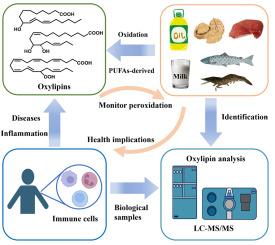
Oxylipins are bioactive lipid mediators derived from polyunsaturated fatty acids (PUFAs). They are involved in metabolism in the body and contribute to host defense in plants. Although several oxylipins are discussed to be absorbed after oral intake, there is a lack of sufficient evidence and consensus on whether oxylipins ingested from food can directly influence metabolism. In recent decades, the consumption of foods rich in n-6 PUFAs has significantly increased, which may alter the profile of dietary oxylipins. Therefore, focusing on the distribution of oxylipins in food, their bioactivity and bioavailability, and their potential impact on health represents a key step in advancing the understanding of oxylipins and the significance of their presence in the food supply.
Scope and approach
This review provides an overview of current research on oxylipins in food, including their formation pathways, distribution and biological activities. Then, advanced analytical methods for oxylipins and areas requiring further research are summarized.
Key findings and conclusions
Oxylipins are widely distributed in PUFA-rich foods and are mainly formed via enzymatic and non-enzymatic oxidation. However, due to the diversity of PUFA species and metabolic pathways, the types and concentrations of oxylipins in food are significantly different. Furthermore, oxylipins may serve as indicators for assessing lipid oxidation and provide molecular information about oxidation products in food. Some oxylipins in foods can be absorbed and participate in metabolism. Moreover, the harmonization and standardization of oxylipin analytical procedures are necessary to ensure the reproducibility and comparability of experimental results.
期刊介绍:
Trends in Food Science & Technology is a prestigious international journal that specializes in peer-reviewed articles covering the latest advancements in technology, food science, and human nutrition. It serves as a bridge between specialized primary journals and general trade magazines, providing readable and scientifically rigorous reviews and commentaries on current research developments and their potential applications in the food industry.
Unlike traditional journals, Trends in Food Science & Technology does not publish original research papers. Instead, it focuses on critical and comprehensive reviews to offer valuable insights for professionals in the field. By bringing together cutting-edge research and industry applications, this journal plays a vital role in disseminating knowledge and facilitating advancements in the food science and technology sector.



 京公网安备 11010802042870号
京ICP备2023020795号-1
京公网安备 11010802042870号
京ICP备2023020795号-1

 分享
分享
 求助内容:
求助内容: 应助结果提醒方式:
 扫码关注我们
