Wenqing Yu , Liwei Hu , Yige Wei , Chengyu Xue , Yunfei Liu , Huixu Xie
{"title":"Advances of novel hydrogels in the healing process of alveolar sockets","authors":"Wenqing Yu , Liwei Hu , Yige Wei , Chengyu Xue , Yunfei Liu , Huixu Xie","doi":"10.1016/j.bioadv.2025.214280","DOIUrl":null,"url":null,"abstract":"<div><div>Tooth extraction is a common oral surgical procedure that often leads to delayed alveolar socket healing due to the complexity of the oral microenvironment, which can hinder the patient's aesthetic and functional recovery. Effective alveolar socket healing requires a multidisciplinary approach. Recent advancements in materials science and bioengineering have facilitated the development of innovative strategies, with hydrogels emerging as ideal restorative materials for alveolar socket repair due to their superior properties. This review provides an overview of recent advances in hydrogels for alveolar socket healing, focusing on their classification, physical properties (e.g., mechanical strength, swelling behavior, degradation rate, and injectability), biological functions, and applications in relevant animal models. Specifically, the bone-regenerative and antimicrobial properties of hydrogels are highlighted. Furthermore, this review identifies future directions and addresses challenges associated with the clinical application of hydrogels in extraction socket healing.</div></div>","PeriodicalId":51111,"journal":{"name":"Materials Science & Engineering C-Materials for Biological Applications","volume":"173 ","pages":"Article 214280"},"PeriodicalIF":6.0000,"publicationDate":"2025-03-09","publicationTypes":"Journal Article","fieldsOfStudy":null,"isOpenAccess":false,"openAccessPdf":"","citationCount":"0","resultStr":null,"platform":"Semanticscholar","paperid":null,"PeriodicalName":"Materials Science & Engineering C-Materials for Biological Applications","FirstCategoryId":"1085","ListUrlMain":"https://www.sciencedirect.com/science/article/pii/S2772950825001074","RegionNum":2,"RegionCategory":"医学","ArticlePicture":[],"TitleCN":null,"AbstractTextCN":null,"PMCID":null,"EPubDate":"","PubModel":"","JCR":"Q2","JCRName":"MATERIALS SCIENCE, BIOMATERIALS","Score":null,"Total":0}
引用次数: 0
Abstract
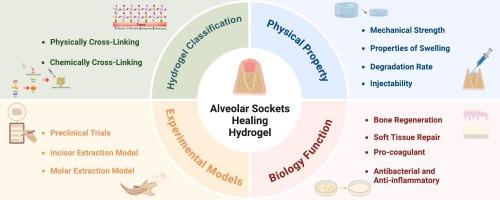
Tooth extraction is a common oral surgical procedure that often leads to delayed alveolar socket healing due to the complexity of the oral microenvironment, which can hinder the patient's aesthetic and functional recovery. Effective alveolar socket healing requires a multidisciplinary approach. Recent advancements in materials science and bioengineering have facilitated the development of innovative strategies, with hydrogels emerging as ideal restorative materials for alveolar socket repair due to their superior properties. This review provides an overview of recent advances in hydrogels for alveolar socket healing, focusing on their classification, physical properties (e.g., mechanical strength, swelling behavior, degradation rate, and injectability), biological functions, and applications in relevant animal models. Specifically, the bone-regenerative and antimicrobial properties of hydrogels are highlighted. Furthermore, this review identifies future directions and addresses challenges associated with the clinical application of hydrogels in extraction socket healing.
期刊介绍:
Biomaterials Advances, previously known as Materials Science and Engineering: C-Materials for Biological Applications (P-ISSN: 0928-4931, E-ISSN: 1873-0191). Includes topics at the interface of the biomedical sciences and materials engineering. These topics include:
• Bioinspired and biomimetic materials for medical applications
• Materials of biological origin for medical applications
• Materials for "active" medical applications
• Self-assembling and self-healing materials for medical applications
• "Smart" (i.e., stimulus-response) materials for medical applications
• Ceramic, metallic, polymeric, and composite materials for medical applications
• Materials for in vivo sensing
• Materials for in vivo imaging
• Materials for delivery of pharmacologic agents and vaccines
• Novel approaches for characterizing and modeling materials for medical applications
Manuscripts on biological topics without a materials science component, or manuscripts on materials science without biological applications, will not be considered for publication in Materials Science and Engineering C. New submissions are first assessed for language, scope and originality (plagiarism check) and can be desk rejected before review if they need English language improvements, are out of scope or present excessive duplication with published sources.
Biomaterials Advances sits within Elsevier''s biomaterials science portfolio alongside Biomaterials, Materials Today Bio and Biomaterials and Biosystems. As part of the broader Materials Today family, Biomaterials Advances offers authors rigorous peer review, rapid decisions, and high visibility. We look forward to receiving your submissions!



 京公网安备 11010802042870号
京ICP备2023020795号-1
京公网安备 11010802042870号
京ICP备2023020795号-1

 分享
分享
 求助内容:
求助内容: 应助结果提醒方式:
 扫码关注我们
