Engineering and Structural Elucidation of a Sac7d-Derived IgG Fc-Specific Affitin and Its Application for the Light-Controlled Affinity Purification of Antibodies
Felix Veitl, Andreas Eichinger, Peter Mayrhofer, Markus R. Anneser, Mauricio Testanera, Kilian Rauscher, Matthias Lenz, Arne Skerra
{"title":"Engineering and Structural Elucidation of a Sac7d-Derived IgG Fc-Specific Affitin and Its Application for the Light-Controlled Affinity Purification of Antibodies","authors":"Felix Veitl, Andreas Eichinger, Peter Mayrhofer, Markus R. Anneser, Mauricio Testanera, Kilian Rauscher, Matthias Lenz, Arne Skerra","doi":"10.1002/cbic.202500102","DOIUrl":null,"url":null,"abstract":"<p>While protein A affinity chromatography is widely established for antibody purification, the acidic elution conditions often lead to protein aggregation and deamidation. Here, an alternative approach is described for the purification of antibodies utilizing an engineered binding protein based on the archaebacterial Sac7d scaffold in combination with light-controlled α-CD affinity chromatography (Excitography). Starting from a published affitin molecule, a monomeric protein version (C3A24) was engineered by substituting the unpaired thiol side chain Cys24 within the binding site by Ala, and, unexpectedly, its binding activity towards the human IgG1 Fc region was even improved (<i>K</i><sub>D</sub> = 76 nM). X-ray analysis of the cocrystallized C3A24 with a recombinant human Fc fragment revealed a 2:1 stoichiometry, with a binding site at the junction between the C<sub>H</sub>2 and C<sub>H</sub>3 domains. Interestingly, this binding site coincides with the ones of protein A, protein G, and the neonatal Fc receptor (FcRn). The affitin/Fc interaction is dominated by a network of hydrogen bonds, whereas, unpredicted by the initial affitin design, the two C-terminal Lys residues are also involved via a salt bridge and another hydrogen bond. Using the Azo-tagged C3A24, we purified clinically relevant antibodies from cell culture medium in a single step under physiological buffer conditions.</p>","PeriodicalId":140,"journal":{"name":"ChemBioChem","volume":"26 11","pages":""},"PeriodicalIF":2.8000,"publicationDate":"2025-03-14","publicationTypes":"Journal Article","fieldsOfStudy":null,"isOpenAccess":false,"openAccessPdf":"https://onlinelibrary.wiley.com/doi/epdf/10.1002/cbic.202500102","citationCount":"0","resultStr":null,"platform":"Semanticscholar","paperid":null,"PeriodicalName":"ChemBioChem","FirstCategoryId":"99","ListUrlMain":"https://chemistry-europe.onlinelibrary.wiley.com/doi/10.1002/cbic.202500102","RegionNum":4,"RegionCategory":"生物学","ArticlePicture":[],"TitleCN":null,"AbstractTextCN":null,"PMCID":null,"EPubDate":"","PubModel":"","JCR":"Q3","JCRName":"BIOCHEMISTRY & MOLECULAR BIOLOGY","Score":null,"Total":0}
引用次数: 0
Abstract
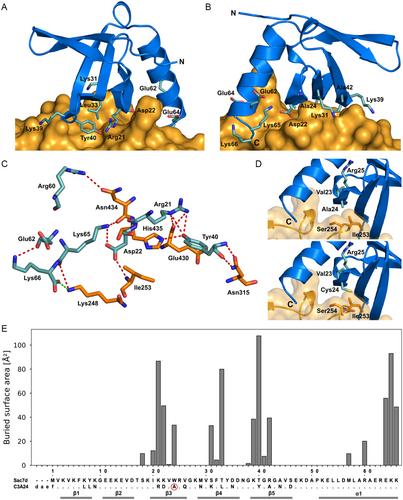
While protein A affinity chromatography is widely established for antibody purification, the acidic elution conditions often lead to protein aggregation and deamidation. Here, an alternative approach is described for the purification of antibodies utilizing an engineered binding protein based on the archaebacterial Sac7d scaffold in combination with light-controlled α-CD affinity chromatography (Excitography). Starting from a published affitin molecule, a monomeric protein version (C3A24) was engineered by substituting the unpaired thiol side chain Cys24 within the binding site by Ala, and, unexpectedly, its binding activity towards the human IgG1 Fc region was even improved (KD = 76 nM). X-ray analysis of the cocrystallized C3A24 with a recombinant human Fc fragment revealed a 2:1 stoichiometry, with a binding site at the junction between the CH2 and CH3 domains. Interestingly, this binding site coincides with the ones of protein A, protein G, and the neonatal Fc receptor (FcRn). The affitin/Fc interaction is dominated by a network of hydrogen bonds, whereas, unpredicted by the initial affitin design, the two C-terminal Lys residues are also involved via a salt bridge and another hydrogen bond. Using the Azo-tagged C3A24, we purified clinically relevant antibodies from cell culture medium in a single step under physiological buffer conditions.
虽然蛋白 A 亲和层析法被广泛用于抗体纯化,但酸性洗脱条件往往会导致蛋白质聚集和脱酰胺。在这里,我们介绍了另一种纯化抗体的方法,即利用基于古细菌 Sac7d 支架的工程结合蛋白,结合光控 α-CD 亲和层析(Excitography)。从已发表的亲和素分子开始,我们用 Ala 取代了结合位点上未配对的硫醇侧链 Cys24,从而设计出了单体蛋白版本(C3A24),出乎意料的是,它与人类 IgG1 Fc 区域的结合活性甚至得到了提高(KD = 76 nM)。对 C3A24 与重组人 Fc 片段的共晶体进行的 X 射线分析表明,结合位点位于 CH2 和 CH3 结构域的交界处,两者的比例为 2:1。有趣的是,这个结合位点与蛋白 A、蛋白 G 和新生儿 Fc 受体(FcRn)的结合位点相吻合。亲和素与 Fc 的相互作用主要是通过氢键网络进行的,而最初的亲和素设计未曾预料到的是,两个 C 端赖氨酸残基也通过盐桥和另一个氢键参与其中。利用偶氮标记的 C3A24,我们在生理缓冲液条件下从细胞培养基中一步就纯化出了临床相关抗体。
期刊介绍:
ChemBioChem (Impact Factor 2018: 2.641) publishes important breakthroughs across all areas at the interface of chemistry and biology, including the fields of chemical biology, bioorganic chemistry, bioinorganic chemistry, synthetic biology, biocatalysis, bionanotechnology, and biomaterials. It is published on behalf of Chemistry Europe, an association of 16 European chemical societies, and supported by the Asian Chemical Editorial Society (ACES).






 京公网安备 11010802042870号
京ICP备2023020795号-1
京公网安备 11010802042870号
京ICP备2023020795号-1

 分享
分享
 求助内容:
求助内容: 应助结果提醒方式:
 扫码关注我们
