Sizhe Qiu, Bozhen Hu, Jing Zhao, Weiren Xu, Aidong Yang
{"title":"Seq2Topt: a sequence-based deep learning predictor of enzyme optimal temperature.","authors":"Sizhe Qiu, Bozhen Hu, Jing Zhao, Weiren Xu, Aidong Yang","doi":"10.1093/bib/bbaf114","DOIUrl":null,"url":null,"abstract":"<p><p>An accurate deep learning predictor is needed for enzyme optimal temperature (${T}_{opt}$), which quantitatively describes how temperature affects the enzyme catalytic activity. In comparison with existing models, a new model developed in this study, Seq2Topt, reached a superior accuracy on ${T}_{opt}$ prediction just using protein sequences (RMSE = 12.26°C and R2 = 0.57), and could capture key protein regions for enzyme ${T}_{opt}$ with multi-head attention on residues. Through case studies on thermophilic enzyme selection and predicting enzyme ${T}_{opt}$ shifts caused by point mutations, Seq2Topt was demonstrated as a promising computational tool for enzyme mining and in-silico enzyme design. Additionally, accurate deep learning predictors of enzyme optimal pH (Seq2pHopt, RMSE = 0.88 and R2 = 0.42) and melting temperature (Seq2Tm, RMSE = 7.57 °C and R2 = 0.64) were developed based on the model architecture of Seq2Topt, suggesting that the development of Seq2Topt could potentially give rise to a useful prediction platform of enzymes.</p>","PeriodicalId":9209,"journal":{"name":"Briefings in bioinformatics","volume":"26 2","pages":""},"PeriodicalIF":7.7000,"publicationDate":"2025-03-04","publicationTypes":"Journal Article","fieldsOfStudy":null,"isOpenAccess":false,"openAccessPdf":"https://www.ncbi.nlm.nih.gov/pmc/articles/PMC11904407/pdf/","citationCount":"0","resultStr":null,"platform":"Semanticscholar","paperid":null,"PeriodicalName":"Briefings in bioinformatics","FirstCategoryId":"99","ListUrlMain":"https://doi.org/10.1093/bib/bbaf114","RegionNum":2,"RegionCategory":"生物学","ArticlePicture":[],"TitleCN":null,"AbstractTextCN":null,"PMCID":null,"EPubDate":"","PubModel":"","JCR":"Q1","JCRName":"BIOCHEMICAL RESEARCH METHODS","Score":null,"Total":0}
引用次数: 0
Abstract
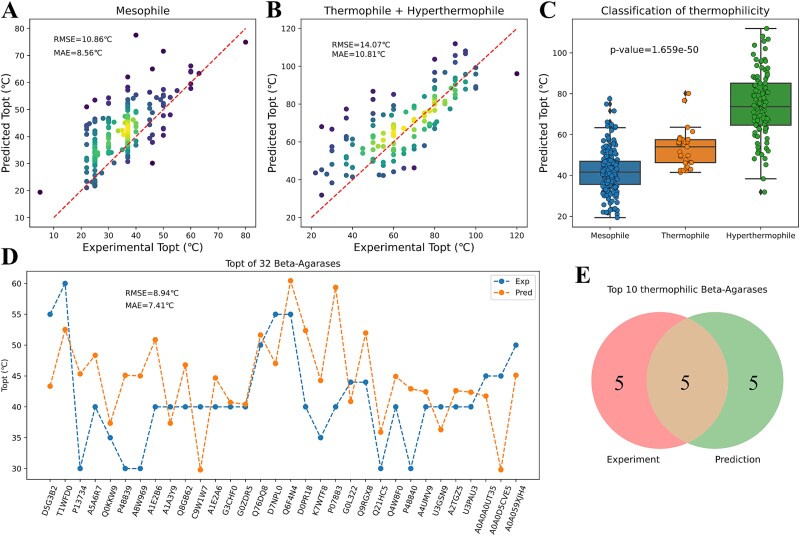
An accurate deep learning predictor is needed for enzyme optimal temperature (${T}_{opt}$), which quantitatively describes how temperature affects the enzyme catalytic activity. In comparison with existing models, a new model developed in this study, Seq2Topt, reached a superior accuracy on ${T}_{opt}$ prediction just using protein sequences (RMSE = 12.26°C and R2 = 0.57), and could capture key protein regions for enzyme ${T}_{opt}$ with multi-head attention on residues. Through case studies on thermophilic enzyme selection and predicting enzyme ${T}_{opt}$ shifts caused by point mutations, Seq2Topt was demonstrated as a promising computational tool for enzyme mining and in-silico enzyme design. Additionally, accurate deep learning predictors of enzyme optimal pH (Seq2pHopt, RMSE = 0.88 and R2 = 0.42) and melting temperature (Seq2Tm, RMSE = 7.57 °C and R2 = 0.64) were developed based on the model architecture of Seq2Topt, suggesting that the development of Seq2Topt could potentially give rise to a useful prediction platform of enzymes.
期刊介绍:
Briefings in Bioinformatics is an international journal serving as a platform for researchers and educators in the life sciences. It also appeals to mathematicians, statisticians, and computer scientists applying their expertise to biological challenges. The journal focuses on reviews tailored for users of databases and analytical tools in contemporary genetics, molecular and systems biology. It stands out by offering practical assistance and guidance to non-specialists in computerized methodologies. Covering a wide range from introductory concepts to specific protocols and analyses, the papers address bacterial, plant, fungal, animal, and human data.
The journal's detailed subject areas include genetic studies of phenotypes and genotypes, mapping, DNA sequencing, expression profiling, gene expression studies, microarrays, alignment methods, protein profiles and HMMs, lipids, metabolic and signaling pathways, structure determination and function prediction, phylogenetic studies, and education and training.





 京公网安备 11010802042870号
京ICP备2023020795号-1
京公网安备 11010802042870号
京ICP备2023020795号-1

 分享
分享
 求助内容:
求助内容: 应助结果提醒方式:
 扫码关注我们
