Katharina Schiller, Nicolás von Ellenrieder, Daniel Mansilla, Chifaou Abdallah, Kassem Jaber, Alfonso Garcia-Asensi, John Thomas, Erica Minato, Jean Gotman, Birgit Frauscher
{"title":"Widespread decoupling of spindles and slow waves in temporal lobe epilepsy","authors":"Katharina Schiller, Nicolás von Ellenrieder, Daniel Mansilla, Chifaou Abdallah, Kassem Jaber, Alfonso Garcia-Asensi, John Thomas, Erica Minato, Jean Gotman, Birgit Frauscher","doi":"10.1111/epi.18359","DOIUrl":null,"url":null,"abstract":"<div>\n \n \n <section>\n \n <h3> Objective</h3>\n \n <p>Memory impairment is common in people with temporal lobe epilepsy (TLE). Recent studies in healthy subjects showed a positive correlation between sleep spindles coupled to slow waves (SWs) and memory performance. We aimed to determine differences in spindle–SW coupling in TLE patients compared to healthy controls using combined high-density electroencephalography and polysomnography.</p>\n </section>\n \n <section>\n \n <h3> Methods</h3>\n \n <p>The study population consisted of 20 patients (12 female, 36.5 ± 9.9 years old) with unilateral drug-resistant TLE (10 left temporal) and 20 age- and sex-matched controls (12 female, 31.2 ± 6.3 years old). Spindles (10–16 Hz, .5–3 s) and SWs (.5–4 Hz) were automatically detected during all N2 and N3 epochs using validated detectors. Coupling of spindles with SWs was defined as overlap between both detected events.</p>\n </section>\n \n <section>\n \n <h3> Results</h3>\n \n <p>Coupled spindle–SW rates (per minute) were globally reduced in patients with TLE compared to healthy controls (median = .18 [interquartile range (IQR) = .08–.36] vs. .35 [IQR = .24–.46], <i>p</i> = .014, <i>d</i> = −.46). This reduction was also found for coupled fast spindle (12–16 Hz)–SW (.06 [IQR = .02–.13] vs. .18 [IQR = .07–.25], <i>p</i> = .013, <i>d</i> = −.46) and slow spindle (10–12 Hz)–SW rates (.11 [IQR = .04–.23] vs. .19 [IQR = .13–.27], <i>p</i> = .034, <i>d</i> = −.40). Within TLE patients, there was no local difference between the coupling rates in the lobe with the epileptic focus compared to the contralateral side (.09 [IQR = .02–.13] vs. .07 [IQR = .02–.13], <i>p</i> = .18). The effect size of the reduction was stronger in early than late sleep for both N2 and N3 sleep (early N2 <i>d</i> = −.50 vs. late N2 <i>d</i> = −.39; early N3 <i>d</i> = −.53 vs. late N3 <i>d</i> = −.47).</p>\n </section>\n \n <section>\n \n <h3> Significance</h3>\n \n <p>Despite a focal epileptic generator, patients with unilateral TLE showed a widespread decoupling between sleep spindles and SWs that was most prominent in early sleep. As coupling was shown to be associated with neuropsychological performance in healthy people, this global decoupling may constitute one potential mechanism of poor memory performance in people with TLE.</p>\n </section>\n </div>","PeriodicalId":11768,"journal":{"name":"Epilepsia","volume":"66 7","pages":"2421-2432"},"PeriodicalIF":6.6000,"publicationDate":"2025-03-14","publicationTypes":"Journal Article","fieldsOfStudy":null,"isOpenAccess":false,"openAccessPdf":"https://onlinelibrary.wiley.com/doi/epdf/10.1111/epi.18359","citationCount":"0","resultStr":null,"platform":"Semanticscholar","paperid":null,"PeriodicalName":"Epilepsia","FirstCategoryId":"3","ListUrlMain":"https://onlinelibrary.wiley.com/doi/10.1111/epi.18359","RegionNum":1,"RegionCategory":"医学","ArticlePicture":[],"TitleCN":null,"AbstractTextCN":null,"PMCID":null,"EPubDate":"","PubModel":"","JCR":"Q1","JCRName":"CLINICAL NEUROLOGY","Score":null,"Total":0}
引用次数: 0
Abstract
Objective
Memory impairment is common in people with temporal lobe epilepsy (TLE). Recent studies in healthy subjects showed a positive correlation between sleep spindles coupled to slow waves (SWs) and memory performance. We aimed to determine differences in spindle–SW coupling in TLE patients compared to healthy controls using combined high-density electroencephalography and polysomnography.
Methods
The study population consisted of 20 patients (12 female, 36.5 ± 9.9 years old) with unilateral drug-resistant TLE (10 left temporal) and 20 age- and sex-matched controls (12 female, 31.2 ± 6.3 years old). Spindles (10–16 Hz, .5–3 s) and SWs (.5–4 Hz) were automatically detected during all N2 and N3 epochs using validated detectors. Coupling of spindles with SWs was defined as overlap between both detected events.
Results
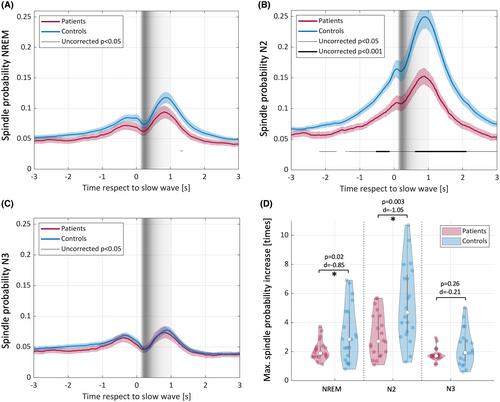
Coupled spindle–SW rates (per minute) were globally reduced in patients with TLE compared to healthy controls (median = .18 [interquartile range (IQR) = .08–.36] vs. .35 [IQR = .24–.46], p = .014, d = −.46). This reduction was also found for coupled fast spindle (12–16 Hz)–SW (.06 [IQR = .02–.13] vs. .18 [IQR = .07–.25], p = .013, d = −.46) and slow spindle (10–12 Hz)–SW rates (.11 [IQR = .04–.23] vs. .19 [IQR = .13–.27], p = .034, d = −.40). Within TLE patients, there was no local difference between the coupling rates in the lobe with the epileptic focus compared to the contralateral side (.09 [IQR = .02–.13] vs. .07 [IQR = .02–.13], p = .18). The effect size of the reduction was stronger in early than late sleep for both N2 and N3 sleep (early N2 d = −.50 vs. late N2 d = −.39; early N3 d = −.53 vs. late N3 d = −.47).
Significance
Despite a focal epileptic generator, patients with unilateral TLE showed a widespread decoupling between sleep spindles and SWs that was most prominent in early sleep. As coupling was shown to be associated with neuropsychological performance in healthy people, this global decoupling may constitute one potential mechanism of poor memory performance in people with TLE.
期刊介绍:
Epilepsia is the leading, authoritative source for innovative clinical and basic science research for all aspects of epilepsy and seizures. In addition, Epilepsia publishes critical reviews, opinion pieces, and guidelines that foster understanding and aim to improve the diagnosis and treatment of people with seizures and epilepsy.




 京公网安备 11010802042870号
京ICP备2023020795号-1
京公网安备 11010802042870号
京ICP备2023020795号-1

 分享
分享
 求助内容:
求助内容: 应助结果提醒方式:
 扫码关注我们
